Designing cities for people rather than just cars is the cornerstone of modern urban planning. When cities are built to prioritize pedestrians, they become more livable, equitable, and sustainable. From tree-lined boulevards to accessible transit, there are many ways we can reshape urban spaces to serve citizens better.
Green Spaces: Walking in Shade and Serenity

The first point is integrating green spaces. If we have shaded areas in which people can comfortably walk, then this will encourage pedestrians to walk. Green spaces are also important to encourage physical activity among citizens by providing parks and spaces where people can participate in group workouts or jog on their own. Parks are also a good way to boost residents’ mental health by providing tranquil spaces for reflection, reading, or picnics.
Inclusive Pathways: Designing for Everyone

Another way to encourage more pedestrian traffic is to design safe and accessible pedestrian pathways. These pathways need to be inclusive of people of all ages and disabilities so that everyone can walk or use a wheelchair instead of depending on vehicular transportation. This can be done by ensuring that sidewalks are wheelchair accessible, providing ample seating, and creating safe crossing points.
Public Transit: Reducing Car Dependence

Planning for people also means creating better public transportation systems. Cities like Tokyo and Vienna are known for their efficient public transit systems. These help decrease the number of people using their cars to commute and go about their daily activities. Effective public transit can be done in many different forms from Trams to Buses to elaborate subway systems—this depends on the scale and specific needs of the city in mind.
Bike Lanes and Bikeshare Systems

Another way to design for people is by creating a vast network of bike lanes around the city. Not only is cycling good for the environment but it’s also a healthy way for people to move around a city. Cities like Amsterdam have successfully introduced bike lane systems that the majority of the citizens use for their daily commutes. Introducing bikeshare programs also helps in encouraging people who don’t own bikes or who are not staying in town for too long to use the bike lanes more often.
Mixed-Use Neighborhoods: Bringing Daily Needs Closer

It is also possible to design cities in a way that makes car use almost unnecessary. This can be done by planning the city in a way that vital infrastructures like workplaces, schools, and health facilities are placed near neighborhoods and each neighborhood has its local facilities like shopping centers. This way, residents can walk to get groceries or take their kids to school instead of driving around for these purposes. This can also be done in reverse by creating systems to make housing affordable for families and individuals in downtown areas where a lot of amenities and workplaces are abundant. This is possible through having multiple mixed-use buildings in Central Business Districts (CBDs).
Traffic Calming: Managing Cars, Not Eliminating Them
Transforming streets into pedestrian-only zones might not be a good idea since it can force traffic to seek alternative routes, which will create problems in areas not converted into pedestrian-only zones. It is not possible to completely get rid of traffic. In this case, it’s essential to introduce traffic-calming measures. By deliberately designing roads and intersections, it is possible to control the speed and flow of cars so that they won’t be a risk to pedestrians.
Parking Reform: Prioritizing Pedestrians

Fixing parking places has a big impact on pedestrian comfort. Eliminating on-street parking and providing public parking in carefully located municipal garages and lots will fix this issue. This shift frees up valuable curb space for wider sidewalks, bike lanes, outdoor seating, and greenery—elements that enhance the pedestrian experience. It also reduces vehicle noise and sightline interruptions, making the walk quieter and safer. When drivers are directed to centralized parking facilities, they are more likely to walk to multiple destinations on foot, thereby promoting pedestrian activity across a broader urban area.
Induced Demand: The Myth of Bigger Roads
It might seem that enlarging the street will eliminate congestion. Unfortunately, seventy-five years of evidence tell us that this rarely happens. Instead, what happens is that the number of drivers quickly increases to match the increased capacity, and congestion returns in full force. It’s called induced demand. Then, how is it possible to decrease automobile usage? It’s simple; Build It and They Will Come becomes Remove It and They Will Go. Quietly.
Smaller Blocks: Slower Cars, Happier Walkers

Smaller blocks also help in creating more walkable cities. They break up long distances, making walking more manageable and providing more frequent crossing opportunities. This leads to a better-connected street grid and a more active pedestrian presence. It will also discourage speeding because smaller blocks mean more intersections in which cars will have to slow down or stop to pass.
Active Facades: Streets That Invite You In

Designing for people also means making interesting places that attract pedestrians. This makes walking useful, safe, comfortable, and even fun. A walk that turns out to be boring tends not to be repeated by those who have a choice. Humans are social animals, and nothing interests us more than other humans. The most interesting places are full of people. A way to make interesting places teeming with social life for pedestrians is by avoiding dead facades. Windows, balconies, doors, stoops, and porches that might hold or invite people in. These elements create active facades. Active facades provide the street with interest and energy.
Culture and Street Life: Bazaars, Street Food, and Flea Markets

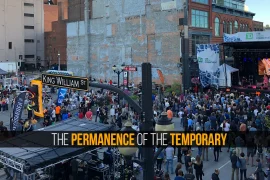
Local attractions will promote walking as people will be discovering interesting places. These could be in the form of architecture, parks, cafes, events, statues, or even graffiti art. Flea markets, bazaars, street food—taking inspiration from the most vibrant urban scenes around the world: the street food aisles in the Far East, the bazaars in the Middle East, and the flea markets that are common in Africa. There’s a lot to learn from these places. These are traditional spaces that have existed for hundreds of years around the world. They promote social interaction and a sense of belonging. Bringing a car to these places is virtually impractical. These long streets bustling with life and noise—the good kind of noise—are a great way to promote walking and even attract tourists. These places are the real definition of planning for people.
Historic Buildings: Human-Scaled and Culturally Rich

Saving historic buildings helps more than just walkability. To begin with, most historic buildings—given that they survive for a long time in good condition—were designed and built in times when there were few to no vehicles. This makes them more human-scaled. Old buildings make walking more meaningful by connecting us to our ancestors, and to the lost institutions that shaped our inherited culture. Modernism and capitalism in general helped the spread of mass-produced, identical buildings with minimal identity. Meanwhile, old buildings offer a unique and memorable streetscape.
Finally, planning for cities isn’t just about planting trees on sidewalks and eliminating on-street parking. It goes deeper than that. Jeff Speck, an American city planner and author, outlines four key criteria that make a city truly walkable. For people to choose walking over driving, the walk must be: useful, safe, comfortable, interesting, and accessible. If a city makes sure that its pedestrian roads provide all these for its citizens, then there will be no reason for people to prefer driving.
Citation:
- Speck, J., 2018. Walkable City Rules: 101 Steps to Making Better Places. Washington, DC: Island Press.
- Shotl, 2021. Designing cities for people, not cars: Pedestrian-friendly urban spaces. [online] Available at: https://shotl.com/news/designing-cities-for-people-not-cars-pedestrian-friendly-urban-spaces [Accessed 10 Jul. 2025].