Social housing has a bad reputation and is typically viewed as cheap, lifeless architecture with little to no established design qualities. Society misjudges the architecture, but most importantly, the people who live there are labelled as lazy delinquents simply because of their monetary stance. As the worldwide population is increasing at an exponential rate, there is a global housing crisis, leaving millions of people homeless across the world as the cost of living continues to soar higher and higher. The world needs a solution not just for housing but specifically for affordable housing, and repurposing abandoned buildings could be the answer.

Quintessential Social Housing Architecture
Social Housing architecture, born out of necessity and compassion, has given rise to one of today’s

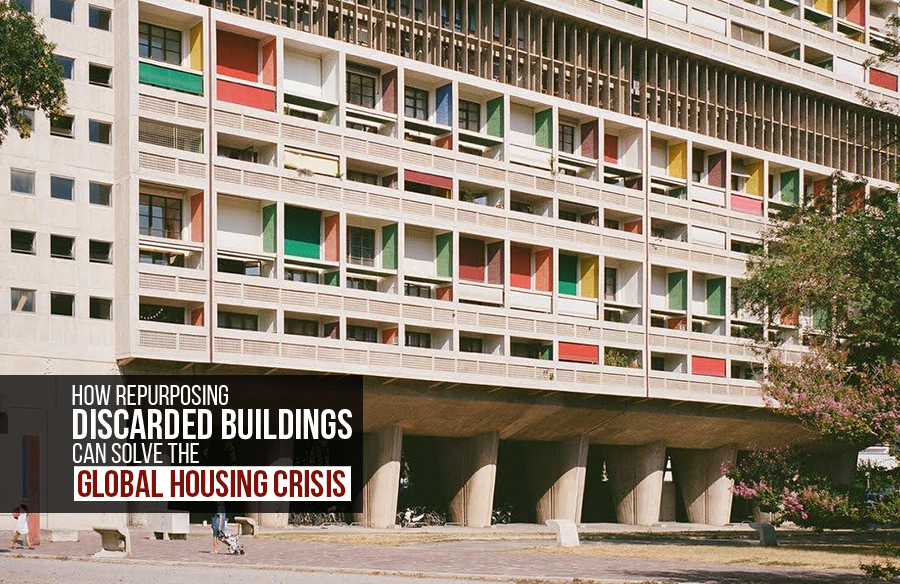
most celebrated architectural styles: Brutalism. Architects like Le Corbusier, who specialised in brutalist architecture, have left an indelible mark on our urban landscapes. Corbusier’s social housing projects, such as Unité d’Habitation in Marseille, France, built during the baby boom of brutalism in 1952 after World War II, stand as a testament to the power of architecture to address societal needs. Unite d’Habitation, labelled as a ‘vertical garden city’, encapsulates the potential of social housing architecture with a rooftop pool, multicoloured balconies and a selection of places to shop and eat together as a community. Architecture can be the solution to many economic and environmental dilemmas whilst still innovating new and bold designs.
Many architects may avoid projects for social housing instead of private residencies due to the lack of funding. It can be assumed that when architects are approached with a social housing brief, they could jump to conclusions about all the boundaries and constrictions these projects come with. Social housing does not have to be dull; it does not have to lack character. Social housing can be elegant, can be vibrant, and, most importantly, it can be ground-breaking. In 2020, Saia Barbarese Toupouzanov Architectes designed and built a lively social housing complex in Montreal, Canada. The studio revamped a brutalist building from the 70s with joyful colours and abundant light. The architects prioritised creating a home rather than a house; they designed more communal spaces, indoors and outdoors, as well as balconies and spiral

staircases so that residents have direct access to a secure space outdoors, immensely improving the quality of life. Many social housing estates can look and feel like prisons, but this energetic complex evokes a safe and happy atmosphere.
The Potential of Forgotten Buildings
The main struggle with social housing is money. Although streets are filled with helpless, homeless people worldwide, governments do not put enough funding into correcting this human error. However, there is a glimmer of hope. A 2021 survey by Habitat for Humanity proposes a solution: repurposing empty spaces to tackle the housing crisis across England, Wales and Scotland. This survey found that roughly 19,500 social housing units could come from 7,000 currently abandoned buildings across these countries. These figures came from just 80% of the local authorities who responded to the survey. Since the COVID-19 pandemic, many businesses have gone bankrupt or simply converted to remote working, leaving a mass of empty office space in its wake. These empty spaces hold so much potential for architects to revitalise into nurturing homes where less-than-fortunate people could turn their lives around. By starting with existing properties such as offices or warehouses, the funds needed to create social housing would drastically decrease and can, therefore, stretch much further.

Providing more affordable housing not only allows cities to thrive but also humanity to flourish again. The world has been on edge for too long, with inflation constantly rising faster by the day and housing costs with it. This economical solution avoids the wastage of infrastructure and contributes to a more sustainable standard of practice. There have been many successful cases of innovative architects taking derelict buildings and breathing life back into them. Architecture studio Tectône took an old Chapel in Charenton-Le-Pont, France and transformed it into a thrift store and social housing. Historic buildings like chapels hold sentimental value for the community, and these projects can often be the hardest to approach. The studio was commissioned by a charity called Emmaus, which aims to combat homelessness by providing them with work and a home. This ethos led to Tectône designing social housing for more than a dozen occupants with a thrift store for them to work whilst keeping the spirit of the chapel alive. In Paris, Francois Brugel Architectes Associes converted an abandoned office building into a beautiful stone social housing block. The complex consists of a stone building dating back to the 18th century with a separate concrete structure from the 1970s, which has now been transformed into 254 social homes with rooftop gardens and a gymnasium. Exceptional architecture and quality of living are provided to the residents at this social housing estate, a concept so rare for social housing made possible by using existing infrastructure, immensely cutting down construction costs.

These repurposing projects by Tectône and Francois Brugel Architectes are two of the few case studies of remodelling abandoned buildings for social housing, and humanity needs to strive for more. Architecture can be exciting and innovative for social housing, especially when using existing infrastructure. Architects must not shy away from social housing projects, assuming they are full of restrictions and shall only be occupied by delinquents who may ruin the beauty of the building as it is simply not true. It has been proven that architecture for these projects can be full of potential. With the government’s cooperation with local architecture studios, the thousands of empty buildings currently wasting space can be repurposed into life-changing architecture. The study by Habitat for Humanity states that collaboration between stakeholders and the community is crucial to maximise the sustainability and efficiency of converting these properties. Once all parties agree, there could be a widespread movement to repurpose dilapidated infrastructure to provide thousands of social housing units across many countries, take homeless people off the street, and offer affordable homes for those in need, positively affecting the housing crisis forever. A new standard of practice that could potentially abolish homelessness and housing difficulties for many countries worldwide.
References:
Aideed, K (2021). The future of council housing. [online]. Available at: https://www.mwarchitects.co.uk/blog/2021/5/3/ss1mp6zetl20533ahlzoeerxion6yb-sk5tw-rr92j
Astbury, J (2024). Parisian office blocks transformed into Ilot Saint-Germain social housing [online] available at: https://www.dezeen.com/2024/05/03/ilot-saint-germain-social-housing/
Habitat for Humanity (2021). Repurposing empty spaces to help address the housing crisis across England, Scotland and Wales. [online]. Available at: https://www.habitatforhumanity.org.uk/wp-content/uploads/2021/07/Repurposing-Empty-Spaces-V13_reducedsize.pdf?utm_medium=website&utm_source=archdaily.com
Kroll, A (2023). Architecture classics: Unite d’Habitation. [online]. Available at: https://www.archdaily.com/85971/ad-classics-unite-d-habitation-le-corbusier#:~:text=Unlike%20most%20housing%20projects%20that,to%20one%20every%20three%20floors.
Ott, C (2021). Habitations saint-michel nord. [online]. Available at: https://www.archdaily.com/968447/habitations-saint-michel-nord-saia-barbarese-toupouzanov-architectes?ad_source=search&ad_medium=projects_tab
Paula, P (2023). From old chapel to thrift shop and social housing. [online]. Available at: https://www.archdaily.com/1004374/from-old-chapel-to-thrift-shop-and-social-housing-tectone
Tapscott, D (2023). We need to think bigger on repurposing vacant buildings for housing. [online]. Available at: https://www.insidehousing.co.uk/comment/we-need-to-think-bigger-on-repurposing-vacant-buildings-for-housing-82372
Yakubu, P (2024). Maximizing dilapidated infrastructure: the potential of repurposing abandoned buildings into social housing. [online]. Available at: https://www.archdaily.com/1016773/maximizing-dilapidated-infrastructure-the-potential-of-repurposing-abandoned-buildings-into-social-housing
Zancanella, A (2024). Repurposing abandoned buildings: a solution to increase affordable housing. [online]. Available at: https://www.linkedin.com/pulse/repurposing-abandoned-buildings-solution-increase-alberto-zancanella-ls9ef/
Image:
Image 1. Arch daily. Abandoned hotel in Croatia. [Photograph]. Available at: https://www.archdaily.com/1016773/maximizing-dilapidated-infrastructure-the-potential-of-repurposing-abandoned-buildings-into-social-housing
Image 2. Gili Merin. Unite d’Habitation exterior. [Photograph]. Available at: https://www.archdaily.com/85971/ad-classics-unite-d-habitation-le-corbusier#:~:text=Unlike%20most%20housing%20projects%20that,to%20one%20every%20three%20floors.
Image 3. James Brittain. Social housing by Saia Barberese Toupouzanov Architectes. [Photograph]. Available at: https://www.archdaily.com/968447/habitations-saint-michel-nord-saia-barbarese-toupouzanov-architectes?ad_source=search&ad_medium=projects_tab
Image 4. Cyrille Lallement. Old chapel turned thrift store and social housing. [Photograph]. Available at: https://www.archdaily.com/1004374/from-old-chapel-to-thrift-shop-and-social-housing-tectone
Image 5. Dezeen. Parisian social housing from old offices. [Photograph]. Available at: https://www.dezeen.com/2024/05/03/ilot-saint-germain-social-housing/