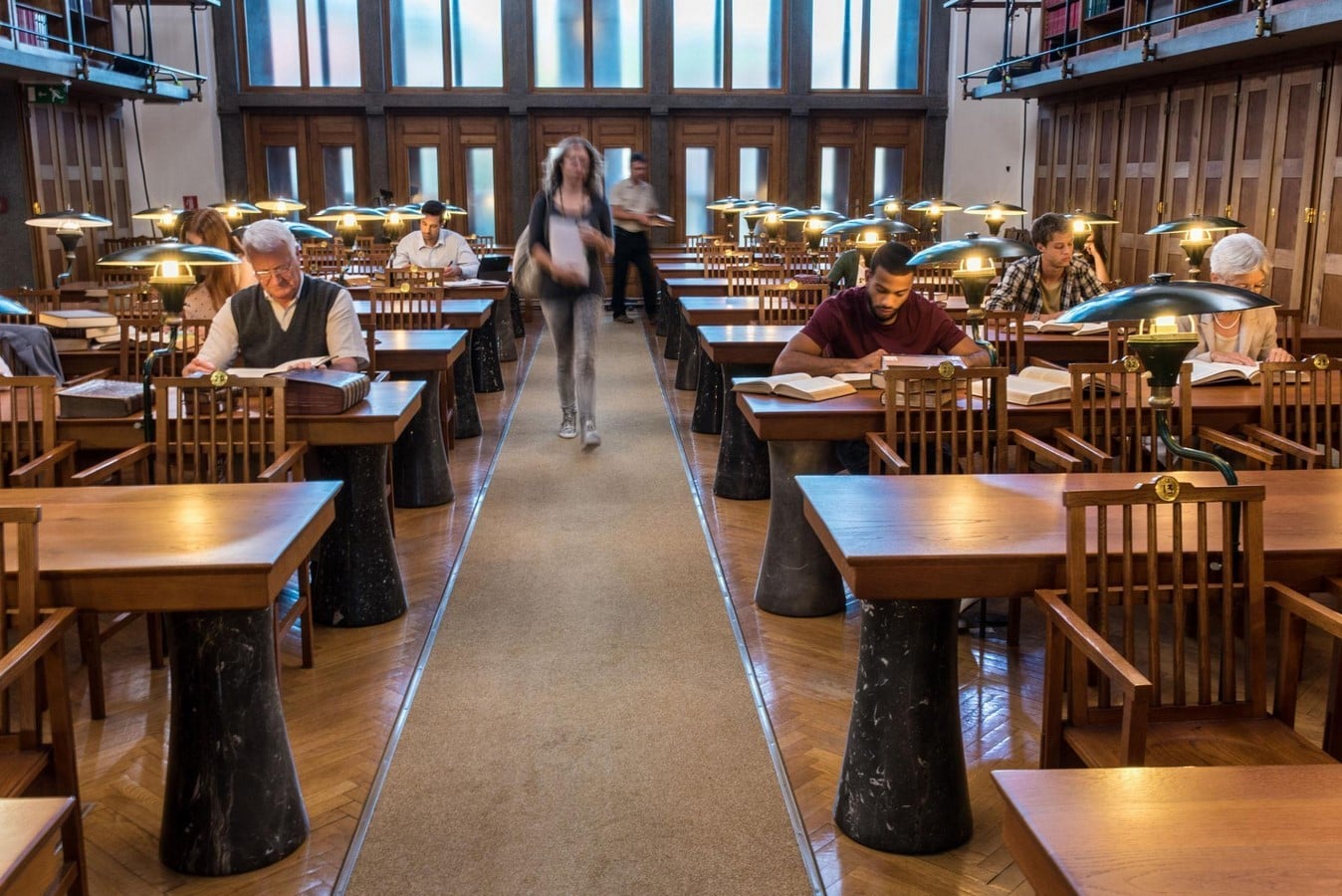
One would think going to a library just for the air conditioning is an insult to an institution of knowledge. But in a time where public places seem to optimize for ‘vibes’ over access, the library remains the only public place that doesn’t ask what your purpose is. A student revising for an examination, an elderly person reading the morning paper, a job seeker using the public computers, or someone simply escaping the afternoon heat can all occupy the same space. There is no expectation to purchase a coffee, pay an entry fee, or justify one’s presence. In an increasingly commercialised urban environment, this has become surprisingly rare. As a form of civic architecture, the public library continues to provide a level of access that few urban spaces can offer today.
From Authority to Access
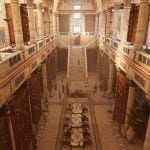
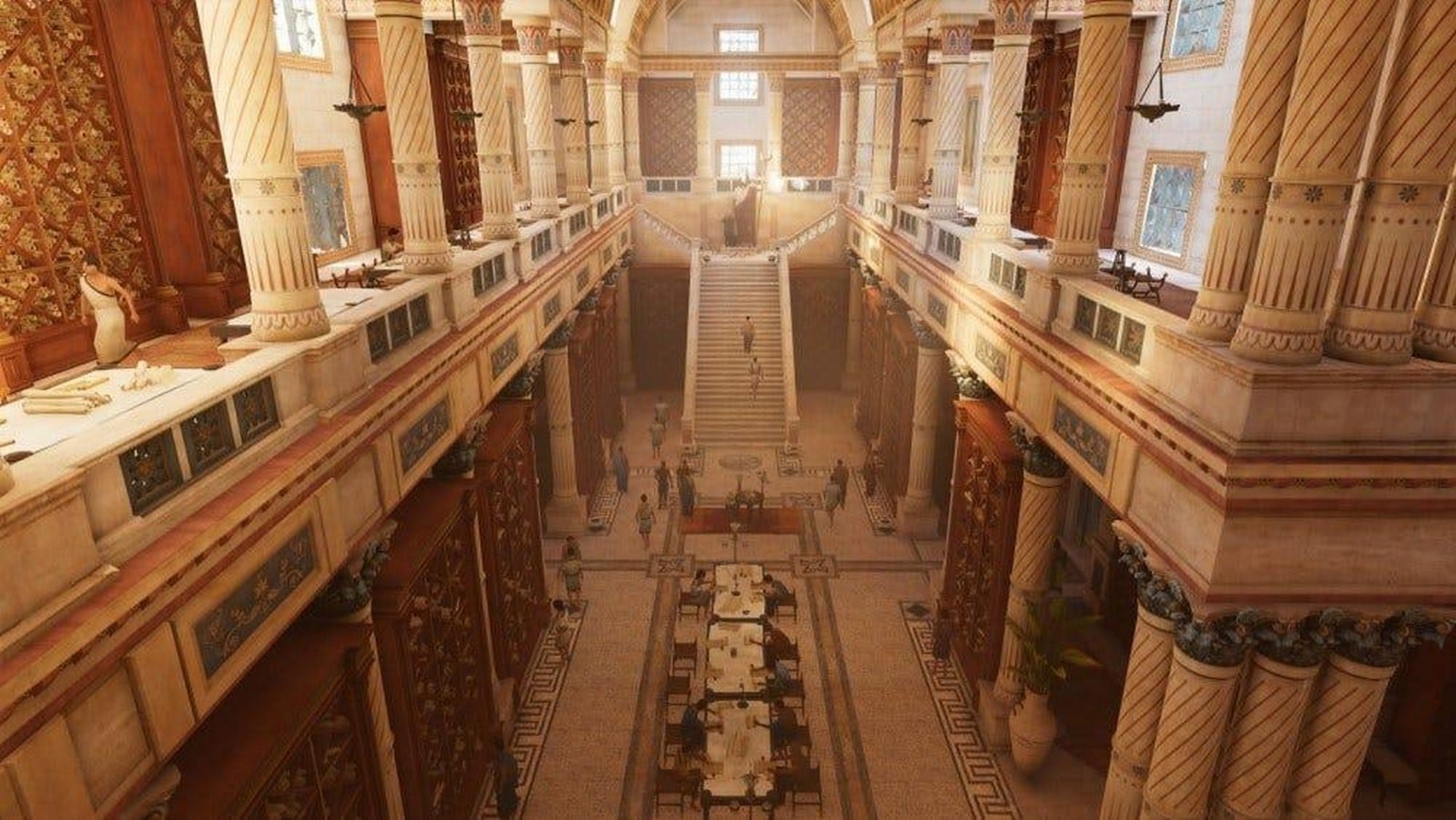
Yet libraries have not always embodied such openness. Before someone even steps inside, they often project a sense of authority through their architecture. In ancient times, libraries were symbols of imperial power along with being institutions of learning. The possession of rare scrolls and manuscripts allowed rulers, religious authorities, and scholars to control access to knowledge, transforming libraries into instruments of prestige and influence rather than public resources. The significance of the library has since shifted from what it contained to who it welcomed. That transformation is not merely social but architectural. Buildings that once controlled access to knowledge gradually became spaces designed to encourage occupation and participation.
This transformation reflects a broader shift in civic architecture, where public buildings are increasingly expected to serve communities rather than simply represent institutions. This change can be attributed to the architecture of libraries themselves. Earlier, libraries were designed around the storage and protection of knowledge, with controlled collections and monumental forms that reinforced their status as institutions of authority. The Library of Alexandria in Egypt, perhaps the most cited example of ancient libraries, was built not through donation but through seizure; ships arriving at the harbour were searched, their scrolls confiscated and copied, and the originals kept.
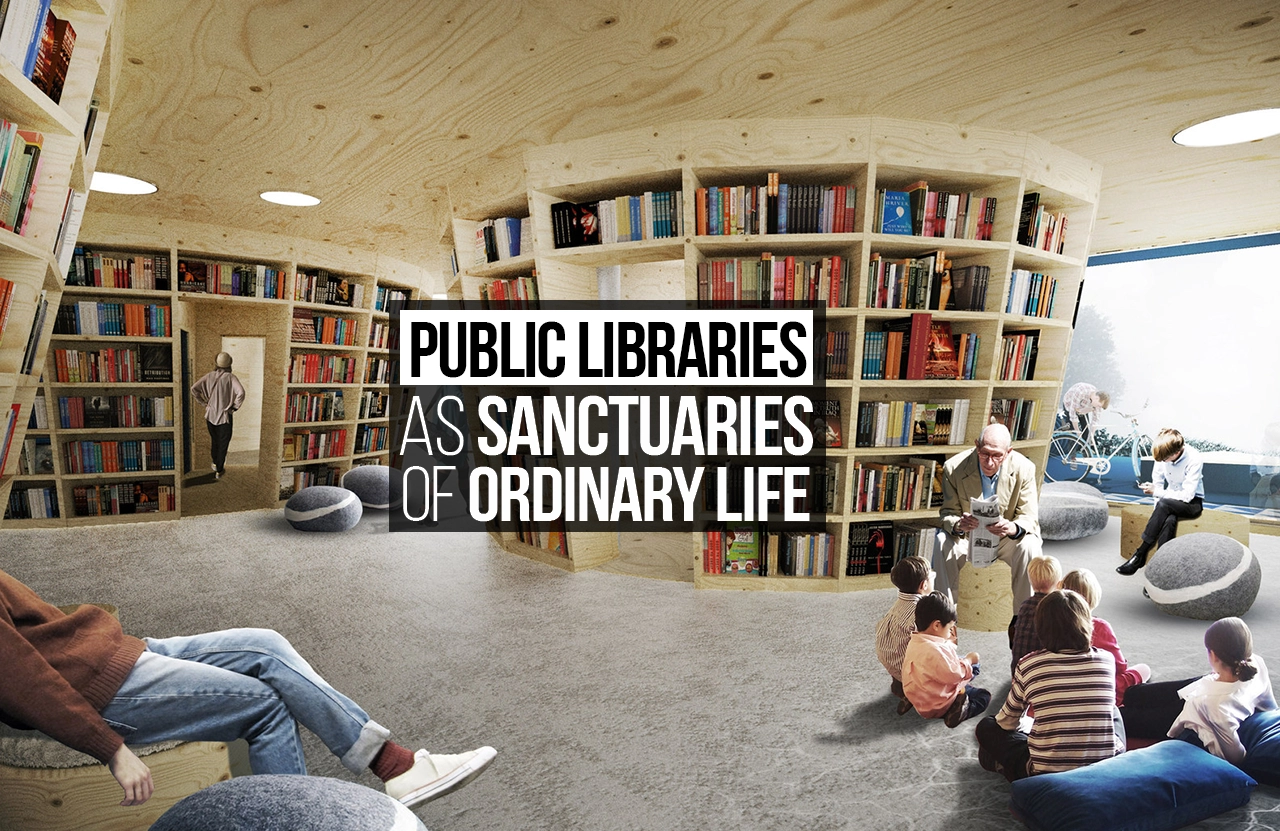
The modern public library is the complete opposite of this. Contemporary public libraries, by contrast, have dedicated spaces that seem to have very little to do with books and research, for instance, makerspaces, children’s areas, community workshops, digital learning facilities, among others. The public library is no longer solely a space for accessing knowledge but for exchanging ideas upon it as well.
Architecture Beyond Books
The inclusion of these programmes shows a broader shift in the role of the public library. No longer confined to the storage and circulation of books, libraries increasingly function as civic spaces that make room for a wide range of activities. Reading groups, public lectures, language classes, digital literacy workshops, and community meetings often take place alongside study and research. In many neighbourhoods, the library serves as a sort of shared living room for the city, providing an inclusive environment where people of different ages, professions, and backgrounds can occupy the same space without the societal pressure that is often present in other public places. This ability to support both learning and community interaction has transformed the library from merely an archive of information into a civic space and an important community refuge.

The Cost of Openness
The difficulty of libraries’ survival in modern times lies in the fact that many of the library’s most valuable functions resist measurement altogether. Yet the people who rely on libraries most are often the least visible within these measures. The student spending an entire afternoon at a reading table, the elderly person returning each morning for the newspaper, or the individual seeking temporary refuge from the summer heat rarely appear in annual reports. Their contribution cannot be measured through circulation figures, yet they embody the very reason public libraries exist, which was to offer space without ever demanding an explanation for its use along with providing knowledge.
In this sense, the library functions not only as civic architecture but also as a community refuge for those who may have nowhere else to go. This quality becomes increasingly significant in cities where access to public space is often tied to consumption. Cafés, co-working spaces, and reading halls may provide places to sit, work, or gather, but participation is usually conditional upon spending money. The public library operates differently. Its openness is not dependent upon purchasing power, social status, or professional purpose. A person may enter to study, attend a workshop, browse shelves, use a computer, or simply spend time within the building. Few civic institutions offer this freedom without the extended consumption guilt.
The Last Free Public Space
With digital alternatives at hand, it is easy to assume that the library has been replaced. That the elderly man can read the news on a screen and the job seeker can search for jobs on LinkedIn. But this assumption forgets about people with limited to no access to data, resources, and devices to do so. Unlike most urban spaces, the library does not ask what you have or what you need. It remains, perhaps uniquely, a space that anyone can enter and no one has to justify being in.
In an urban environment increasingly shaped by consumption and efficiency, such spaces are becoming difficult to find. The relevance of the public library lies not only in the knowledge it provides, but in its effort to be inclusive and accommodating of ordinary life in all its forms, whether purposeful or not.
References:
American Library Association, n.d. Libraries Transforming Communities. Available at: Libraries Transforming Communities [Accessed 7 June 2026].
Casson, L., 2001. Libraries in the Ancient World. New Haven: Yale University Press.
Oldenburg, R., 1999. The Great Good Place. New York: Marlowe & Company.
World Bank, n.d. Digital Development. Available at: World Bank Digital Development [Accessed 7 June 2026].
Tripadvisor, n.d. Reading Room, National and University Library, Ljubljana [photograph]. Available at: https://www.tripadvisor.in/Attraction_Review-g274873-d6582184-Reviews-National_and_University_Library-Ljubljana_Upper_Carniola_Region.html [Accessed 7 June 2026].
Hodgson, C., 2023. History Unmasked: The Library of Alexandria. Medium. Available at: https://medium.com/@Christopher.hodgson/history-unmasked-the-library-of-alexandria-05d2d1ab5f8b [Accessed 7 June 2026].
Tamba, T., 2024. Community library event [online image]. Note. Available at: https://note.com/toshobu_tamba/n/n4cba76fb346e [Accessed 7 June 2026]