Since their very inception during prehistoric times, the communities of the Republic of Korea have developed an outstanding niche in the world in terms of their artistic sensibilities and architectural accomplishments. The geographical conditions of the peninsula have equipped the Koreans with opportunities to experience a confluence of both continental and maritime cultures. Its vibrant cultural context, music, art, literature, dance forms, architecture and planning, textiles, and other creative aspects demonstrate a unique dialogue between traditionalism and modernism.
The Republic of Korea also preserves a significant amount of cultural heritage, the majority of which has been recognized by the UNESCO’s World Heritage List and is subjected to be under protection for future generations.
1. Hwaseong Fortress | Republic of Korea

An exemplary creation of the 18th-century military architecture of the Republic of Korea, the Hwaseong is a brick and piled stone fortress of the Joseon dynasty of Gyeonggi-do province. It was built as a defensive fortress, to form a new political basis and to contain the remnants of the Crown Prince Jangheon. The mammoth walls, 5740 meters in length, enclose an astonishing area of about 130 hectares.


The fortress is an epic culmination of scientific ideas and construction know-how derived and acquired from scholars hailing from Europe and East Asia. It exhibits significant developments in construction technologies and material sciences which came as a result of the scientific exchange between the East and West. The structure has had an immense influence on the propagation of advanced Korean architecture, urban planning, and other related fields. It efficiently combined the primitive fortress construction methods with an influx of innovative site planning, thereby enabling the stakeholders to have access to a greater defense mechanism and administrative functions. It stands as a mighty testimony to the socio-technological developments of the Republic of Korea during the 18th century.
2. Changdeokgung Palace Complex

Built during the reign of the Joseon dynasty in the 15th century, the Changdeokgung palace complex stands as an example of East Asian palace architecture and garden design. It spans an area of 57.9 hectares in Jongno-gu, at the foot of Mount Baegaksan, the guardian mountain.


The palace complex demonstrates the primitive principles of Pungsu and Confucianism through its architectural design and landscaping. The site setting and selection were done per pungsu ideologies while the building layout was laid down along the lines of Confucianism. The palace exceptionally integrates and harmonizes the built forms with the natural context as an adaptation to the topography of the site and its existing green cover.
3. Haeinsa Temple Janggyeong Panjeon, the Depositories for the Tripitaka Koreana Woodblocks | Republic of Korea

Situated on the slopes of Mount Gayasan, the Janggyeong Panjeon in the Haeinsa temple is a sanctuary to the Tripitaka Koreana, which is the largest complete collection of old Buddhist literature engraved on about 80,000 wooden blocks from the time of 1237 to 1248. This ancient literature is recognized by Buddhist scholars all around the world for its superior quality and astounding accuracy.


These depositories are an archeological marvel owing to the specialized structural features and the effective solution for addressing the issue of storage and conservation of the 80,000 woodblocks engraved with the Buddhist scriptures. The collection is also highly revered by art historians and archaeologists for its skillful artistry and unique execution of engraving techniques.
4. Gyeongju Historic Areas

The Gyeongju Historic areas are one of the most crucial aspects of Korean architecture during the rule of the Silla dynasty during the 7th and 10th centuries. The sites and monumental structures built in and around Gyeongju bear an undiminishing testimony to the cultural achievements of that era.


The region contains a noteworthy concentration of exemplary Korean Buddhist art forms, sculptures, pagodas, remnants of temples and palaces, reliefs, etc. All the monuments surrounding and dotting the landscape of Gyeongju are of utmost significance in the flourishment of Buddhist and secular architecture in the Republic of Korea.
5. Jongmyo Shrine | Republic of Korea

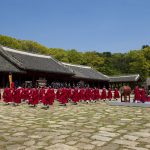
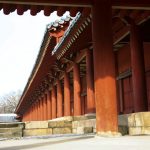
The Jongmyo shrine was originally constructed during the later parts of the 14th century but was destroyed due to the Japanese invasion in the 16th century, and again rebuilt in the early 17th century with additional expansions. It was built with the purpose to house the spirit tablets of the queens and kings of the Joseon dynasty.


The Jongmyo shrine is the most ancient and authentic example of the Confucian royal ancestral shrines. It possesses a unique spatial setting layout that has remained intact in its totality. The significance of the shrine has been enhanced owing to its persistence and the intangible cultural heritage it stands for.
6. Namhansanseong

Constructed and defended by Buddhist soldier monks, the Namhansanseong was used as an emergency capital for the Joseon dynasty. It is located along a mountainous trail, 25 kilometers southeast of Seoul. The earliest remains date back to the 7th century but it was built several times as a precautionary measure against attacks by the Sino-Machu Qing dynasty.


It exemplifies a synthesis of defense military engineering and transformative fortification techniques. The fortified walls contained various types of civil, religious, and military establishments. Namhansanseong came as an outcome of the re-exploration of Chinese and Korean urban fortification techniques with the catalyst of fear following the introduction of firearms from the West. It stands as a symbol of Korean sovereignty.
7. Royal Tombs of the Joseon Dynasty

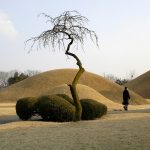
Shaped by the pungsu principles and per the context of Confucian ideologies, the royal tombs of the Joseon dynasty resonate with the historic past of the natural surroundings of the site and the ancestral history of the Joseon dynasty.


Owing to the implications of the pungsu principles and conservation of the natural greenscape, a memorial sacred space has been developed for ancestral rituals and ceremonials. The tombs are outstanding examples of Korean and East Asian tomb architecture and showcase the significant development of burial mounds in the Korean context. The configurations of the built structures reinforce the age-old traditions and further enable the living practice of worship of the ancestral beings.
8. Sansa, Buddhist Mountain Monasteries in Korea | Republic of Korea

Located throughout the southern provinces of the Korean peninsula, Sansa is a constitution of seven Buddhist mountain monasteries – Buseoksa, Bongjeongsa, Tongdosa, Beopjusa, Seonamsa, Magoksa, and Daeheungsa. Established during the 7th to 9th centuries, the seven monasteries have functioned as spaces for religious and spiritual upbringings.


It has accommodated a diversity of Buddhist schools and popular ideologies within its enclosure. It houses numerous historical structures, documents, objects, halls, and other spaces that reflect a culmination of features of Korean Buddhism. These monasteries have stood the test of time and stand still as living centers of faith and religious practices.
9. Seokguram Grotto and Bulguksa Temple


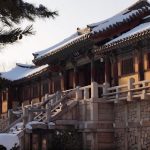
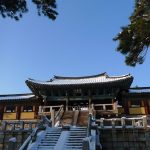
The Seokguram Grotto and Bulguksa temple together form a religious architectural complex of utmost significance. Established in the 8th century under the Silla dynasty, the structures lie on the slopes of Mount Tohamsan and were built by the minister Kin Dae-Seong.
The Seokguram Grotto consists of a statue of Buddha surrounded by Bodhisattvas, the ten disciples, two devas, two vajrapaanis, and eight divine guardians. Carved out of white granite stone, it is a masterpiece of East Asian Buddhist architecture and arts. The Bulguksa temple is made out of wood and stone terraces and stands as a fine example of the Buddhist religious architecture of Gyeongju.
10. Seowon, Korean Neo-Confucian Academies | Republic of Korea

A serial property comprising nine Seowan, a representation of a kind of Neo-Confucian academy of the Joseon dynasty; the Seowan, Korean Neo-Confucian Academies is an undying testimony to the cultural heritage associated with Neo-Confucianism in the Republic of Korea.


The Seowan illustrates a historic narrative per which Neo-Confucianism from China was tailored to local Korean livelihoods, as a result of which occurred a transformative process in terms of architectural development, planning, and functionalities of spaces.
References:
(KOCIS), K., 2022. UNESCO Heritage in Korea : Korea.net : The official website of the Republic of Korea. [online] Korea.net. Available at: <https://www.korea.net/AboutKorea/Culture-and-the-Arts/UNESCO-Treasures-in-Korea> [Accessed 19 August 2022].
Centre, U., 2022. Republic of Korea – UNESCO World Heritage Convention. [online] Whc.unesco.org. Available at: <https://whc.unesco.org/en/statesparties/kr> [Accessed 19 August 2022].