The Origin of Art Deco
“Art Deco” was coined after the Exposition Internationale des Arts Décoratifs et Industriels Modernes (International Exhibition of Modern Decorative and Industrial Arts), held in Paris in 1925. This exhibition responded to the Society of Decorative Artists’ desire to showcase contemporary decorative arts. The emphasis was on artistic creations with modern sensibilities. A wide range of items, from crystal fountains to jewelry, were on display.
Art Deco, also known as Style Moderne, influenced various fields like architecture, fashion, decorative art, jewelry design, interior design, posters, furniture, textiles, and industrial design. It brought a fresh, modern perspective to design, emphasizing the qualities of machine-made objects. This style resonated with the spirit of the 1920s and 1930s and experienced a revival after World War II.
While Art Deco buildings transport us to a bygone era, the style itself was a departure from traditional ornate architecture. Le Corbusier was probably the first to use the term “Art Deco” in his journal, L’Esprit Nouveau, referring to the 1925 exhibition. Although the term gained widespread recognition in the 1960s, it described a design style that flourished decades earlier.
The Arrival of Art Deco Style in Kolkata
During the 1920s and 1930s, Chicago experienced rapid economic growth. This spurred the “City Beautiful” movement, aiming to enhance urban aesthetics. The Century of Progress Exposition (1933-1934) significantly influenced the Art Deco style in Chicago. The ornate Chicago Theatre is a prime example of this style.
In 1935, to strengthen American influence in British India, Thomas White Lamb was commissioned to design the Metro Cinema, a catalyst for Art Deco in India.
Post-partition, Kolkata’s rapid urbanization and growing middle class led to a housing demand. Simultaneously, industrial growth necessitated new factories and offices, often adopting Art Deco to symbolize modernity.

The Journey from Art Deco to Indie-Deco: “Jugaad”
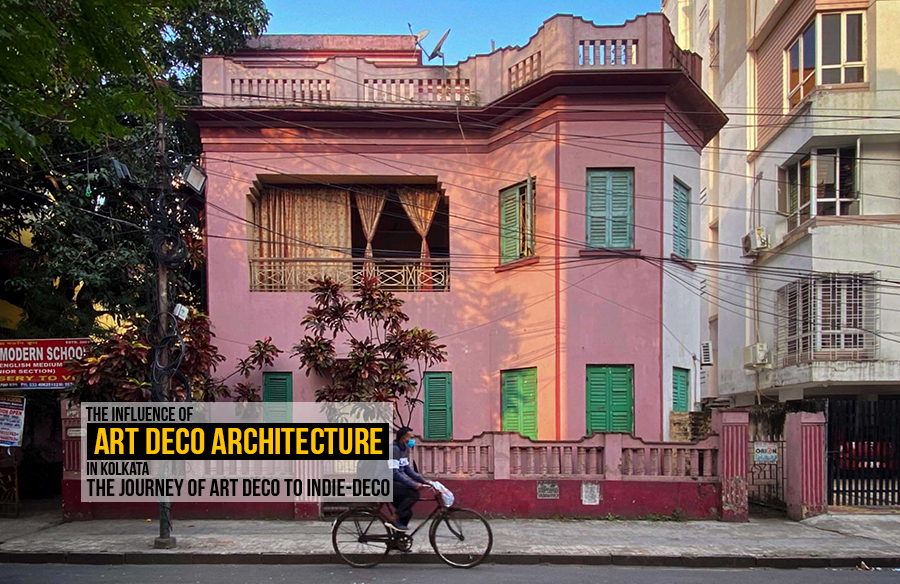
Swarup Dutta, a scenographer and artist, has studied Kolkata’s architectural evolution for a decade. He highlights a unique Bengal law allowing civil engineers and draftsmen to file building plans, unlike in other states where architects are mandatory. This reduced costs for homeowners, as architects typically charged 2-5% of construction costs, according to former civil servant Jawhar Sircar.
Bengalis often requested “Metro style” homes from civil engineers, or “contractors.” However, these engineers, focused on technical aspects, offered template designs that were customized based on client needs. This led to similar-looking buildings in areas like Hindustan Park and Lake Temple Road, creating a distinctive neighborhood aesthetic.


Materiality and Philosophy of Art Deco
While influenced by European trends, Art Deco in Kolkata has evolved to reflect local tastes and climate. Its design philosophy is rooted in modernity, luxury, and technological progress.
- Modernity: Embracing the advancements of the 20th century, a celebration of industrialization, technological and urban development. It reflects a spirit of progress and innovation.
- Luxury and Opulence: Often associated with luxury, Art Deco features lavish materials, ornate details, and a sense of grandeur. Marble and granite enhance sophistication, while stainless steel adds a modern, sleek aesthetic.
- Forms and Functional design: the style featured fundamental geometric shapes, to create a sense of order, symmetry, and visual impact. Simultaneously, the usage of sleek lines and streamlined forms accentuate efficiency and modernity.
- Concept the context: Born in Europe, Art Deco has adapted to Kolkata’s climate, local context, and cultural heritage. Verandas and courtyards provide shade and ventilation, while local materials and craftsmanship blend Eastern and Western styles.
Legacy
Art Deco’s influence in Kolkata is evident across residential, commercial, and public buildings. Iconic examples include Victoria House, Metro Cinema Building, Merchandise Mart, Tribune Tower, Planetarium & Adler Planetarium, and Astor Hotel.
While commercial and public buildings were predominantly constructed during the 1920s and 1930s, primarily for the Century of Progress Exposition, Art Deco’s adaptation for residential housing by locals occurred in the late 1960s. This suggests a delayed but significant adoption of the style in residential architecture.


References:
- Ghosh, D. (2017). City Secrets: Art Deco architecture spread across Kolkata, thanks to a state law – and jugaad. Scroll. Retrieved from: https://scroll.in/magazine/860603/city-secrets-art-deco-architecture-spread-across-kolkata-thanks-to-a-state-law-and-jugaad
- Parni, R. (2023). Art Deco in South Kolkata. Paper Plane. Retrieved from: https://www.joinpaperplanes.com/art-deco-in-south-kolkata/
- Das, S. (2012). Architect Scot & art deco – how the ‘metro pattern’ became calcutta’s very own – from saris to staircases. The Telegraph Online. Retrieved from: https://www.telegraphindia.com/my-kolkata/places/at-the-art-deco-indira-cinema-mudar-patherya-finds-the-story-of-a-mans-fight-to-preserve-a-piece-of-kolkata-heritage/cid/2004720
- Patherya, M. (2024). Art dekho – a quest to protect Indira Cinema’s art deco legacy. The Telegraph Online. Retrieved from: https://www.telegraphindia.com/my-kolkata/places/at-the-art-deco-indira-cinema-mudar-patherya-finds-the-story-of-a-mans-fight-to-preserve-a-piece-of-kolkata-heritage/cid/2004720
- Anand, M. (2022). Influence of Art deco in India. CIRCA. Available at: https://circawarehouse.com/blogs/circa-stories/influence-of-art-deco-in-india