The year 2021, unlike its tedious predecessor, could only be described as good and eventful. The year had seen the rise of the Squid Game phenomenon, Suez Canal memes and several other cultural events. In the world of architecture, 2021 presented an idea: a proposal of what could be a new frontier- the utopian project of “the Line”
The idea of The Line, which was formulated as a part of NEOM in 2017, was officially launched in 2021. In the years that followed, this spectacle was met with the constant noise of criticism and praise alike. The quiet arrived in September 2025, when the project was formally suspended. Between 2021 and 2025 what had unfolded was a disaster of epic proportions.
What did The Line represent?
To learn from the misgivings of the Line, the gravity of its ambitions must be examined. It is important to ask what made this project so compelling. For Saudi Arabia, the Line emerged as a crucial part of an alternate answer to its identity as an oil dependent nation (Financial Times, 2025). NEOM, the highly futuristic brainchild of Prince Mohammed Bin Salman (MBS) was the flagship of Vision 2030. The name itself reflects this sentiment with the Greek prefix for new “neo” fused with the letter “M” of “mustaqbal” the Arabic word for “future”.
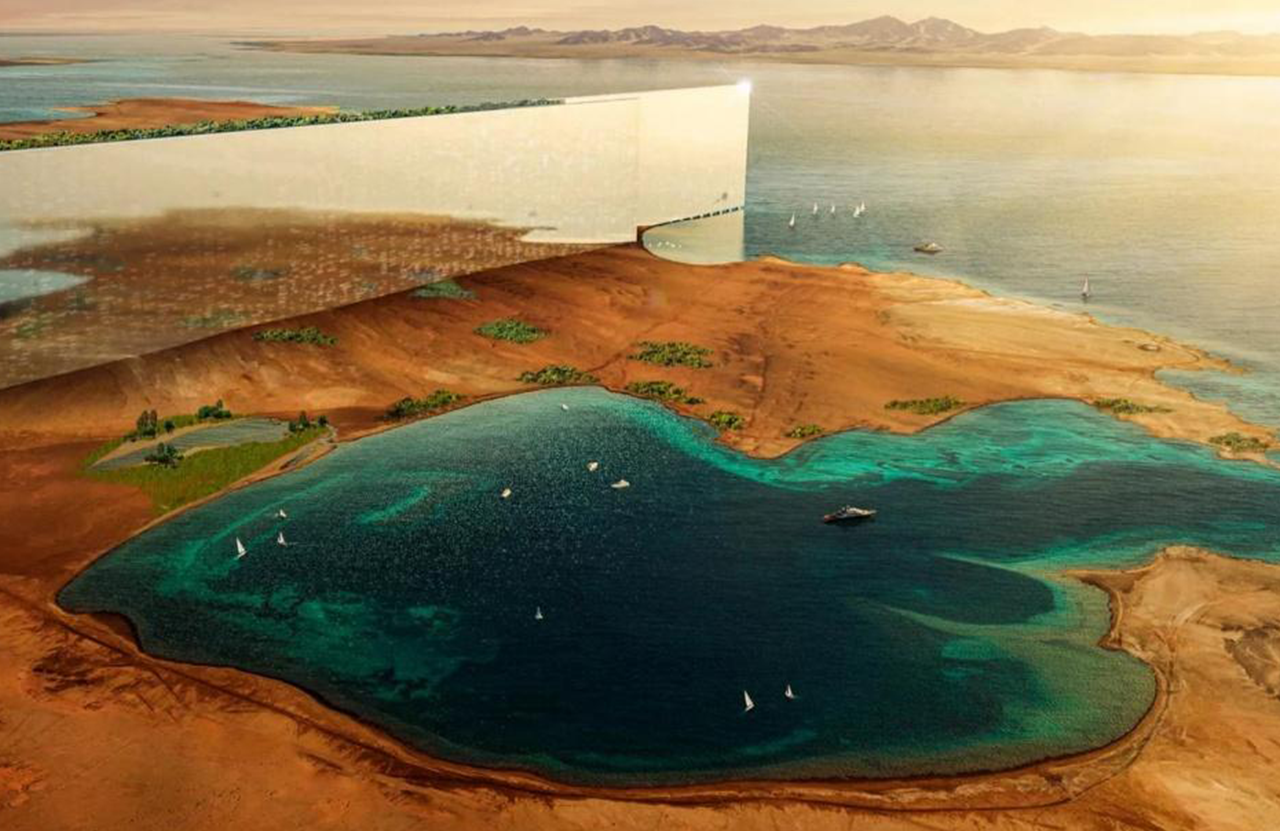
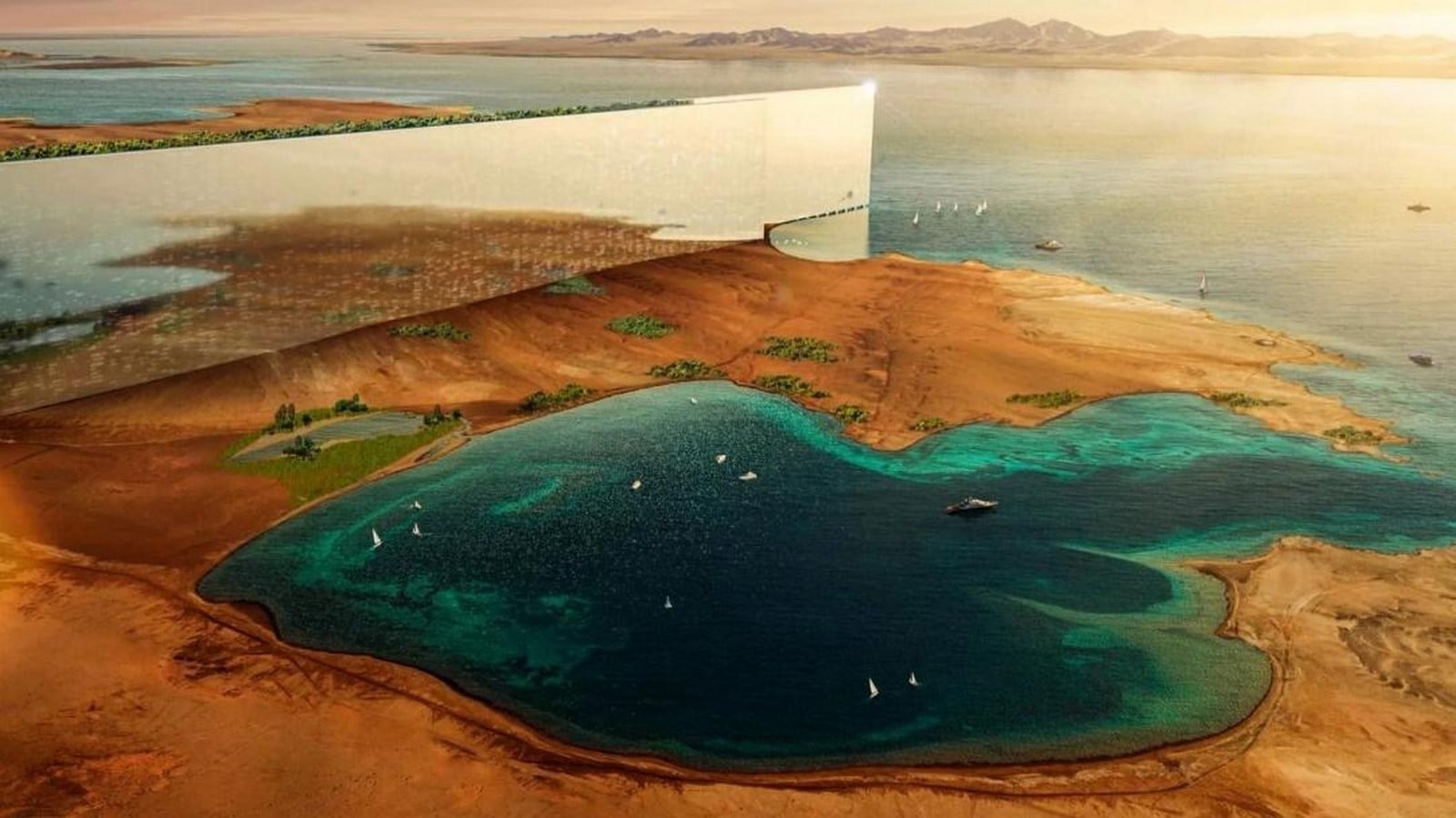
For MBS and Saudi Arabia this “new future” meant no cars, no streets, no surface emissions, AI, and automated managements. The Line was pictured as two continuous structures, 500 metres in height running parallel across 170 kilometres from the Red Sea coast toward the interior. Originally, the design developed by the Los Angeles architecture firm Morphosis proposed a 2 kilometre wide strip of settlements from the sea to mountains connected by rail. In the Late 2020, the Crown Prince suggested they “flip it in to two towers” (Discovery UK, 2023).
The idea was to stack the urban functions of a city vertically rather than spread them across a flat plane (The Capital Review, 2026). This concept of minimizing the footprint to better integrate within the natural surroundings while efficiently distribute the functions to reduce the infrastructural needs was termed “Zero Gravity Urbanism”. After the failures of the twentieth century city building, this presented a compelling solution ; or in the words of the as the Crown Prince, a “civilisational resolution” (Financial Times, 2025).
The Proposition of The Line
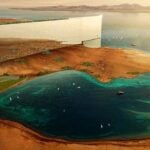
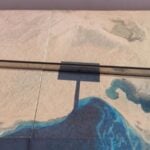
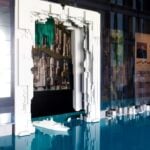
Picture this: Two continuous mirror glass clad buildings, 500 metres high and 200 metres wide running parallelly across 170 kilometres from the Red Sea. At the centre of the Line – a Hidden Marina – a 2.4-kilometre section with a giant gateway tall enough to accommodate cruise ships, arriving from the canal connecting the Red Sea to inside the two mirrored walls. Suspended upside down from this gateway is the “Chandelier”, a 30-storey glass and steel building.
If this sounds like something dreamt up in the Hollywood, you would be right. The design for the Hidden Marina in the Line was developed by Thom Mayne and Morphosis from prior concepts developed by Olivier Pron, the award-winning concept artist and art director known for his work on films like Guardians of the Galaxy (2014) and Doctor Strange (2016).
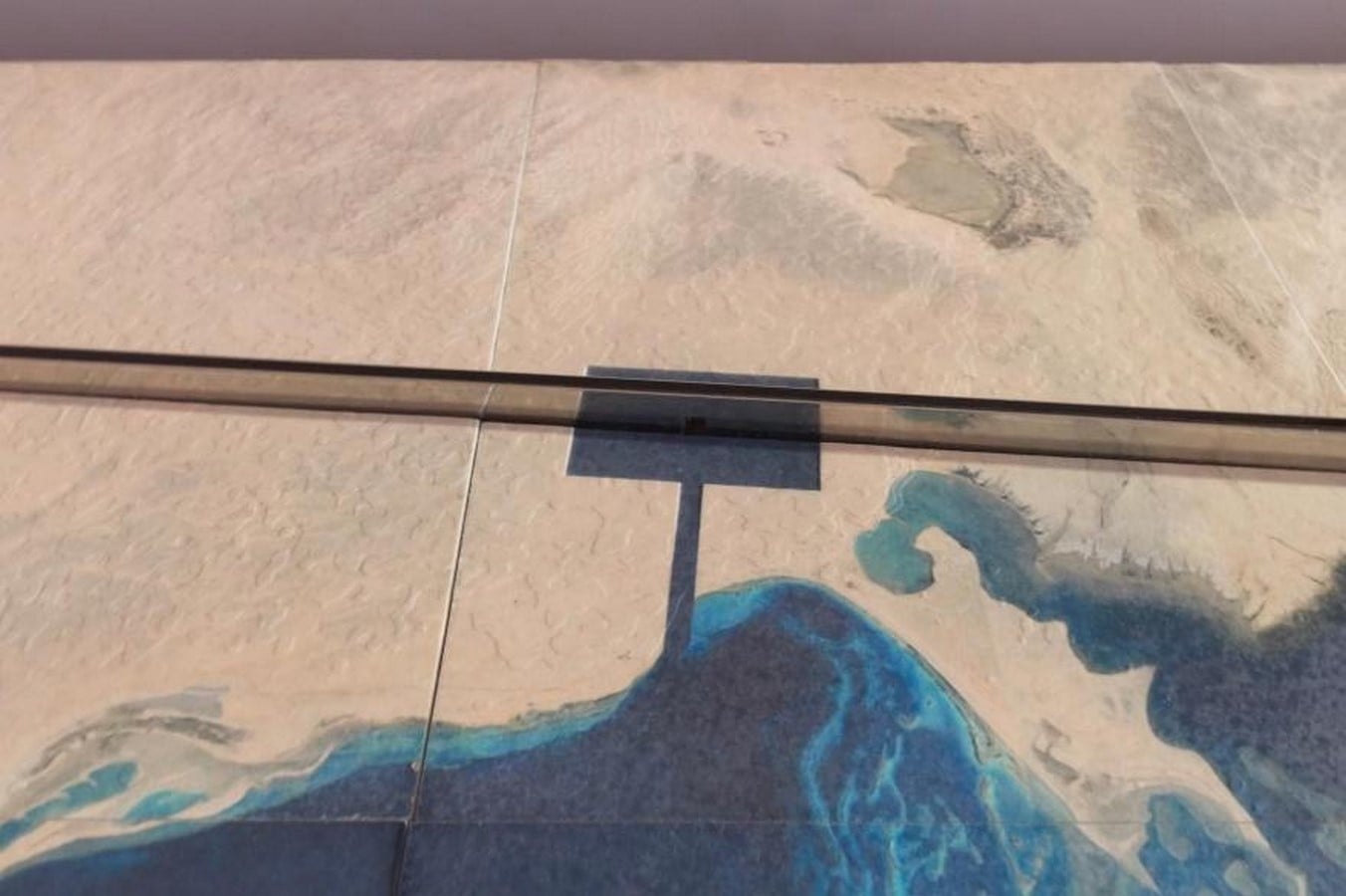
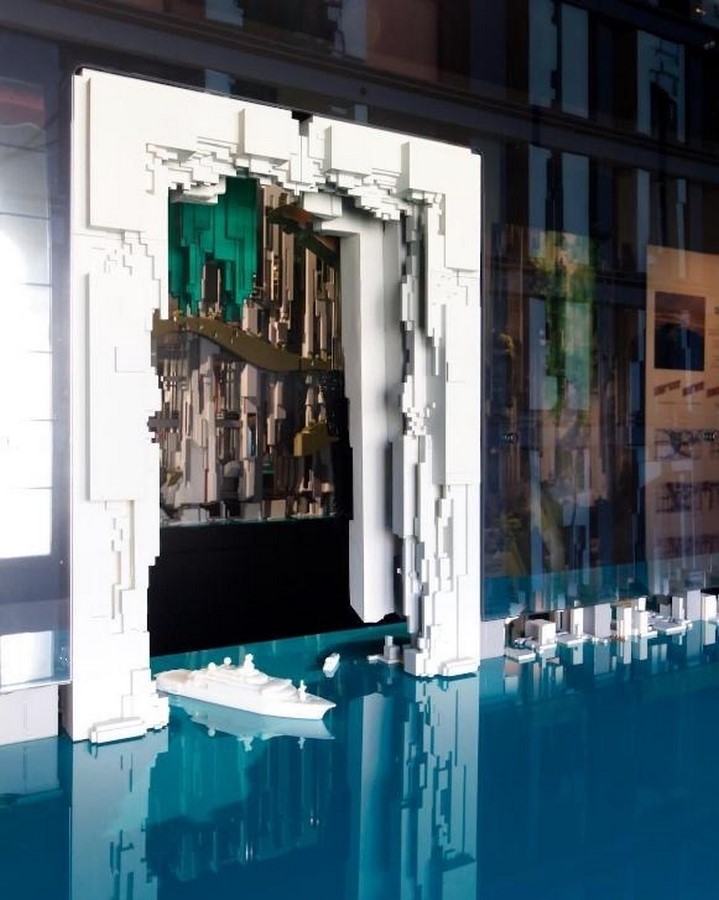
Hidden Marina would feature a high-speed rail station beneath it and 45,000 seat football stadium above the chandelier,350 metres above sea level, ready in time for the nations 2034 World Cup. According Financial Times (2025), several architects raised their concerns regarding the plausibility of the structure including withstanding its own weight against the wind speeds and even the practical functioning of basic infrastructure such the waste flow from toilets. Tarek Qaddumi, executive director of The Line quelled the questions with replies such as “We’re going to have hundreds of shuttle cars running back and forth, picking up the sewage on retractable bridges” (Financial Times,2025).
Several design decisions such as the mirrored façade was down to the client- Crown prince, himself. Advices on limiting the height to 100 metres to preserve views and contain costs were disregarded.
Within the buildings, a series of concrete towers, or cores, would contain lifts, stairs and service shafts, spaced 140 metres apart. Vertically, at every 100 meters, a 16-metre-deep platform or a “primary deck” would form the horizontal structure. Above these, boulevards would stretch the length of The Line. The proposal also included a 500-metre-tall royal palace, hospitals and universities.
The Line was estimated to house to 9 million people in a 34 square kilometre footprint. The linear city would run entirely on renewable energy and preserve 95% of NEOM’s land for nature.
The glossy renderings and the promise of a brand-new future had captivated the world. On paper, the proposition appeared flawless and hopeful. Reality, however would prove far more relentless.
The Reality of The Line
The Line had divided the designers in their opinions. While some applauded the ambitious project, others remained on the fence. The sceptics would be soon validated as the ambitions of The Line began to collide with reality of construction, climate, livelihood, and cost
The Line was planned in the Arabian Desert where the wet bulb temperatures already exceed degrees half the year with projections spiking sharply higher by the end of the century (Dezeen, 2022). The extreme heat, intense solar radiation and dust are fundamental characteristics of the site. These conditions would require massive energy intensive cooling techniques to make the desert inhabitable. The mirrored façade represented an equally enormous surface to maintain and cool, making the climate that the project claimed to respond, to one of the very conditions it had to technologically overcome.
Along came the question of construction. One of the main ways in thy city considered itself sustainable relied on its small footprint. Unfortunately, a small footprint does not necessarily mean a small environmental footprint. The sheer quantity of the materials required to construct The Line was extraordinary. According to Financial Times (2025), in the singular module of 800 metre the city was estimated to require .5 million tonnes of structural steel, 5.5 million cubic metres of concrete and 3.5 million tonnes of reinforcement steel. 20 such modules were set to be completed by 2030. The amount of material required for the project would therefore, put an enormous pressure on the global supply chains causing issues not limited to high prices and availability (Financial Times,2025).
Here, it is imperative to ask the distinction between operational sustainability and embodied sustainability. Can a city be considered sustainable if the process of constructing this so called “renewable city” requires an unprecedented consumption of resources?
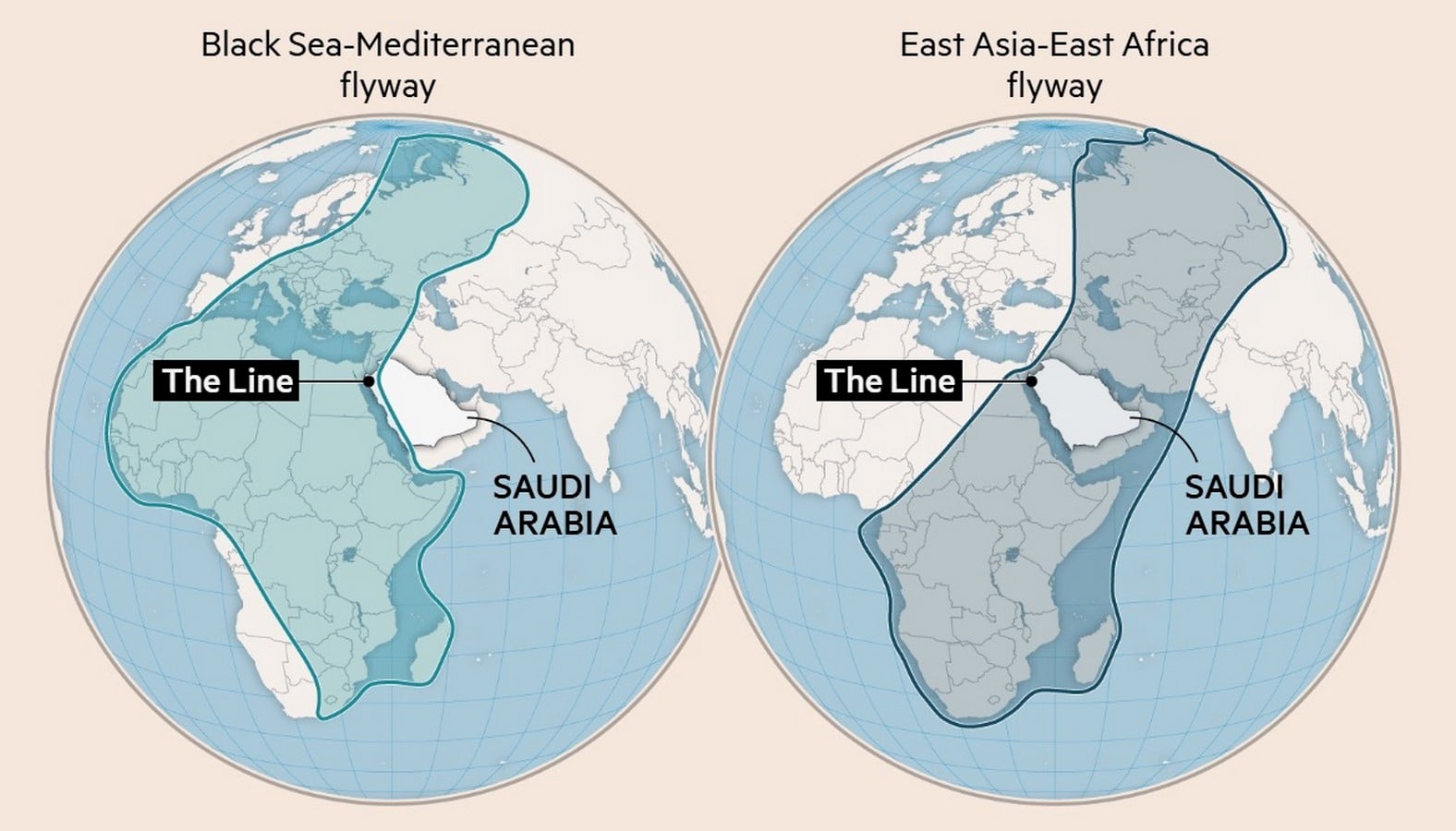
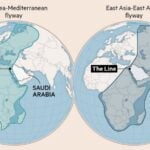
The landscape that The Line promised to preserve contained ecosystems, migratory routes and communities. Several experts raised concerns over the effect of the linear structure and its mirrored façade on wildlife, particularly migratory birds. No number of gaps in the structure would solve this issue. The 170 kilometres long structure does not merely occupy the land; it introduces a new geographical barrier into it.
The land proposed for The Line was home to the Huwaitat community, a tribe settled in the area for generations. Seeking to establish the future, the community was displaced. This displacement would become one of NEOM’s earliest controversies as members of the community resisting eviction faced imprisonment. Abdul Rahim al-Huwaiti was killed in 2020 after refusing to leave and posting videos of the crisis. This was a stark symbol of conflict between the future of a city and present conditions of people already living in its path. In a documentary released in 2024, the plight of the workers working on Vision 2030 sites was uncovered. The promise of a city for humanity becomes difficult to accept the progress rests if human necks.
Finally, the question of money; the estimates of the eventual cost grew dramatically, while rising construction costs, engineering difficulties and the sheer scale of the undertaking led to a shift from its original ambition (Financial Times, 2025).The Wall Street Journal published the project audit with $8.8 trillion to complete the original vision, a 2080 finish date, and evidence of deliberate manipulation. According to Financial Times (2025), the large investments Riyadh had hoped to secure from foreign investors never materialised
By September 2025, work on The Line had been suspended. The 170-kilometer vision had been reduced to a much smaller and uncertain proposition. Satellite images show excavation and tunnelling works for the railway system. The foundations for the first module are also visible. Ultimately, the sands left behind now serves as a reminder of distance between renders and reality.
What now?
After all that is said and done, The Line site left with a component that is commercially rational. The nation intends to spend $3 billion on developing Oxagon, an octagonal industrial zone with a port on the Red Sea. What makes Oxagon commercially viable is its location; data centres require large amounts of water for cooling, and Oxagon is located on the coast.
There is an absurd in irony in directing the funds and efforts into a data centre. The Line was marketed as the “civilisational resolution”- sustainable and designed for humanity prioritizing people over cars with minimal land consumption ; a utopia running on renewable energy. The contradiction lies in what the transition reveals. What appears now as commercially viable is infrastructure for artificial intelligence which is an industry whose demand for electricity and cooling has itself become an environmental concern.
The Line provides an uncomfortable lesson for architects: ambition and innovation are valuable only when they remain grounded in reality. Architects are often considered harbingers of change in society through the designs and solutions that support humanity. They are encouraged to challenge conventions to imagine futures. The Line shows importance of considering who pays the environmental, social and economic cost of making those futures possible.
References:
Financial Times (2025) ‘End of The Line: how Saudi Arabia’s Neom dream unravelled’. Financial Times, [online]. Available at: https://ig.ft.com/saudi-neom-line/
The Capital Review (2026) ‘The long unravelling of The Line’. Medium, 4 June. Available at: https://medium.com/@TheCapitalReview/the-long-unravelling-of-the-line-76165a67b164
Discovery UK (2023) THE LINE: Saudi Arabia’s City of the Future in NEOM [YouTube video].
Dezeen (2022) ‘The Line: architects react to Saudi Arabia’s proposed 170-kilometre-long city’. Dezeen, 2 November. https://www.dezeen.com/2022/11/02/neom-the-line-saudi-arabia-architects-opinion/?fbclid=IwAR2zQtRnCMHUlgi3J2tQI3gbe7-LR8eAtB726w9G6b8JpZkU9fbXLjiXxaQ
NEOM (2022) NEOM | What is THE LINE? [YouTube video]. 25 July. Available at: https://www.youtube.com/watch?v=0kz5vEqdaSc