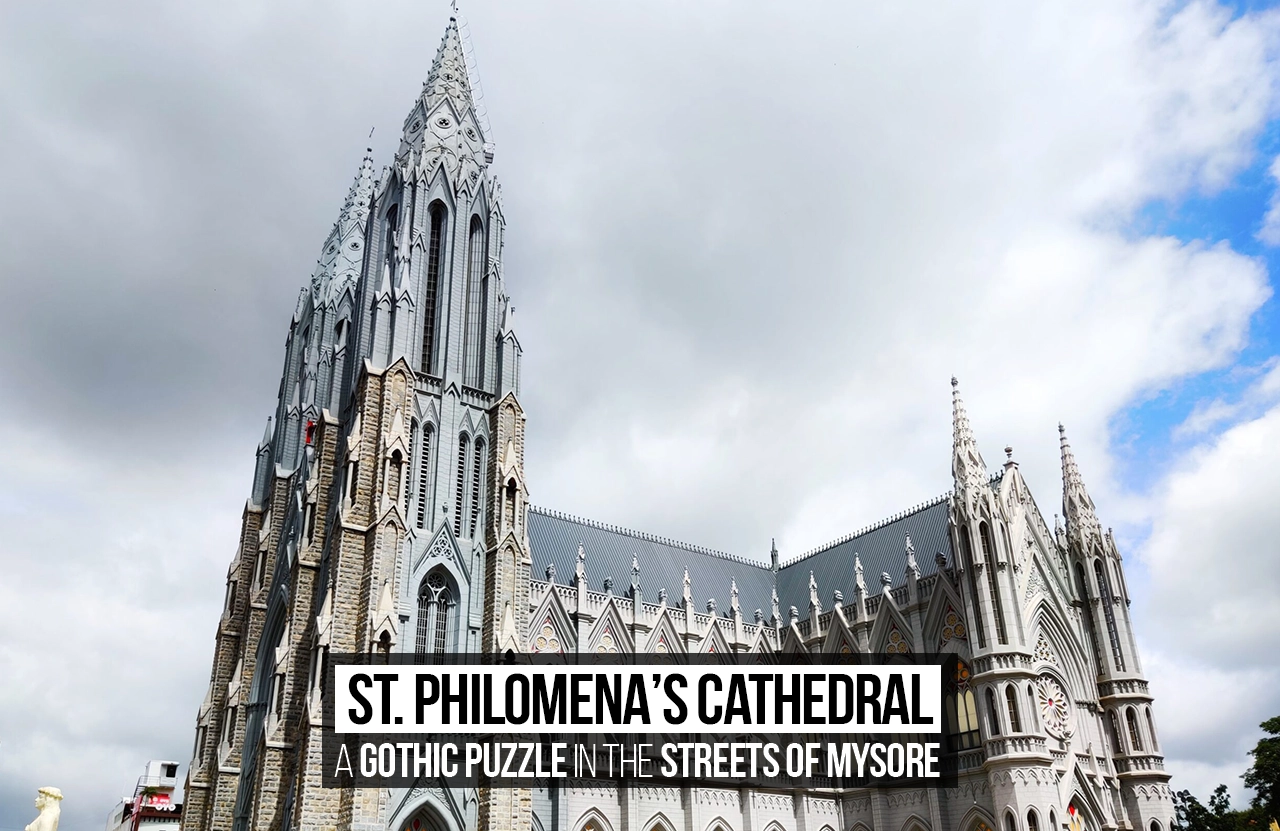
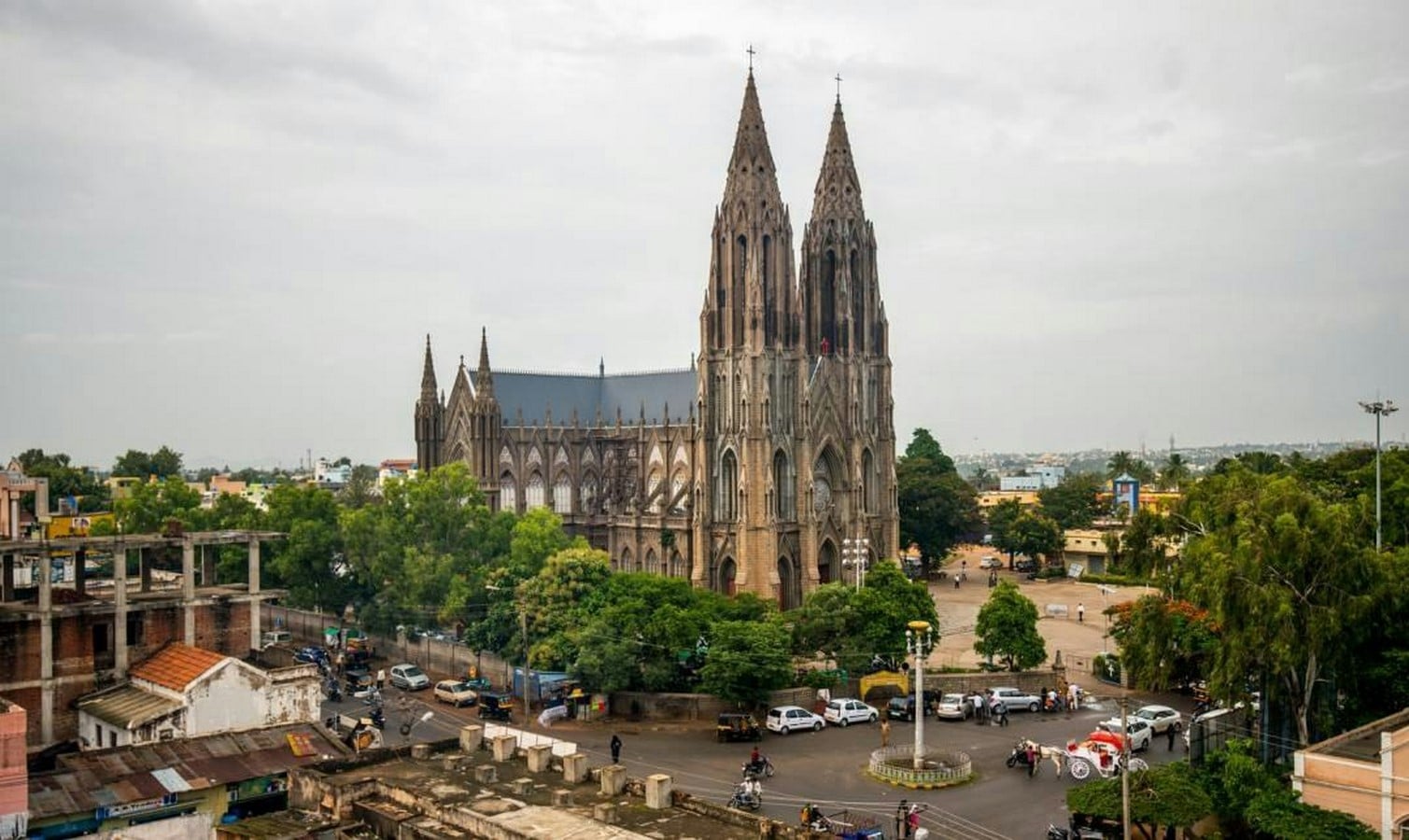
Mysore’s streets greet us with culture, tradition, and heritage that demand your complete attention. The crowds near Devaraja pull you in every direction with vendors, color, noise, and a diversity of people that make you feel like a part of the community. You lose your train of thought entirely and surrender to the chaos around you. It is in that surrender that the spires appear. They are not announced. They are just there for those who notice, quietly trying to camouflage themselves into the surroundings of the market, and yet uniquely, unmistakably standing out. The buildings around seem almost deliberately placed, as if framing something worth finding. With detail so dense it feels like a puzzle demanding to be solved, St. Philomena’s Cathedral has that effect on people who were not looking for it.
Historical Context: A Saint, a Relic, and a Principality
This tall structure was born out of the medieval European tradition in a city of dense Indo-Saracenic and traditional Hindu architecture. It is not accidental, this contrast, nor was it a colonial imposition. A Maharaja commissioned St. Philomena’s Cathedral.
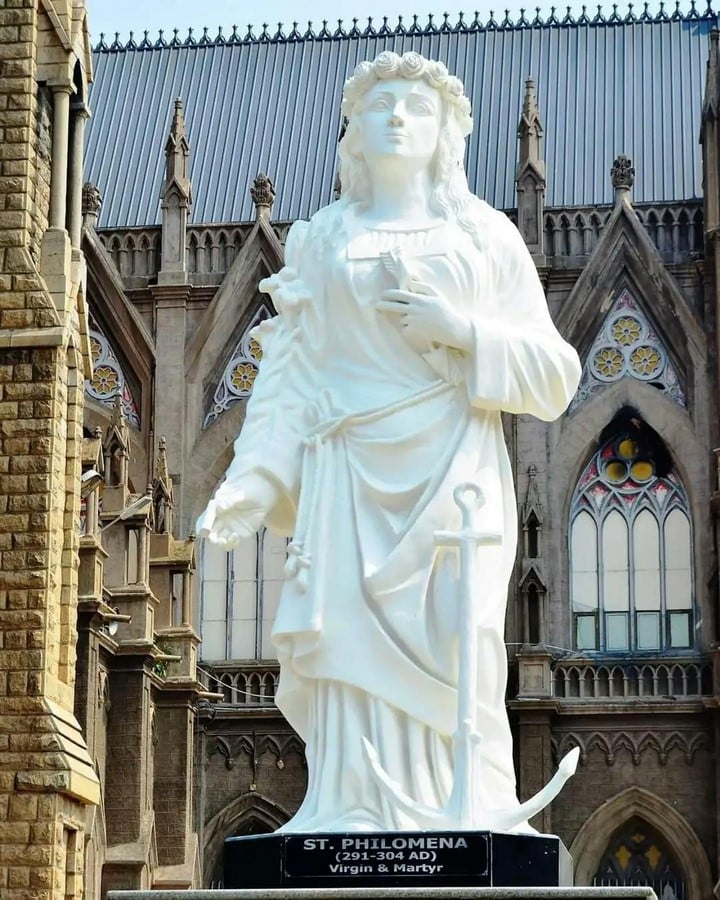
Unlike the architectural monuments traditionally commissioned by Maharajas as displays of wealth or power, St. Philomena’s Cathedral began with none of those motives, nor with any admiration for Western architecture. It began with bones. In 1802, the remains of a teenage girl were discovered in the Catacombs of Saint Priscilla in Rome. They were identified as Saint Philomena, a third-century Greek princess martyred for her faith. In 1926, Sir T. Thumboo Chetty, then Huzur Secretary to the Maharaja of Mysore, got his hands on a relic of the saint and passed it to Father Cochet, who brought a proposal to Maharaja Krishnaraja Wadiyar IV: build a church worthy of it.
The Maharaja agreed. This was not an unusual act for Krishnaraja Wadiyar IV. The man funded temples, mosques, and now a cathedral, and was known as much for his governing abilities as for his pluralism. The first church at this site had been built in 1843, a modest wooden structure erected to serve British officers stationed in Mysore. By the 1930s, Mysore’s Catholic population had grown considerably. Plans were drawn for something far more ambitious. French architect Daly designed the new cathedral, and construction proceeded under the supervision of Bishop René Feuga. The cathedral was consecrated in 1936 and fully completed by 1941. Eight years of construction produced one of Asia’s tallest church structures, with spires that rise to a height of 175 feet.
Architectural Character: Gothic Grammar in a South Indian City
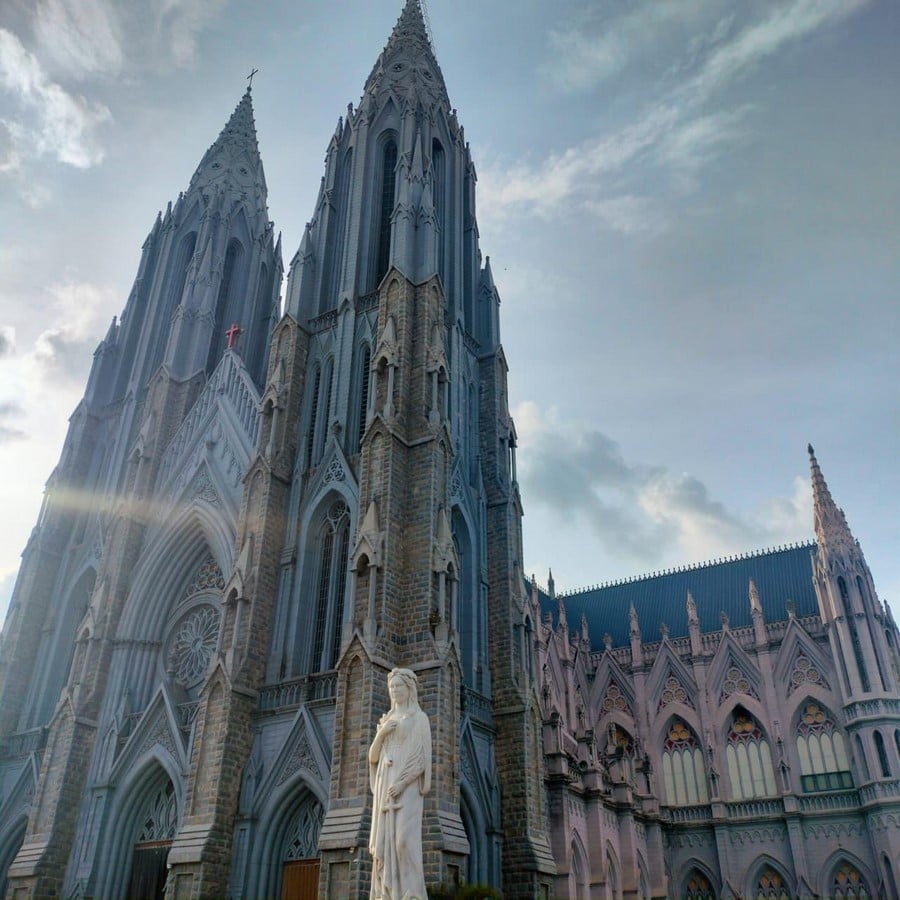
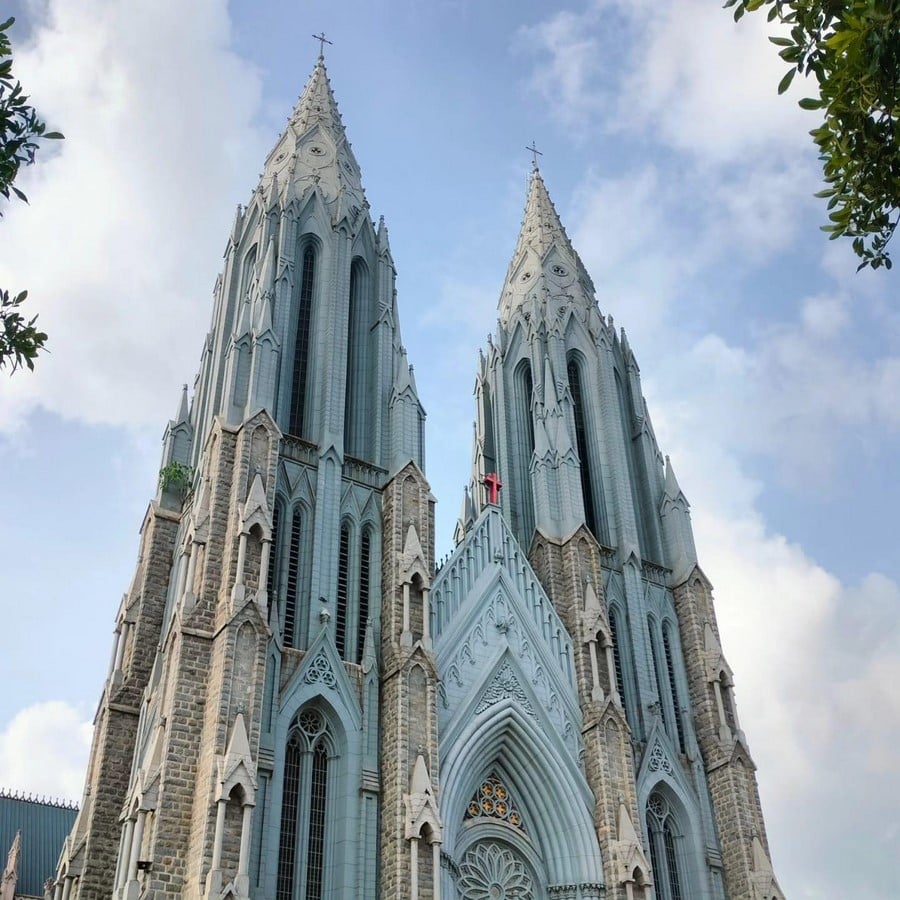
The twin spires, pointed arches, and deliberate verticality of St. Philomena’s Cathedral point directly to its Neo-Gothic roots. Mysore already had a complicated architectural vocabulary by the time the cathedral was built. The Indo-Saracenic grandeur of the Mysore Palace, the classical colonnades of the Jaganmohan Palace, and the Dravidian towers of the Chamundeshwari Temple on the hill to the south. St. Philomena’s Cathedral added an entirely different register. Pure European Gothic, with no concessions to local idiom in its external form. Some might say it goes against its surroundings. Some might say it stands uniquely within them. Whatever you’re reading, it catches hold of your attention and does not let go.
The floor plan follows the cruciform arrangement standard of the Gothic tradition. The nave, the long arm of the cross, stretches approximately 255 feet and seats up to 800 people. Below the main altar, a crypt descends into the earth, housing a statue of Saint Philomena brought from France, along with the relic that prompted the building’s construction in the first place.
The twin spires are the building’s defining element, and they earn that status. At 53 metres, they are proportioned with a precision that makes them appear taller than they already are. The 12-foot crosses at the apex of each spire push the structure further skyward, making St. Philomena’s Cathedral visible for miles across Mysore, catching the attention of tourists, natives, and everyone who had no intention of ending up here. Three ornamental doors face the entrance front, flanked by buttresses that hold the weight of the vaulted nave and push it outward through the walls, keeping the whole thing standing with a quiet structural logic that most visitors never think about.
The Interior: Light as Material
Step through the entrance doors and the nave opens in front of you. It does not ease you in. The scale hits immediately, a long vertical stretch of granite pillars drawing your eye forward before your feet have decided to follow. The ceiling vaults above. The building holds its proportion all the way through, which is rarer than it sounds.
The stained glass windows do most of the talking inside. Imported from France, they line the nave and aisles, each panel carrying a scene from the life of Christ. But what they actually do is catch the light. Southern Indian sunlight moves through them differently at different hours, and the stone floor below receives blues and ambers that shift and settle and shift again. Come in the morning, between eight and ten, and the eastern windows produce something that is genuinely difficult to prepare for. It is the kind of light that makes people stop walking.
Below the altar, steps lead down into the crypt. The descent is gradual, and the light goes with you only partway. By the time you reach the bottom, the walls are cool stone, and the silence is a different quality than the silence upstairs. The French statue of Saint Philomena stands there in the dark. A Greek saint, rendered in France, housed in a German-inspired cathedral, in the middle of Karnataka. That accumulation of origins is not something the building explains. It just holds it, quietly, and leaves you to work it out.
The Holy Mass is conducted here daily in Kannada, Tamil, and English. Three languages, one ceiling, the same light coming through the same glass every morning. Saint Philomena was removed from the Roman Catholic calendar of saints in 1961, her historical existence deemed unverifiable. The cathedral built in her name is still standing.
Cultural Significance and Influence on the Urban Fabric
Mysore has always held more than one story at a time. The city’s identity leans heavily on the Wadiyar dynasty, the Palace, and the Dasara festival. It is a specifically Hindu cultural register, worn openly and without apology. And within that same city stands this cathedral, not as a contradiction but as a continuation of the same instinct that built everything else. Krishnaraja Wadiyar IV did not commission St. Philomena’s Cathedral despite who he was. He commissioned it because of it.
Built not by conquest but by invitation, the cathedral sits in Mysore’s skyline without competing with anything around it. The Palace domes do their thing. The temple towers do theirs. The spires of St. Philomena’s simply occupy their own position, distinct and uncompromising, visible from streets where nobody was looking for them.
For the city’s Catholic community, it is the seat of the Diocese of Mysore. Masses in three languages fill the nave with a congregation that reflects the city’s actual diversity, not a curated version of it.
Legacy: A Building That Stays Itself
St. Philomena’s Cathedral does not try to belong. That is precisely why it does.
It did not attempt to borrow from its surroundings, no Dravidian motifs worked into the stonework, no Indo-Saracenic arches softening the Gothic grammar. It arrived as itself, and it has stayed that way for nearly a century. A building that commits fully to its own logic, structurally, formally, materially, earns a kind of permanence that buildings trying to please everyone never quite manage.
The Maharaja who commissioned it understood this. You do not build something that lasts by hedging. You build it by deciding.
The spires are still visible from across the city. The light still moves through the French glass every morning. The crypt is still cool and dark beneath the altar. Some buildings answer questions. This one keeps asking them.
References:
Wikipedia Contributors (2024). List of Omaha landmarks. [online] Wikipedia. Available at: https://en.wikipedia.org/wiki/St._Philomena%27s_Cathedral.
Philomena.org (no date). Saint Philomena Cathedral, Mysore, India. [online]. Available at: https://www.philomena.org/mysore.asp [Accessed: 20 June 2026].
Re-Thinking The Future (2024). St. Philomena’s Cathedral, Mysore. [online]. Available at: https://www.re-thinkingthefuture.com/case-studies/a12110-st-philomenas-cathedral-mysore/ [Accessed: 20 June 2026].
India Highlight (no date). St. Philomena Cathedral, Mysore. [online]. Available at: https://www.indiahighlight.com/attraction/mysore/st-philomena-cathedral [Accessed: 20 June 2026].
iShareThese (2026). St. Philomena’s Church Mysore. [online]. Available at: https://isharethese.com/st-philomenas-church-mysore-things-to-do-destinations-karnataka/ [Accessed: 20 June 2026].