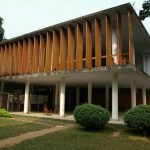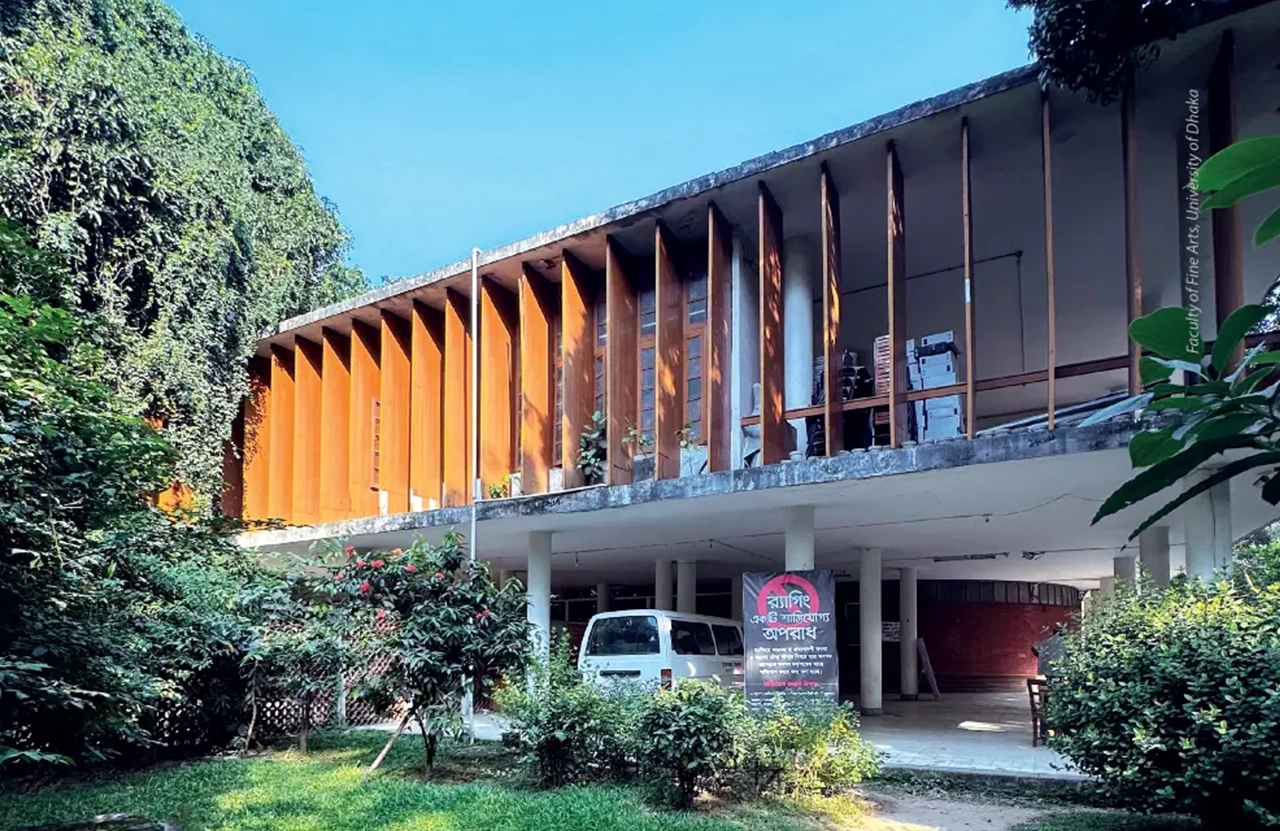
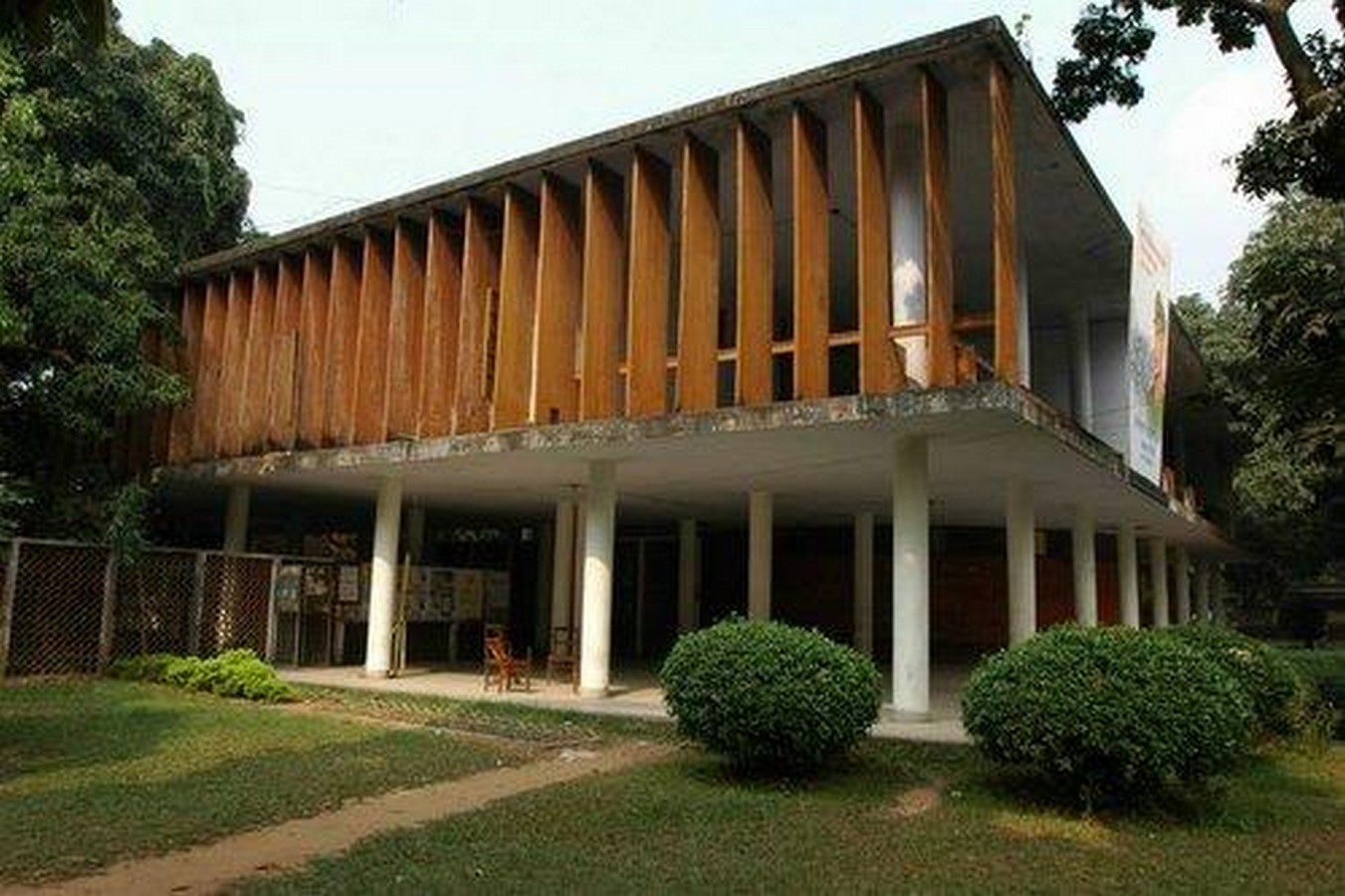
The Art Faculty Building, situated at the campus of Dhaka University, was designed by architect Mazharul Islam in the early 1950s. It is considered one of the first and most important examples of modern architecture in Bangladesh. It is part of the wider search for identity in post-colonial South Asia because the building was designed at a time of political change and cultural redefinition. While modern architecture is seen as the blind adoption of the Western trend, architect Mazharul Islam’s approach was different. He tried to ground modern architecture in the reality of place, location, and use. While modern architecture is seen as the adoption of modernism as a style, the art faculty building is seen as modernism interpreted through place by finding a balance between globalism and regionalism.
Modernism and the Question of Identity
Architecture and identity became important issues in South Asia after the partition of India in 1947. Modernist architecture is the result of the new identity in South Asia. Modernist architecture was adopted as a symbol of modernity, breaking away from colonial pasts. While modernist architecture is seen as the adoption of universal ideas, the architecture did not relate to place. The search for identity was an important aspect of East Pakistan, which was related to place, location, and environment, as seen in modernist architecture, as in the case of the Art Faculty Building.
Mazharul Islam began work with this condition. The principles of modern architecture were dismissed, and they were reinterpreted according to the realities of Bengal. Contrary to the inclusion of the use of historical references, this approach highlighted the use of spaces and environmental responses of the building. In this manner, it can be said that there is mediation between the principles of modern architecture and the realities of the place. This can be said to be very prominent in the case of the Art Faculty Building, as it represents a particular style of modern architecture, which is neither derivative nor generic.
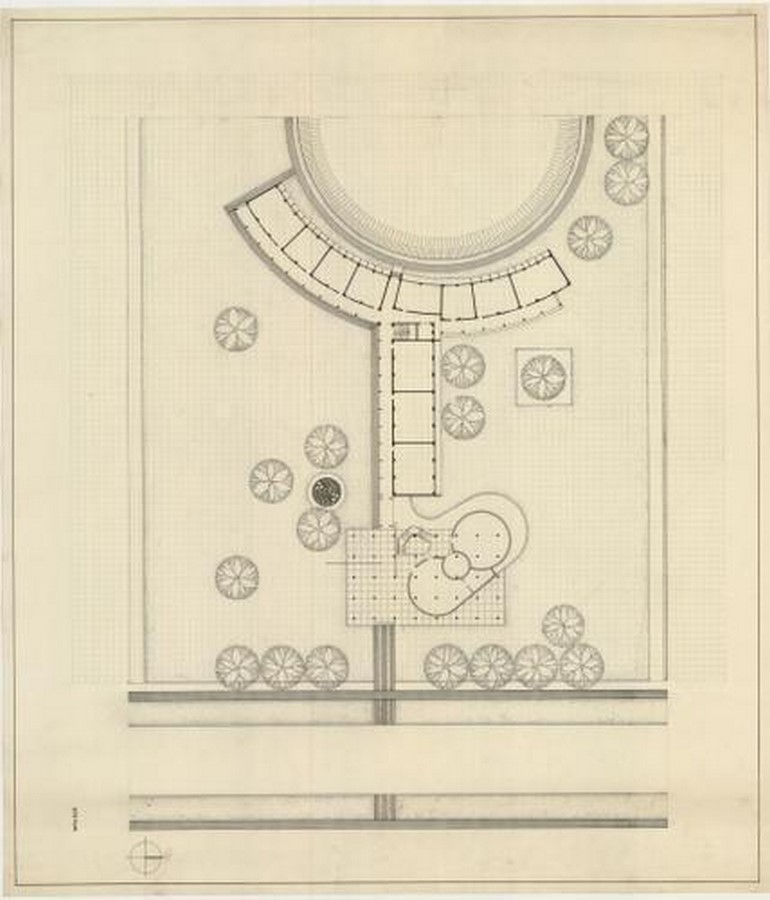
Planning and Spatial Organization
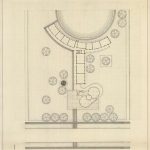
The planning of the Art Faculty Building can be distinguished from the typical institutional building plans of the period, as there was more stress on a rigid approach to planning and design. Instead of there being one volume for the entire compact building, there is the inclusion of several volumes connected to open spaces and courtyards. This approach enables the process of movement to occur gradually, as opposed to the typical linear movement within a building.
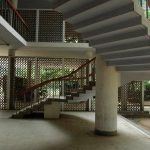
The entrance to the building is marked by the open ground level, which raises the building to create a threshold of shade. This approach minimizes the level of formalism and institutionalism, which is typical of such buildings. It establishes a link between the interior and exterior of the building. From here, there is movement to the semi-open spaces of corridors, verandahs, and courtyards.
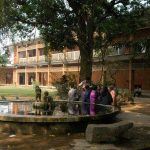
The use of the courtyard is an important aspect in the planning of the building, and it can be regarded as a tool for organizing the whole plan of the building. This is not just a visual aspect of the building but a climatic and social nucleus in which the whole plan of the building is organized. This helps in the utilization of natural lighting and ventilation in deep parts of the building, as well as the creation of a feeling of communal utilization of the building’s facilities. This planning is not just efficient but also considers the nature of art education.
Climate as a Design Generator
Here, instead of looking at climate as a constraint for design, it is taken as a factor for designing the building. In hot and humid climates, such as in Dhaka, various passive design elements have been used to control temperature, natural light, and wind.
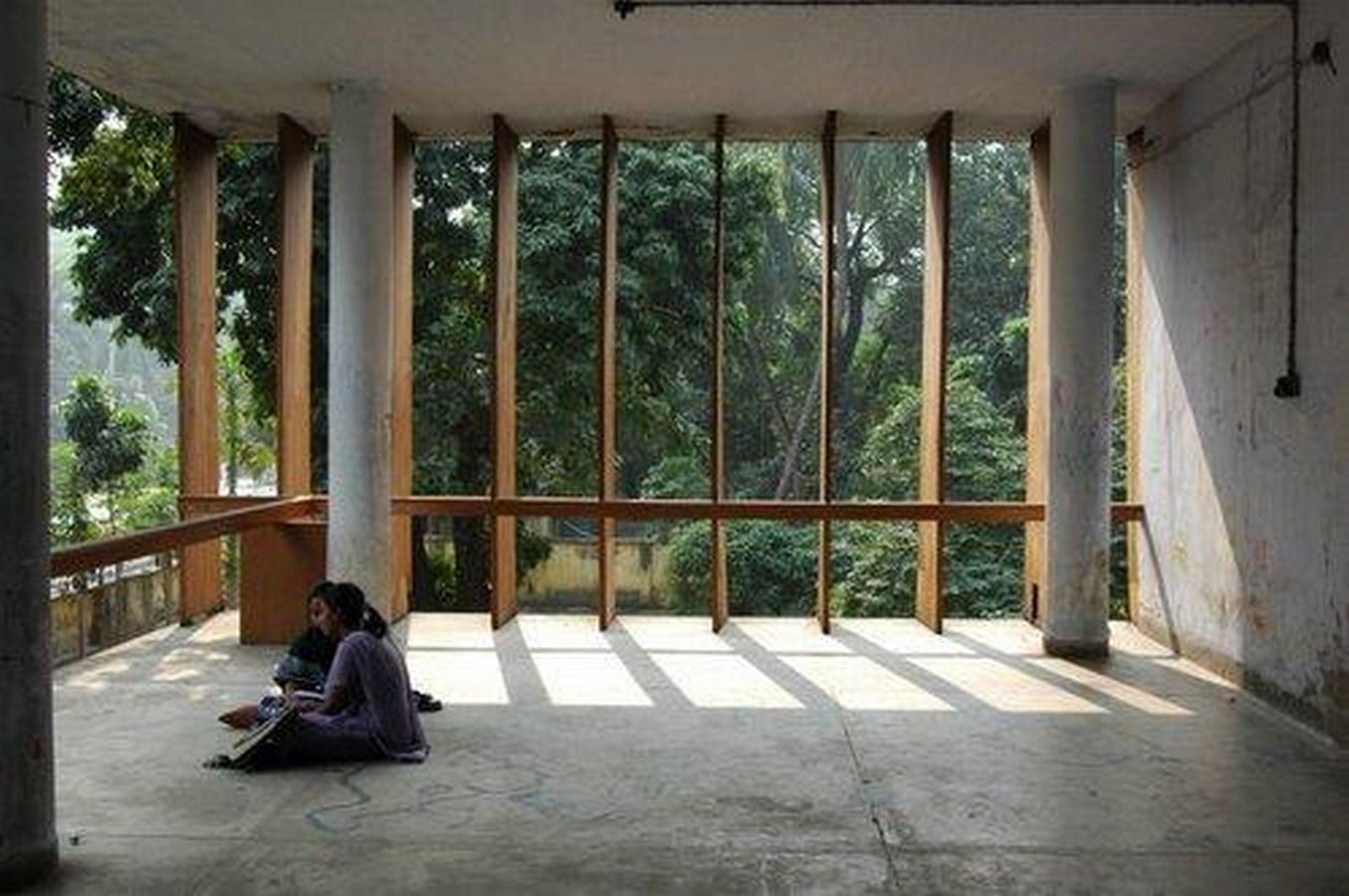
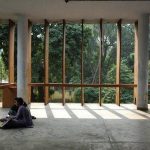
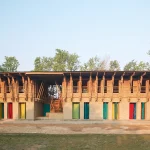
Verandahs and overhangs are used as transition spaces to filter out sunlight and protect the openings and walls from direct sun. These are used to design semi-open spaces. Wooden louvered walls and screens are used to filter out sun rays and for ventilation. These are not part of the building but are used as part of the building. The design of the building volume is such that there is proper ventilation, too. The sun’s light is diffused and not direct. This provides better comfort for the people inside these studios and classrooms. This is another aspect where the building relates to the natural environment and becomes a part of it.
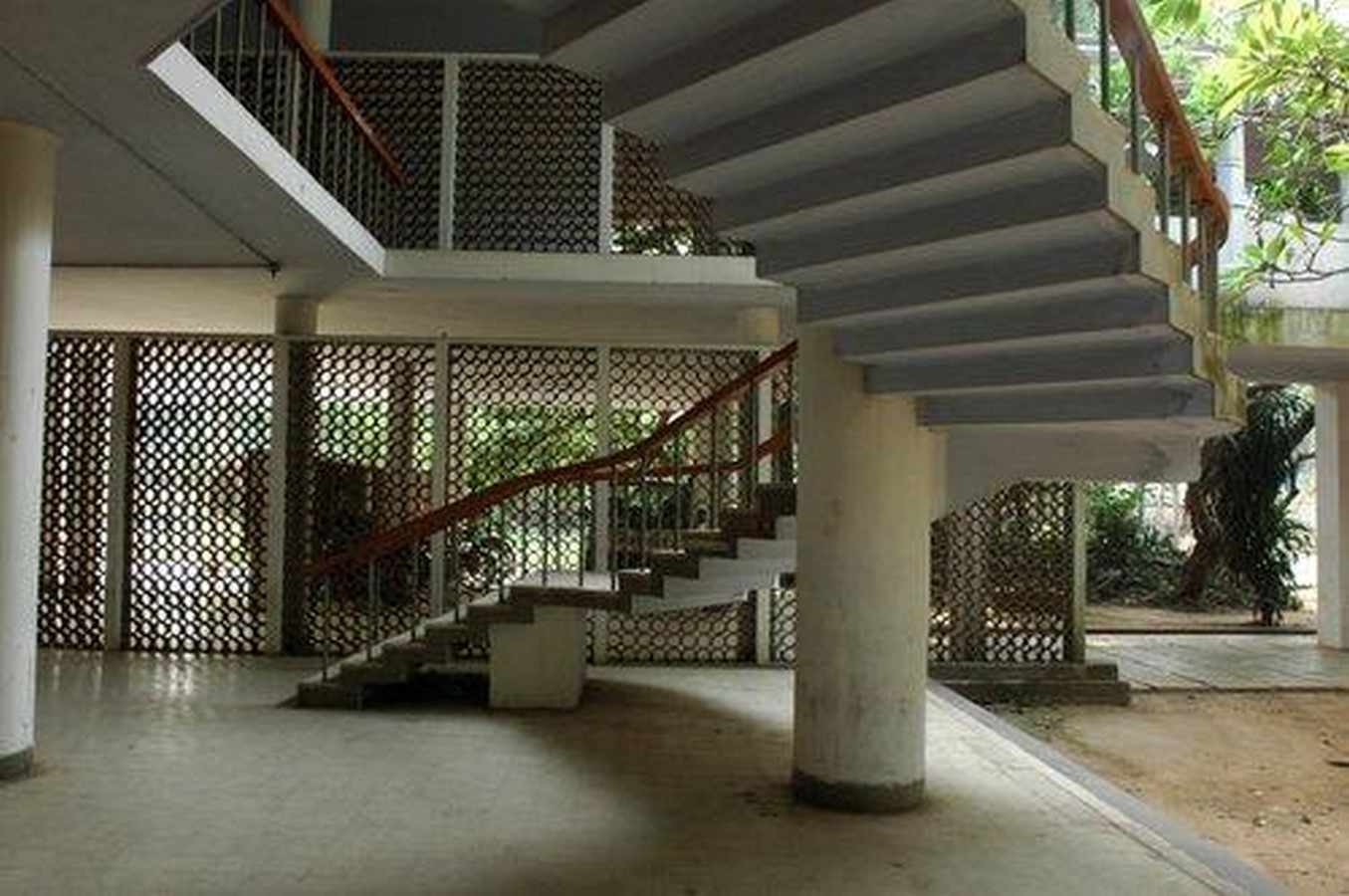
Material Expression and Tectonics
The Art Faculty Building uses minimal materials but has chosen them well. Brick and reinforced concrete are used as building materials as well as finished materials.
The use of bricks is very significant as it creates a strong sense of relating to the context. Its texture and tone change according to the change in light. This creates a sense of dynamism in the building. This is not just used as a decorative element. There is a sense of familiarity attached to the use of bricks.
The use of reinforced concrete provided the structural flexibility. This enabled open planning and larger spans. The use of all these materials provided a balance between open and closed spaces. The wooden screens and louvers act as shading devices and reinforce this relationship further. Overall, these elements contribute to the building’s environmental performance and tactile qualities.
Architecture and Landscape Integration
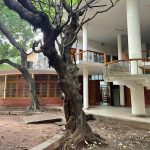
The building has a good relationship with the site. It works with the site, not against it. Mzharul Islam has retained all the large trees, which were ancient. Overall, the building layout is such that it sits lightly on the site. This is not very common with institutional buildings.
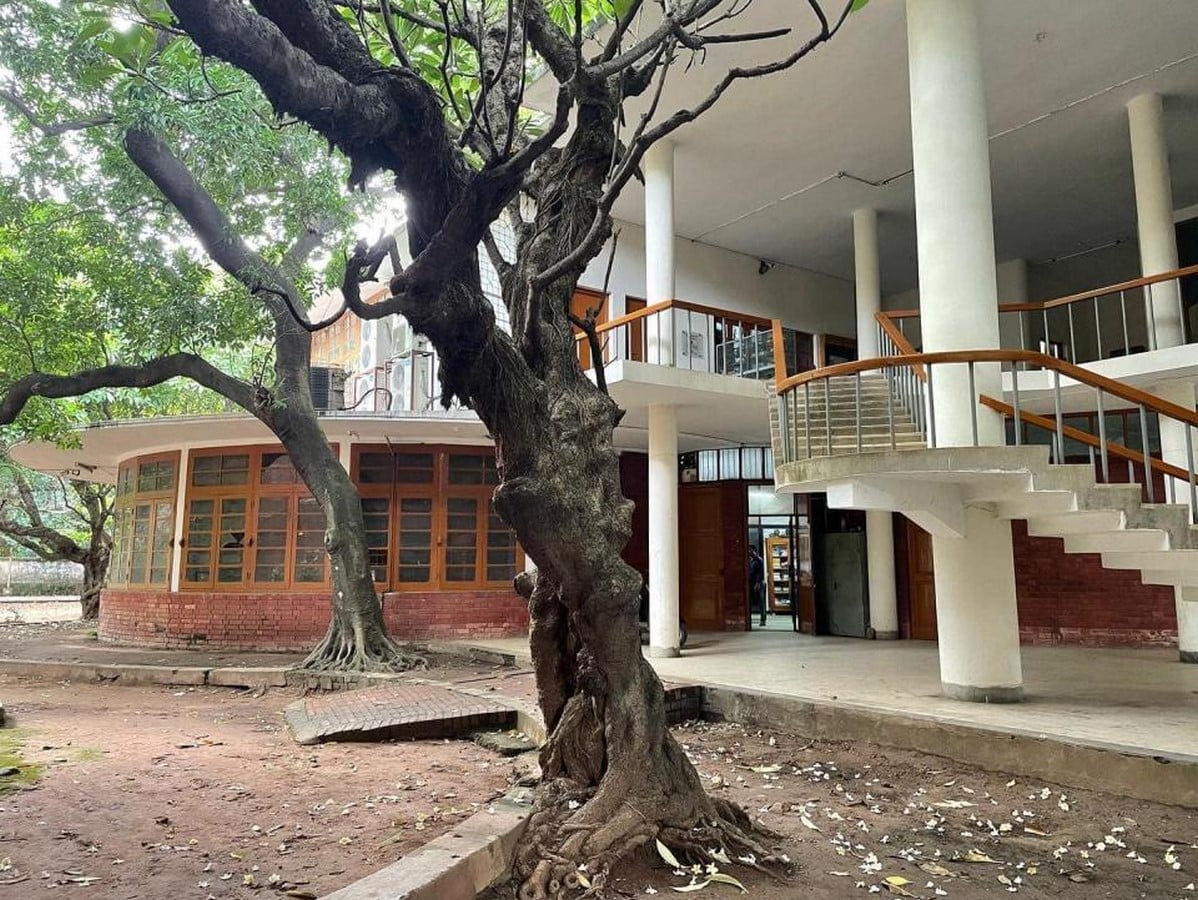
The open spaces, courtyards, and shaded areas have extended the interior spaces to the exterior. This eliminates the line between interior and exterior, man-made and nature. There is always a sense of movement and views of green, light, and sky.
In this building, the role of the landscape is not just an afterthought. Rather, it has been incorporated into the architectural composition. It has been utilized in a manner that enhances the building’s relationship with the site.
Innovation and Architectural Significance
The building was constructed during a period when there was a significant change in architectural practice. The style of architecture for institutional buildings was quite rigid and ornamental or rigid and functional. Mazharul Islam’s building was a pioneering work with regard to innovative architectural design, which was minimal and innovative.
The importance of the building is the way it synthesized different components, such as modernist abstraction, climatic response, material expression, and spatial openness into one whole. It was one of the first regional modernist buildings in Bangladesh. It was free of colonial architectural influences as well as international styles.
It was also significant in the sense that it proved that modernist architecture can be adapted to the environment without compromising its conceptual integrity. It is still an important part of the cityscape, not only because of its academic and cultural importance but also because of its relevance.
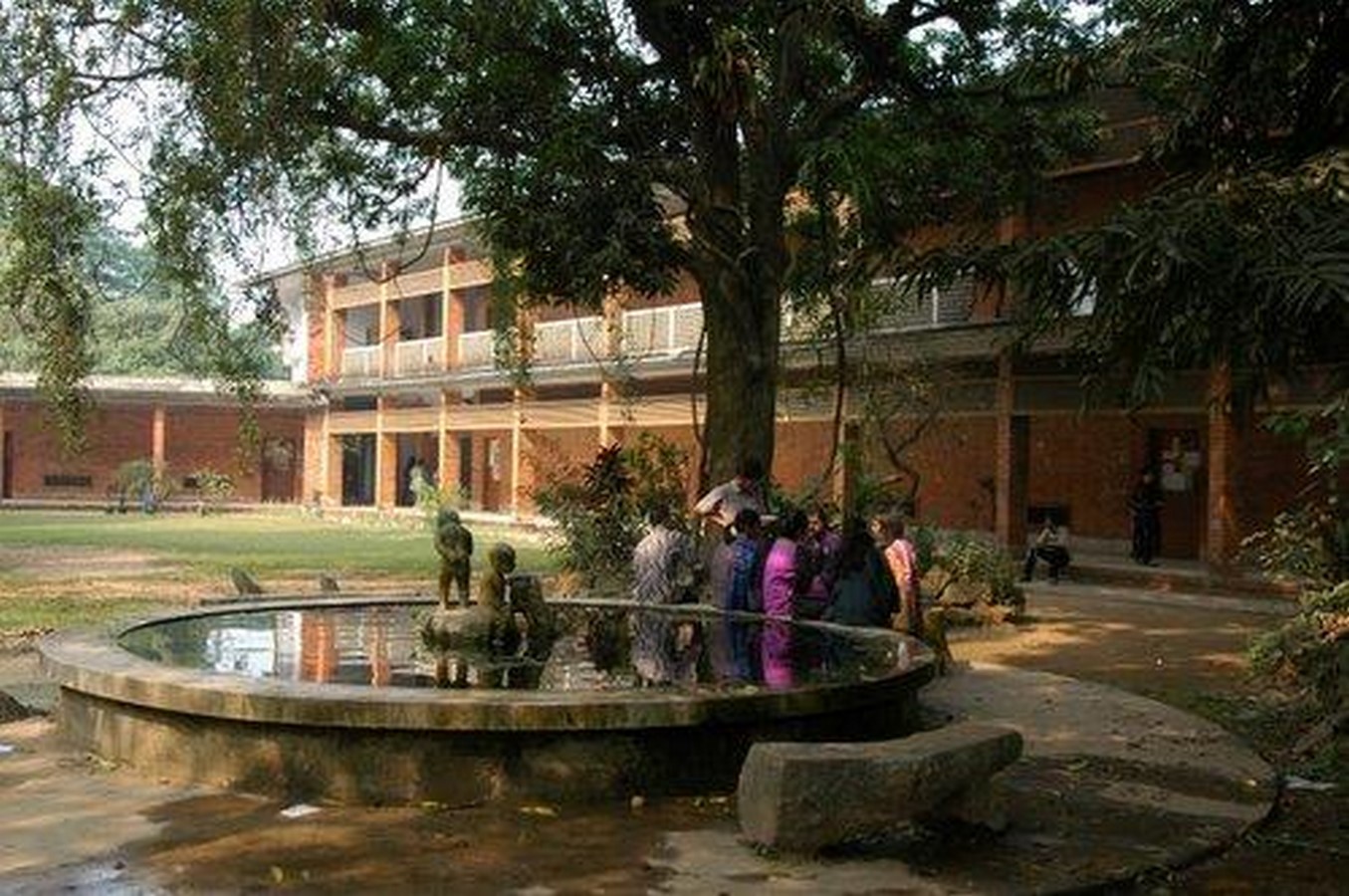
The art faculty building is an example of modernist architecture in the context of contextuality. It is the way it accommodates the climate, material, landscape, and social components that it is not formally modernist architecture. It is the way it moves away from the formal definition of modernist architecture that it creates its own language. It is relevant; it is modern.
Mazharul Islam’s work shows that there is no opposition between the global and the local; they can be negotiated. The art faculty building is an example of architecture that is the result of careful adaptation and not blind imitation. It is the way it establishes an approach towards relevant architecture that is responsive, intimately connected with the environment, and timeless.
References:
Morshed, A. (2017) ‘Modernism as Postnationalist Politics: Muzharul Islam’s Faculty of Fine Arts (1953–56)’, Journal of the Society of Architectural Historians, 76(4), pp. 532–549.
Ashraf, K.K. (1997) ‘The Architecture of Achyut Kanvinde and Muzharul Islam’, Mimar / JSTOR listing.
Frampton, K. (1983) ‘Towards a Critical Regionalism: Six Points for an Architecture of Resistance’.
Muzharul Islam Archive (n.d.) Fine Arts Institute, Dhaka University, Bangladesh.
Gattupalli, A. (2023) ‘Regional Modernism in Bangladesh: The Architecture of Muzharul Islam’, ArchDaily, 2 October.
UNESCO World Heritage Centre (2023/2024) The Architectural Works of Muzharul Islam: an Outstanding Contribution to the Modern Movement in South Asia.