The New Face of Innovation
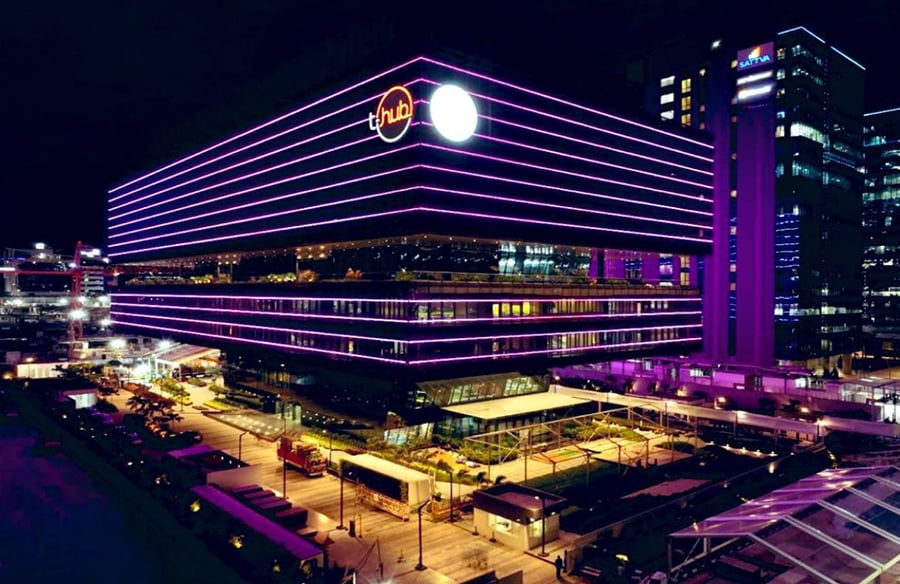
Hyderabad has always been a city of contrasts. Its history is woven in pearls, palaces, and Mughal majesty. Is it present? Shaped by global technology giants and IT campuses. In 2022, a chapter was added to this evolving story. Located in the Raidurg innovation district, T-Hub 2.0 is more than just another addition to Hyderabad’s skyline. It redefines ambition.
At nearly 582,689 square feet (New Indian Express, 2022), it holds the title of the world’s largest innovation hub. Yet its importance cannot be measured in scale alone. What it truly represents is that Hyderabad is a city steadily reshaping and expanding its identity. This city, once known primarily as a service base for international tech, has become a place where the future is enthusiastically imagined, tested, and built.
A Factory for Ambition
This is not a corporate headquarters. It was never meant to be. Instead, T-Hub was designed as an ecosystem. A place where startups, mentors, corporates, policymakers, and investors orbit one another nearby. The building does not just house them; it engineers collisions. Lounge areas blur into hackathons. Auditoriums host founders pitching prototypes to seasoned investors. Small, quiet pods become the settings for conversations that alter careers. The structure frames these interactions, but it also pushes them forward.
The “T” That Anchors Tomorrow
The form of the building says as much as its function. The “T” shape is no accident. It stands for Technology, Talent, and Tomorrow. The three promises Telangana made to its entrepreneurial community (New Indian Express, 2022). At the same time, the cross-axis gestures quietly toward the Charminar, the city’s most familiar landmark. This is not a building that forgets where it stands. It is futuristic, yes, but also tethered to memory.
Inside, the floors unfold like the chapters of a startup’s life. On the ground floors, the atmosphere is restless and alive. Young founders crowd around hot desks, scribbling early ideas onto whiteboards. Move a few levels up, and the tone changes. Here, mentoring rooms and accelerator spaces refine half-formed concepts into structured, workable plans. At the very top, the scale expands again, global institutions like DST’s AI/ML Excellence Centre and JICA’s social-impact programs step in, giving local ideas the reach and partnerships they need to grow (New Indian Express, 2022). Even how users move through the building tells the same story. Open staircases, transparent lounges, and wide atria aren’t just for circulation. They’re deliberate invitations to bump into someone new, to spark a conversation that might turn into the next big leap. Many founders will admit their best ideas were born in conversations that were never scheduled.
When Architecture Works as Hard as Its Occupants
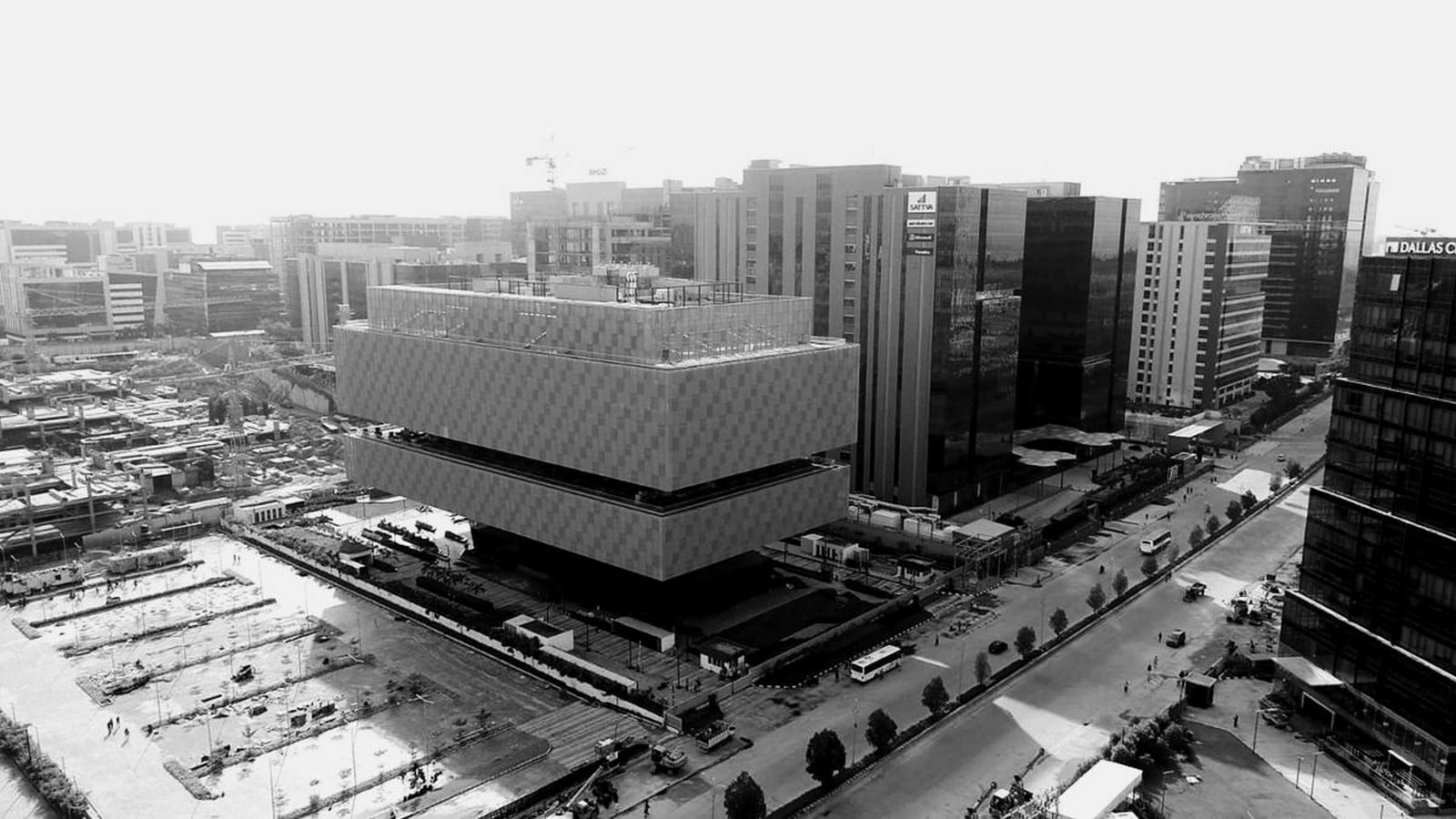
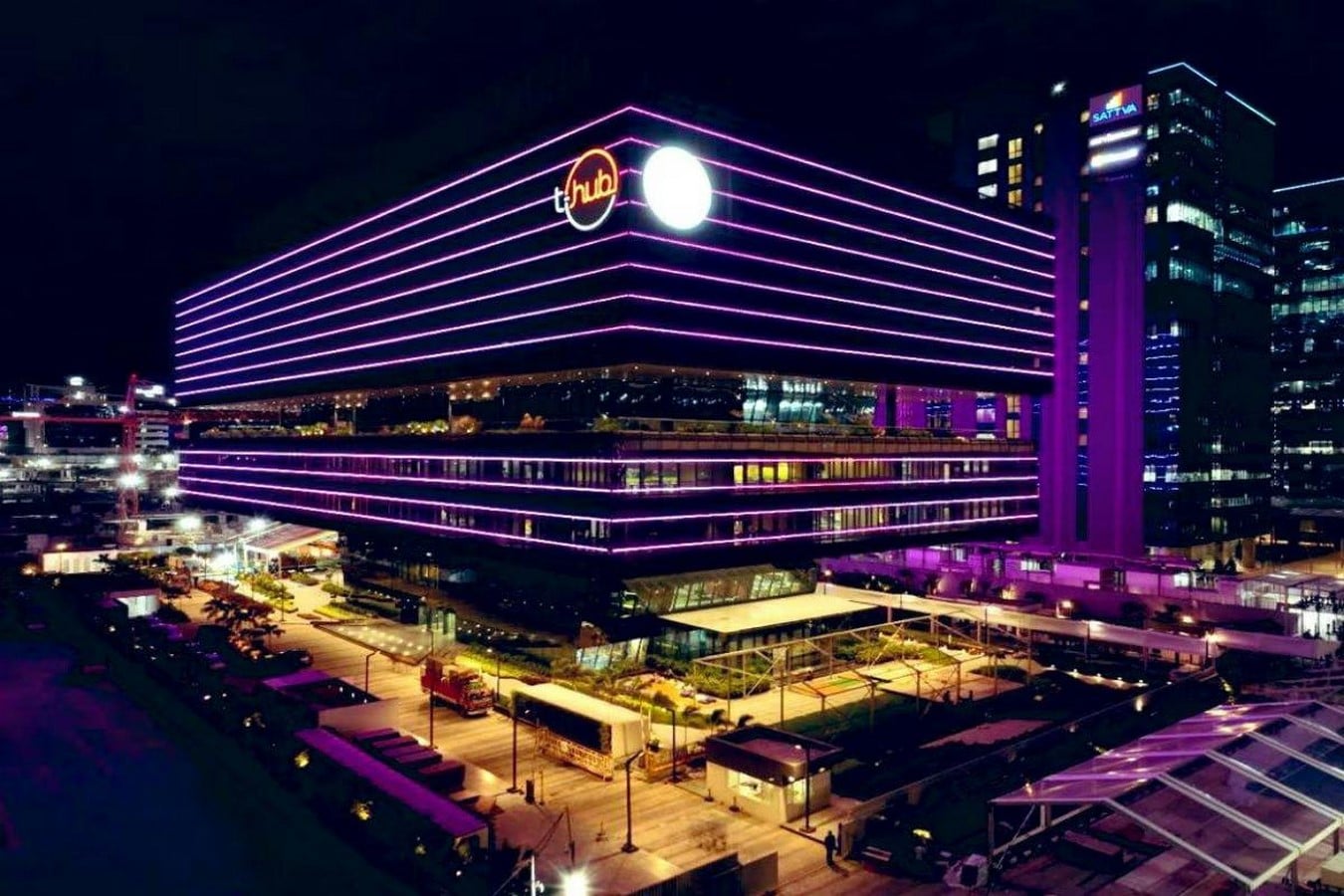
From the outside, the building appears to balance a massive block of space on four columns. It is, in fact, one of India’s largest cantilevered structures (New Indian Express, 2022). That feat required confidence and precision. The reinforced concrete skeleton inside makes long spans possible, leaving interiors flexible. That flexibility matters. A single floor might be filled with hackathon teams one week and reorganised as a conference venue the next. The design anticipates constant flux. The façade does more than make a strong visual impression. Its horizontal fins and deep overhangs shield the interiors from Hyderabad’s unforgiving sun while still letting in just the right amount of daylight (ASBL, 2023). The result is a sequence of bright, open spaces that feel active and welcoming without being overwhelmed by heat. Inside, the material palette is deliberately limited to concrete, glass, and steel. The simplicity creates a neutral backdrop where the real vibrancy comes from its occupants. In many ways, the building steps aside so its community can take the spotlight.
Lighting and HVAC adjust subtly as rooms fill or empty. High-speed networks ensure that a pitch in Hyderabad can be broadcast to investors across the world without a pause. Modular systems allow entire floors to shift function overnight, transforming from hackathon battlegrounds to polished conference venues (T-Hub Blog, 2023). This is a building tuned to the rhythm of startups; fast, adaptive, and always in motion.

Life Inside – A Community in Motion
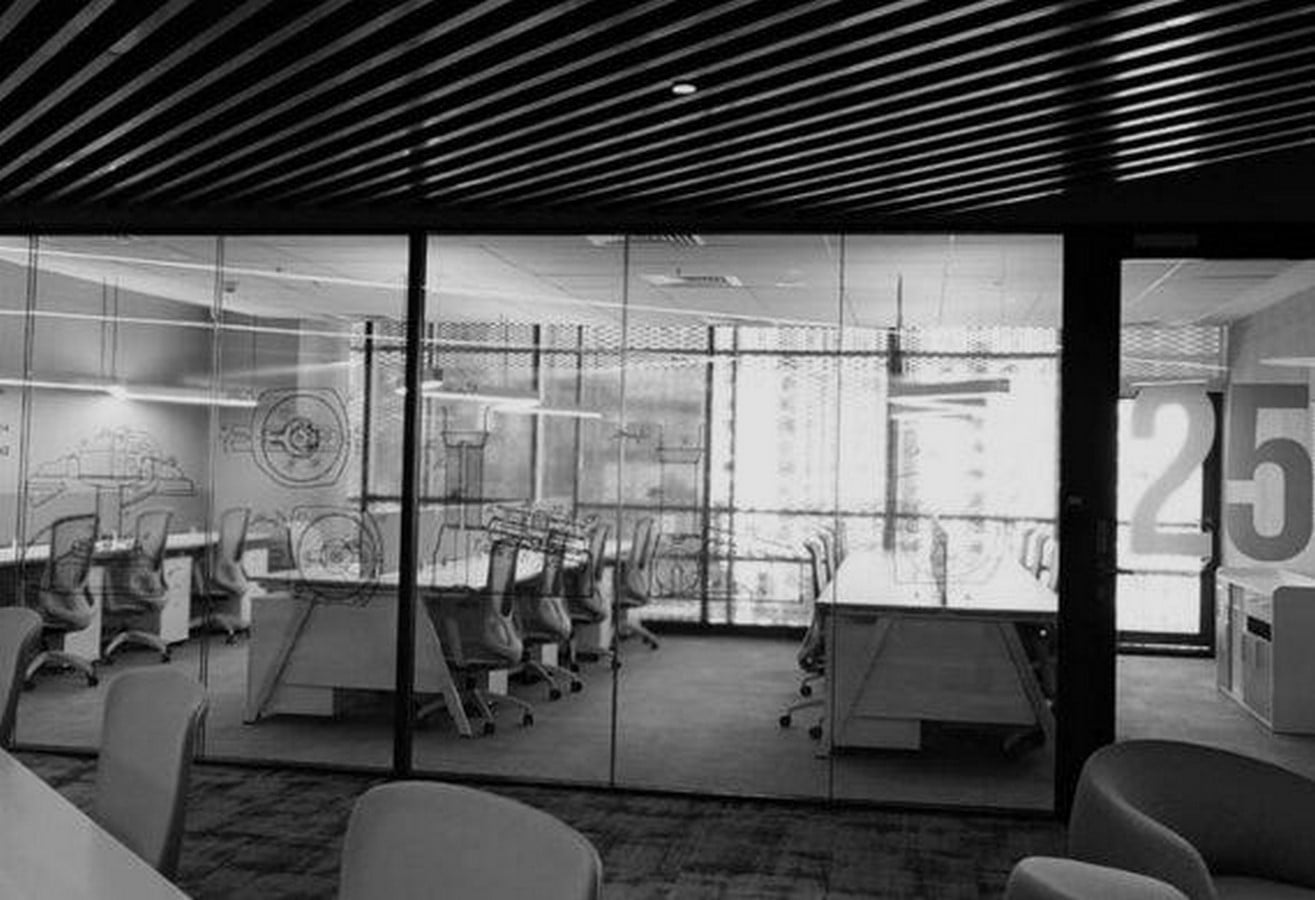
Step inside, and the building comes alive with its own rhythm. The echoes of conversation spill from lounges into corridors. Whiteboards fill with quick sketches and half-formed ideas, their ink still drying as teams rush off to the next discussion. From one corner, the buzz of a hackathon rises, a chorus of tapping keyboards, laughter, and hurried debates. Across the atrium, an impromptu coffee meeting stretches into a partnership pitch.
The building doesn’t simply contain this activity; it choreographs it. Transparent lounges, open staircases, and wide atria make encounters almost inevitable. Every movement, up the stairs, across a hall, around a corner, carries the possibility of a new connection. Each floor vibrates with its very own rhythm, yet together they produce one shared chorus: Hyderabad claiming its role as India’s startup capital. The building doesn’t passively allow this; it shapes it. An atrium stroll might end in a new partnership. A coffee break might trigger the spark for a unicorn idea.

Sustainability as Substance, Not Slogan
For all its scale, T-Hub 2.0 was built with restraint. The building holds a LEED Platinum certification, one of the highest benchmarks for sustainability worldwide (ASBL, 2023). Its shading systems alone reduce cooling loads enough to cut energy use by nearly 40% (ASBL, 2023). Rainwater harvesting and recycling bring down water consumption by about 35% which is a crucial achievement in a city where scarcity is a growing concern (ASBL, 2023).
But its role doesn’t stop at efficiency. Through its Atal Innovation Centre programs, T-Hub supports startups working on clean energy, circular economies, and water solutions (T-Hub Programs, 2024; T-Hub News, 2024). Sustainability here isn’t hidden away. It’s visible in the façade, embedded in the building’s systems, and multiplied through the innovations it nurtures.
Beyond the Site – Architecture as Influence
Zoom out, and it becomes part of the city’s global story. Hyderabad has long been home to the campuses of international tech giants. But T-hub shifts the narrative. It tells the world that Hyderabad is not just a host, it is a producer of innovation. Sitting at the heart of Raidurg’s tech corridor, T-Hub connects research, industry, and entrepreneurship into one fabric (New Indian Express, 2022). It works as soft power, a physical statement that Hyderabad intends to lead in Asia’s startup race.
A Launchpad, Not a Landmark
T-Hub 2.0 is full of contradictions: vast but flexible, futuristic but familiar, bold yet understated. Unlike most office towers, it does not simply symbolise ambition. It manufactures it. Cities across the globe compete to copy Silicon Valley. Hyderabad has chosen another metaphor. Not valleys, but hubs, concentrated, connected, alive with people. Architecture here is not just a static shelter, but a launchpad.
References:
- ASBL (2023) The future of green building in Hyderabad: Emerging trends to watch. ASBL Insights. https://asbl.in/blog/the-future-of-green-building-in-hyderabad-emerging-trends-to-watch/
- New Indian Express (2022) T-Hub 2.0 to be go-to place for 20 K startups. New Indian Express, 29 June. https://www.newindianexpress.com/cities/hyderabad/2022/jun/29/t-hub-20-to-be-go-to-place-for-20k-startups-2460837.html
- T-Hub Blog (2023) T-Hub 2.0: Unleashing Next-Generation Innovation. T-Hub Official Blog, 21 December. https://t-hub.co/blog/t-hub-2-0-unleashing-next-generation-innovation/
- T-Hub Programs (2024) AIC Sustainability Cohort-2. https://programs.t-hub.co/aic-sustainability-cohort-2/
- T-Hub News (2024) 23 startups chosen for AIC T-Hub’s sustainability cohort in Hyderabad. https://t-hub.co/news/aic-sustainability-cohort-hyderabad/