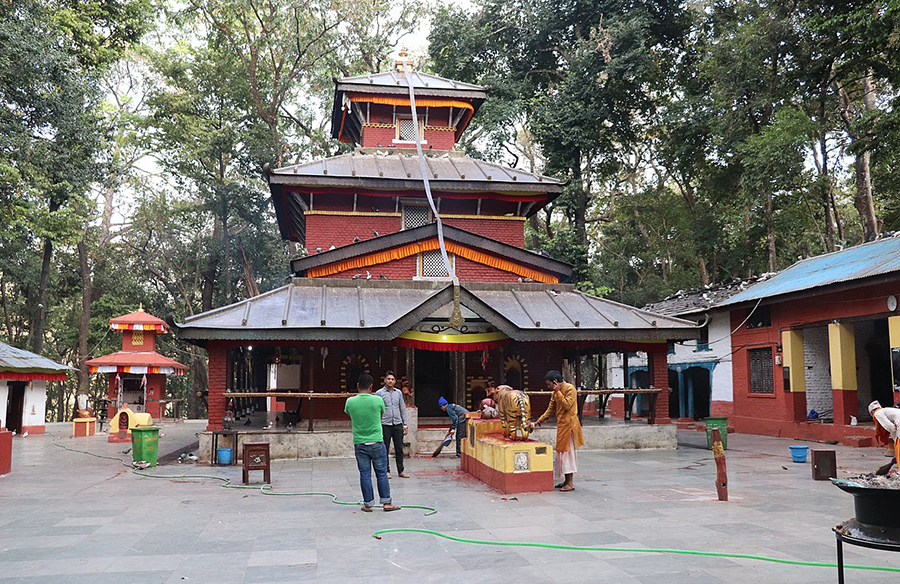
The Kalika Bhagwati Temple is an exemplary embodiment of multi-roof temple architecture. Lying across the Kali Gandaki River amidst dense forest, it is one of the vital pilgrimage sites of Baglung, Nepal. As a site dedicated to Kali, the fierce form of Shakti and the consort of Shiva, it holds a rich historical and architectural heritage. Throughout history, the temple was referred to by different names, including those of Majhki Devi, Kali, Kalika Devi, Shree Devi, and Maisthan. Over time, this place has transformed into a center of worship and an unseen architectural jewel.

Background
Kalika Bhagwati Temple traces its roots to the year 1591 B.S. According to the Legend, King Pratapi Narayan Malla of Parbat and his escorts were on their way back from Palpa with a dowry gift for the king’s marriage with Bishrawadevi, the daughter of the King of Palpa. The sculpture of Kalika Devi was given as a gift but fell on the route to Parbat at this palace and could not be detached from the ground. Following this divine incident, King Pratapi Narayan Malla constructed the temple at this very spot. To begin with, it was established only as a simple structure with a khar roof. Over time, the temple underwent reconstruction and embellishments until it reached the present multi-roofed state, which was of stone slate before this.

Main Temple
The main temple features a multi-tiered roof which is also the characteristic of many other sculptures and architectural masterpieces found in Nepal. Yet, it distinguishes itself with its unique features and elements that set it apart. It presents a roof with two-and-a-half stories constructed using bricks and stones. The supporting wooden struts are carved with the simple design and the top roof of the main temple is coated with copper, showing its antiquity. There is a golden pinnacle at the top of the temple, built in ancient times.
Stepping inside the main temple, visitors encounter four copper and wooden doors, one in each cardinal direction. The east door, however, remains closed due to the belief that its opening signifies Nagaprakat. Two copper guardian lions flank the main door, exuding a sense of grandeur and protection. The interior of the main temple reveals a square Mandapa adorned with 14 sculptures (murtis) and 108 diyos. The prominent within are Mahakali, Mahalaxmi, and Mahasaraswati. Shivalinga and Ganesh Murti find their abode in this sacred space, surrounded by intricate ribbons and bells. An Aakhanda Dhuni sits on the right side of the main door, adding to the spiritual ambiance (No photos allowed).


Surrounding Context
The Kalika Bhagwati Temple is an architectural wonder. The temple area is covered by a dense forest, with four entrances in each direction of the cardinal points. From the main entrance, one long stone pathway about 650m long, leads to the main temple. This pathway is surrounded by the forest, and upon nearing the temple, both sides of the path are beautifully adorned by rows of bell stations. The compound has small temples of deities like Ganesh, Shiva, Laxmi, Narayan, etc. These structures are mostly slope-roofed with brick facades and are dispersed around the main temple. The compound and stone pathway also branches off towards other sights: such as the Ganesh temple, and water taps to the right; another winds down by steps to the Kali Gandaki River to the left, another pathway to the Animal sacrificing section (Bali Diney Thau). Similarly, the path towards the very east, which is exactly behind the temple; grounds through a forest to an excellent viewpoint to the Kaligandaki River.


Materials and Construction
In the past, the temple was initially constructed using khar (thatch) and later replaced with a slate roof. However, it has had a copper roof for a long time and the structure of the temples has always been the woods. The recent renovation, carried out after the lockdown, has refreshed the facades, bringing a uniform brick façade appearance across the temple structures. Additionally, smaller temples, a Bhajan Ghar (prayer hall), as well as sheds have been added. According to the Guthi Management Committee, the temple’s inner structures had deteriorated, and the copper roofing had begun to leak. Hence, the recent renovation was conducted in two phases in order to solve those issues. These types of renovations and new construction projects take place regularly within the premises throughout the year for the growth of the temple, emphasizing local materials, technology and craftsmanship.


Kalika Bhagwati as a cultural and religious celebration
Kalika Bhagwati Temple is a vibrant hub of cultural and religious significance, especially during Dashain and Chaite Dashain, when the victory of good over evil is celebrated with goddess Durga. The temple comes alive with fairs, devotees, and visitors, creating a dynamic atmosphere of celebration. Architecturally, it serves as more than a sacred site; it is a focal point where community, tradition, and hope unite. The design of the temple, with its extraordinary details and spacious courtyards, accommodates large gatherings, making it a true home for festivals and spiritual reflection in Hindu Culture.

To sum up, the Kalika Bhagwati Temple in Baglung is one of the most prized treasures in the architectural and cultural pluralities of Nepal. Its multi-roofed beauty, with all its history and spiritual reverberations, it is a spot to be visited by both the devotee and architectural enthusiasts. With time, this place had been preserved and restored so that its architectural wonders would continue to enchant generations. This place is a conjunction of nature and holy architecture, respectively, and can be considered a hidden treasure to be explored by people in search of architectural marvels and spiritual solace.
References:
Khadka, B. (2008). Baglungka Pawar Khadka. Baglung: Suganga Prakashan.
Image Citations
Image 1: Sapkota, G. (2024). Kalika Bhagwati Temple. [Photograph]
Image 2: Nepal, S. (2019). बागलुङको प्रशिद्द कालिका भगवती मन्दिर. [Facebook]
Image 3: Acharya, S. (2024). Front Details- Kalika Bhagwati Temple. [Photograph]
Image 4: Acharya, S. (2024). Cornices and pinnacle details- Kalika Bhagwati Temple. [Photograph]
Image 5: Acharya, S. (2024). Main Entrance-Kalika Bhagwati Temple. [Photograph]
Image 6: Acharya, S. (2024). Stone pavement pathway with dense forest. [Photograph]
Image 7: Acharya, S. (2024). Hanging bell inside the temple premises. [Photograph]s
Image 8: Acharya, S. (2024). Kalika Bhagwati Temple premises including small temples. [Photograph]
Image 9: Nepal, D. (2023). Kalika Temple in Baglung gets renovated. [Kalika Temple in Baglung gets renovated | Dainik Nepal]
Image 10: Acharya, S. (2024). Roofing Details-Kalika Bhagwati Temple. [Photograph]
Image 11: Acharya, S. (2024). Shiva Temple cornices Details. [Photograph]
Image 12: Acharya, S. (2024). Kalika Bhagwati Temple during Dashain. [Photograph]