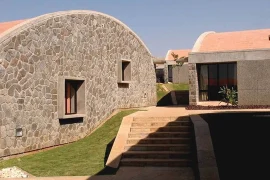
Mohatta Palace, located in the upscale area of Karachi, offers exquisite views of the sea and a serene environment with mature Bargad and Peepal trees. Mohatta Palace was built in the late 1920s and therefore is one the best illustrations of the Indo-Saracenic architecture. The structure is primarily constructed using carved stones from Jodhpur and Gizri, showcasing the luxury of its era and promoting the significance of social and political events. In contemporary times, the palace serves as the cultural centre and museum, a place of interest for tourists, researchers, artists and scholars alike. This article will delve into the multifaceted importance of Mohatta Palace, its impact on Karachi’s fragile urban fabric and its role as a harbinger of cultural heritage. Further, the architectural style, design approach, historical importance and regional influence will be topics of discussion, allowing you to experience a structure had on its people and its surroundings.

The Birth of Mohatta Palace
Architectural Splendour and Brilliance
Mohatta Palace was designed and constructed by Aga Ahmed Hussain in 1927 for the renowned Marwari Businessman. It was built as an abode of Shivratan Chandraratan Mohatta. Although officially referred to as Qasr-e-Fatimah in Pakistani government documents, locals have always known it as Mohatta Palace. Since its inception, it has been referred to as the “Taj Mahal of Karachi” but its story differs from that of the Taj Mahal. Shivratan commissioned this residence to protect his ailing wife, remembering it’s not a mausoleum but an abode of a loving couple. Doctors recommended Shivratan a location with sea winds for his wife’s betterment, and as an act of love, Mohatta Palace was created. This Palace is not just a labour of love, but also a symbol of dedication and a gift to the metropolis that is Karachi.
The residence encapsulated the infusion of multiple architectural styles primarily transformed and evolved from the genesis of Hindu, Islamic and Western elements. This architecture and design approach is called an Indo-Saracenic architectural style. This style had relevance to its era, as it was famous in India during the British Raj. It is a composition that depends on the infusion of architectural elements such as arches, domes, and intricate stone detailing on walls and windows.
Since the time of the British Raj, there has been a noticeable infusion of cultural elements and traditions from Western civilization, which is echoed in the architecture of this palace. The era encouraged the amalgamation of native and Western architectural practices elaborated in detail and intricate elements of Mohatta Palace. Karachi, during Raj, was a city burgeoning with trade and commerce, mirroring the cosmopolitan nature of the urban periphery in the choice of material, elaborate ornamentation and design approach.


Historical Significance of Mohatta Palace
The “Summer Home” of Shivratan Mohatta
Mohatta Palace was primarily used as a guest house or a “summer home” by the Marwari Businessman Shivratan Mohatta to prevent himself from the scorching heat of Karachi. The combination of pink Jodhpur stone with yellow Gizri stone helps mitigate the city’s heat and summer impact. The climatic responsive architecture aids in keeping the interiors cool. The palace features gardens, terraces, and patios that are adorned with statues of marbles symbolising the wealth correlated to the owner of the palace. The luxurious interiors adorned with pashmina carpets and intricate woodwork highlight the posh lifestyle of the city’s elite.
Strategic Political Landmark
Although the building and its surroundings are lauded for their architectural beauty and proportions and many papers and manuscripts have defined the social and cultural value it holds for the city, the palace was once a strategic ground for political campaigns and the development of plans in post-partition. By 1947, when India gained independence from British rule, the government of Pakistan acquired the palace. It was used as the formal office for political campaigns by the sister of Muhammad Ali Jinnah, Fatimah Jinnah. The palace was dubbed Qasr-e-Fatimah, which she promptly used for her presidential campaigns against President Ayub Khan. It was utilised by her sister Shireen Jinnah after her death and was sealed later in 1980.
She utilised this location for her political campaigns and strategic planning. The venue was used for hosting political meetings and other sophisticated informal gatherings. So, the change in era and partition of the state impacted the functionality of Mohatta Palace, once brimming with laughter and intimate gatherings of the Shivratan Family was turned into the political party office where the clicking sound of typewriters and political slogans had taken the reigns of time. In contemporary times, the day is more generous to its spaces accommodated with activities of exhibition and tourism, but as the night draws near it deplores the image of loss and sadness.
The Value of Mohatta Palace in Contemporary Times
A Cultural Hub and Its Urban Impact
In contemporary times, Mohatta Palace caters to a versatile audience, from researchers and historians to students and artists. The Palace is used as a cultural hub and museum, where exhibitions and educational programs provide diverse experiences to its users. It hosts competitions, historical artefacts, cultural relics, art shows, artist inspirations, and exhibitions, encapsulating this architectural marvel in various forms.
Due to its cultural and heritage importance, conservation activities have been carried out by the provincial government. So the Palace exuded its aura to its admirers, evoking memories of past design practices. Such constructive programs promote a deeper understanding of the architectural significance of the Mohatta Palace and its importance to the city.
Mohatta Palace contributes significantly to Karachi’s urban landscape by providing a tranquil garden oasis within the city’s chaotic design, making it an appealing tourist destination. The palace boasts city tourism, attracting tourists, researchers, and conservationists. The conservation efforts by the provincial authorities and the local architects have increased the practice of protecting other heritage buildings of Karachi, such as Zaib-Un-Nisa Street in Saddar, Karachi and Jinnah residence. Such efforts and enthusiasm towards preserving the city heritage promoted the urban renewal practices defined in the approval of Peoples’ Square near Burns Road and its cultural importance to its native people.

Mohatta an Architectural Splendour: Style and Symbolism
Indo-Saracenic Architecture
The style became famous and was adopted during the British Raj, primarily representing a fusion of Eastern and Western design elements. The Mohatta Palace perfectly encapsulates the architectural elements of Hindu and Islamic design, combined with the style philosophy of Gothic architecture, giving rise to Indo-Saracenic Architecture. The Palace showcases unique domes, intricate jharokhas (overhanging balconies), and arches with motifs and tile work, creating an ambience of the renowned style prevalent during the British Raj.
Symbolic Elements and Influence of Regional Culture
The Mohatta Palace showcases a blend of different architectural styles and symbolism. The domes reflect the grandeur and sophistication of Mughal architecture. The arches use Gizri and Jodhpur stone which gives the building natural beige and red hues, and are designed on principles of Gothic style capturing dominating yet subtle influence. The materials also represent the Rajasthani influence, making it climatically responsive, a feature not commonly seen in contemporary architectural practice. This fusion of architectural elements creates cultural harmony and enhances the aesthetic appeal of the Palace.

Mohatta Palace: The Genesis of Cultural Heritage Preservation
Restoration Effort
For years, the intricate details of Mohatta Palace and its damaged sections had been improved and maintained by vigorous efforts of conservation teams and through generous funding. The primary goal of the maintenance of this cultural site is to provide public access and educate them about the historical lives of Karachi’s elite. The area of damaged sections, restoring the original material and conserving the aesthetic beauty of Mohatta Palace had been the focus of restoration projects. These efforts aim to maintain the structural integrity and the aesthetic beauty of the Mohatta Palace not only making it a place of learning but also fostering a sense of heritage preservation in the youth of the city.
Educational Initiative
Mohatta Palace plays a significant role in educational initiatives. Currently, it also arranges workshops, seminars, conferences, and lectures on arts, history, and architecture. For this purpose, the programs are meant to involve youths in the fight towards conserving and restoring these cultural practices. The goal of such programs and seminars is to foster a sense of pride and ownership in youths for the cultural landmarks of Pakistan. It is the very idea which is gradually decimating our society. A wider goal for cultural preservation is maintained through these initiatives.
Study of Impact on Karachi’s Urban Fabric
A Heritage Landmark
Mohatta Palace holds a strong statement of preservation of beauty and heritage. It is one of the important landmarks of Karachi. The formal residence embodies the city’s heritage, protecting its rich historical past and evolution over the centuries. There is, no doubt, a need for an hour to protect and make efforts on historical sites during rapid urbanisation.
Tourism and Economy
The Palace is marked as a cultural and historical landmark of Karachi, aiding in promoting the vitality and economy of the area through the influx of tourists. People from different ethnicities and geographies visit this place seldom not only to learn but also to capture its ethereal beauty. Local hotels, restaurant businesses, shops and souvenir markets generate revenue through the influx of tourists maintaining the vitality of this area.
Cultural Vitalisation
The sense of cultural revitalisation has spurred around the peripheries and environment of the Mohatta Palace. The activities within the Palace such as educational programs, cultural festivals, and art exhibitions created a sense of community and thriving creativity in Karachi. Such thriving activities had attracted artists, scholars, and cultural enthusiasts infusing new life into the neighbourhood.
Mohatta Palace, for Karachi, is more than just a landmark. It represents cultural history and conservation practices adopted to maintain the past of this city. The architectural splendour of Mohatta Palace and its role as a cultural hub made it an irreplaceable asset to its city. The palace holds multifaceted importance as being a cultural hub, a historical monument, and a splendid museum which is contributing towards the economy and tourism of the city. Mohatta Palace continues to inspire and educate as the genesis of royal legacy and cultural heritage, ensuring that the rich history of Karachi is preserved for future generations.
Reference list:
Baharak Tabibi, A.S. (2021). COLONIAL BUNGALOW DESIGN IN THE TWENTY-FIRST CENTURY KARACHI: Cultural Identity Basis for Architectural Identity of Pakistan. [online] JRAP. Available at: https://jrap.neduet.edu.pk/arch-journal/JRAP_2021(SecondIssue)/02.pdf [Accessed 28 Sep. 2024].
Balouch, A. (2014). Mohatta Palace: A tale of love lost. [online] DAWN.COM. Available at: https://www.dawn.com/news/1122164.
From the Newspaper (2013). Mohatta Palace: some facts. [online] DAWN.COM. Available at: https://www.dawn.com/news/785947/mohatta-palace-some-facts [Accessed 29 Sep. 2024].
Mohattapalacemuseum.com. (2024). Jewel in the Crown. [online] Available at: https://mohattapalacemuseum.com/jewel%20in%20the%20crown.html [Accessed 27 Sep. 2024].
Salman, P. (2020). The successful journey of Mohatta Palace Museum. [online] DAWN.COM. Available at: https://www.dawn.com/news/1580894 [Accessed 29 Sep. 2024].
The (2021). ‘Mohatta Palace Museum has created a soft image of Pakistan’. [online] DAWN.COM. Available at: https://www.dawn.com/news/1655455 [Accessed 29 Sep. 2024].