The Birth of Navi Mumbai
The post-independence era in India was the beginning of new development and planning. Mumbai, a city developed and evolved from the Bombay Presidency (one of the three major provinces of the British Raj in South Asia, the others being the Madras and the Bengal Presidencies) which was an important British hub on the west coast of India, continued to be a magnet for people all over the country for employment opportunities after Independence in 1947. The post-independence period, roughly from 1951, saw an immense rise in the population of Greater Mumbai (the island of Mumbai) from three million to nearly six million. The growing decay of the quality of life amongst most of the population was of tremendous concern. In the light of this intensifying problem, the chairman, late Shri. V.N. Barve and his committee formed to study and enquire into the living conditions of workers, suggested creating a new focal point of employment opportunities on the mainland across the island of Mumbai, to draw away the masses from the over- populous city. Such was the inception of New Bombay, or what is called Navi Mumbai in the present day.
1971 saw the beginning of the planning of Navi Mumbai under leading architects and urban planners. Over the years, many villages were acquired, developed, and provided with infrastructure such as railway stations, roads, and public spaces. The purpose of this effort was achieved. This led to the formation of the Navi Mumbai Municipal Corporation by the state government to maintain the smooth running of the developed nodes of Navi Mumbai. The creation of NMMC was of utmost importance for the speedily developing city, as the population rose from 3,97,000 in 1991 to 7,50,000 in 2001.
It is interesting to study and analyse the details of the Head Office structure of NMMC, which was built in 2014 with the intent to architecturally depict the history, values, and purpose of the planned city.

Location
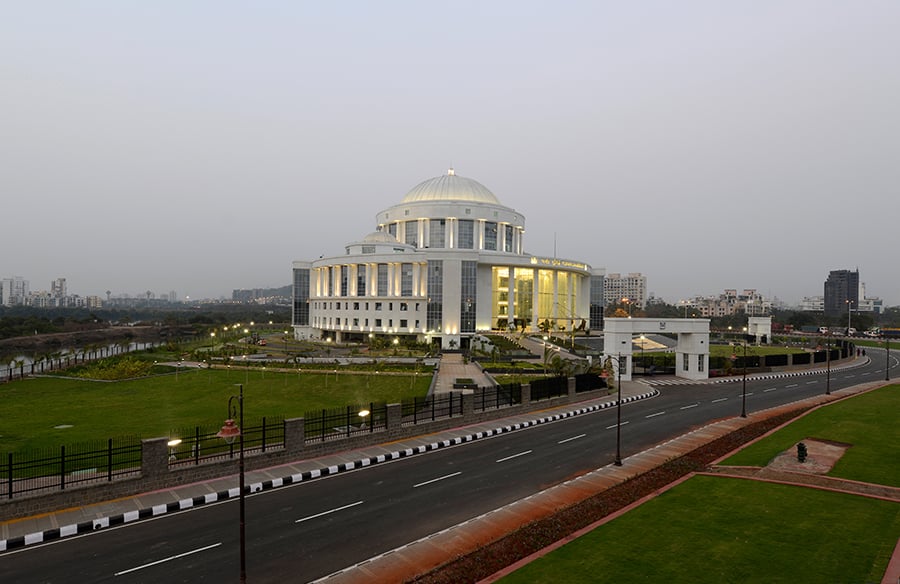
Having a plot area of 27,422 sq.m., the head office of NMMC is located in CBD Belapur, which is approximately in the centre of Navi Mumbai, hence approachable equidistantly from the entire city. The structure, designed by Hiten Sethi Architects, is prominently located at the intersection of two roads on the east and the south side, while the west and the north sides are flanked by green cover and a water body. The structure is the largest building in the area. This, along with no other structure overshadowing it, makes the head office visible from a great distance, creating many vantage points to view it.
Visually, this position and setting of the structure translates to strength. Metaphorically, it appears to be a strong and unwavering head person present in the centre, available for everyone to approach, as it is completely visible with no visual barriers. It provides the essential grandeur required for the head office of a planned city.
The decision to use a circular shape in the plan view is fitting, as it allows the structure to be uniformly visible from all angles. The cylindrical form, topped with a dome, maintains a consistent appearance from every elevation. Introducing corners would have resulted in varied elevations from different perspectives, but the circular design conveys a sense of equality and uniformity.

Design of the Structure
When approaching the structure from the main entrance, one gets an uninterrupted view of the symmetrical edifice. Symmetry portrays visual strength, discipline, and predictability, which is in line with the purpose of the formation of the corporation. Similarly, the white shade chosen for the structure symbolises purity. The main façade, clad in see-through structural glazing and supported by seven robust pillars, portrays transparency and openness.

With a built-up area of 33,259 sq.m., the form of the structure can be understood as two stacked cylinders, the one on the top having a smaller radius. Two smaller, adjacent cylinders flank the upper one, all capped by domes. This architectural design reflects the corporation’s power hierarchy. The building’s size diminishes as it rises, symbolising the flow of authority, which increases from the base to the top. The larger lower cylinder houses key functions, including cabins, workspaces, a cafeteria, an amphitheatre, and secondary areas such as spill-over areas and restrooms.


The entrance foyer is an imposing, triple-height atrium, featuring a reception and waiting areas, from where one can view all three floors above the ground floor, containing the various departments’ offices. Moving forward, a second, larger atrium is revealed, offering similar views. Centrally located within this space is an amphitheatre, symbolising openness and freedom of speech.

This thoughtfully conceived design boasts of significant engineering feats. The building provides 20m column-free office spaces on every floor through the use of post-tension slabs. One such beam spans an impressive 43.21m, making it the world’s largest of its kind. The dome which caps the top cylinder has set a national record for being the largest glass reinforced concrete dome, with a width of 37.31m and a height of 16.40m. The site also features a prominent area for flag hoisting, home to the tallest Indian flag mast, standing at 225 ft.
Sustainability
Considering the amount of heat generated by a structure of this magnitude, the building has been designed as a zero-discharge complex. It has been planned as earthquake-resistant, along with the incorporation of a rain-water harvesting system and a biogas plant. Additionally, the building is also registered with LEED– IGBC for Green Building Certification for GOLD rating.
Beyond the physical attributes of sustainability, the project also represents the core values of the corporation without unnecessary ornamentation. The design follows the principle of ‘form follows function’ promising longevity and strength for the years to come.
The NMMC Head Office stands as a testament to how intangible values such as transparency, openness, discipline, strength, equality, and freedom of speech can be translated into architectural elements that are both physically experienced and perceptible. This design exemplifies how architecture can serve as a medium to express the purpose behind the structure tangibly. It also highlights the unique synergy between the building’s form and the specific requirements of its space, location, site conditions, and surrounding urban fabric.