“With pride and love, she stands tall,
A sentinel amidst the city’s thrall.
Her head held high, watching all,
As we kneel before her crown adorned.
Spires and towers reach for the sky,
Bells singing tales that never die.
A beauty amidst the urban rush,
Through stained glass, a gentle hush,
Colourful rays weave stories bright,
A testament to her timeless light.
Arches towering, columns rise,
Aisles leading to celestial skies.
Hymns of Indo-Gothic splendour,
An artful masterpiece to remember.
Oh, how she stands with grace and might
A beacon in the day and night.
Our Lady of Dolours, pure and grand,
A wonder in this ancient land.”


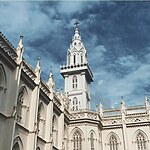
Our Lady of Dolours Basilica, popularly known as Puthanpally is more than a place of worship for the Christian community; it is a legacy of Thrissur, the cultural capital of Kerala. The soaring Bible Tower, visible from anywhere in the city, is a focal point and a remarkable standout in the bustling cityscape. The precinct is where everyone can find a spot, from the devotee to the local business owner. Beautifully crafted church, the Basilica was constructed in Indo-gothic style and is an architectural marvel.

Through the History
The origins of Our Lady of Dolours Basilica trace back to the late 18th century under the leadership of Sakthan Thampuran, the forward-thinking Maharaja of Cochin. In 1794, recognizing the importance of a diverse community for urban development, he relocated 52 Syrian Christian families to Thrissur from Aranattukara, Ollur, and Kottekkad, symbolising the enduring presence of the Apostle in Kerala.
In 1814, with the endorsement of Archbishop Dominicos, the first Catholic church named Our Lady of Dolours was built. Initially under the Cranganore (Kodungallur) Archdiocese, the church came under the Bishop of Verapoly’s jurisdiction following a papal proclamation in 1838.
The arrival of Persian Catholic Bishops Rocos and Melus in the 1860s caused temporary schisms, but unity was soon restored. In 1886, Pope Leo XIII restructured the church hierarchy in Kerala, creating the Syro-Malabar Vicariates of Trichur and Kottayam, and appointing Adolph Medleykot as Trichur’s first bishop. Despite losing their original church, the Catholic community received royal approval from Maharaja Ramavarma of Cochin on October 8, 1925, to construct a new church.
The New Church: Construction and Design

On October 21, 1929, Bishop Mar Francis Vazhappilly laid the foundation stone for the new church. The construction, which spanned eleven years and culminated in the largest church in Asia, was expertly overseen by renowned engineer Jnanaprakasam and superintendent Ambros. Their combined expertise ensured the successful realisation of Bishop Vazhappilly’s ambitious vision. A significant contribution came from the Maharaja of Cochin, who donated teak wood in 1935, which was crucial for the construction.
Consecrated on November 24, 1940, by Bishop Mar Francis Vazhappilly, the church initially fell under the jurisdiction of Lourdes Cathedral. It was later designated a parish on September 17, 1978, and became the headquarters of a forane division in 1980.
Architectural Features and Design Elements
Indo-Gothic Grandeur: A Splendid Fusion
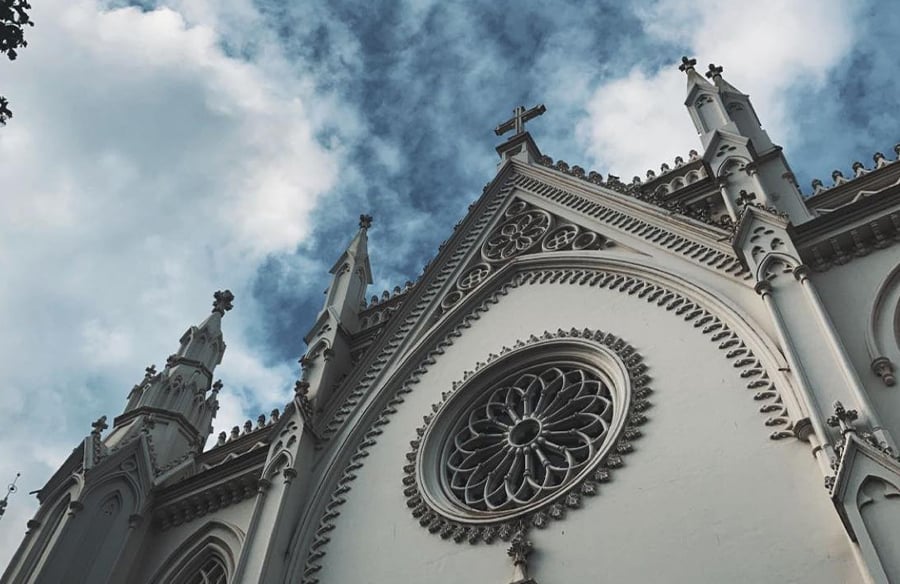
As a stunning example of Indo-Gothic style, this cathedral boasts tumbling lancet arches, intricate rosette windows, and rose glasses in bright colours that are characteristic of the Gothic style, but seamlessly blend with traditional Indian ones to produce a breathtaking architectonic marvel. The high delicate spire which reaches 261 feet from ground level creates such a strong silhouette against the sky that it easily overshadows flanking belfries at 146 feet each. A footprint of approximately 23,000 square feet emphasises the sheer size of the basilica.
Exterior; A Collage of Influences
The entrance facade takes cues from a mediaeval Gothic cathedral, with tall spires and graceful pointed arches. But, if one observes closely; he shall find a fascinating symbiosis of different cultures. It is achieved through detailed carving and similar motifs that are reminiscent of Indian patterns and represent a blending between East and West. Indeed, such careful amalgamation is what characterises Indo-Gothic aesthetics.
Interior

The interior boasts an impressive volume with a Latin cross plan, dominated by a large central element. Two-story side aisles flank it, and eleven altars adorned with artistic murals, icons, and statues line the space. High ceilings and natural light bathe the interior in a tranquil, spiritual atmosphere. Stained glass windows cast colourful symbols while filtering soft light, and soaring arches and columns draw the eye upwards, amplifying the sense of grandeur and sacredness.
Bible Tower

Piercing the sky, the basilica’s crowning glory is its 260-foot Bible Tower. This architectural marvel transcends mere structure, serving as a potent spiritual symbol and a commanding visual landmark. Within its walls, a curated collection of Christian art unfolds the captivating narrative of Jesus’ life and the early church. This treasure trove not only elevates the tower’s significance but also adds a profound dimension to the basilica’s architectural and cultural identity.
A Beacon of Faith and Fusion: Our Lady of Dolours Basilica
Our Lady of Dolours Basilica is one of the most fabulous architectural beauties in Kerala and manifests a perfect mixture of Indian and Gothic styles. From its towering spires to the vast footprint…these mind-blowing dimensions all add up to reverence. Yet hidden amongst this grandeur are fine details that give stories of skilled craftsmanship and culture. It stands as an embodiment of not just simply eternal loyalty, but also lasting architecture.