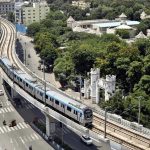
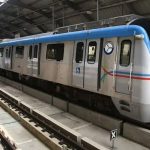
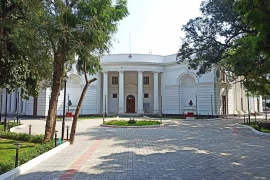
The Hyderabad metro rail project was approved by the Union government in 2003. its construction work which was to start on 3 March 2011, started in 2012. Groundbreaking for the project took place on 26 April 2012. It was opened on 29 November 2017, and its initial estimated cost is 14,132 Crore. The state Government decided to bear 10% of it, while L & T bear the remaining 90% of the cost. When its project started (2012), its cost was 15,957 crore. This has been further revised upwards to 18800 crores. ( November 2017). Larsen & Toubro (LT) builds Hyderabad metro. Larsen & Toubro is a special-purpose vehicle company.
Hyderabad Metro is the world’s largest public-private partnership (PPP) project in the metro sector. The Hyderabad metro project won the best engineering project in 2013 at the sixth annual global infrastructure leadership forum conference in New Work. It is a 72 km long metro line. 57 metro station in Hyderabad metro. Ameerpet metro station is a big metro station in Hyderabad.
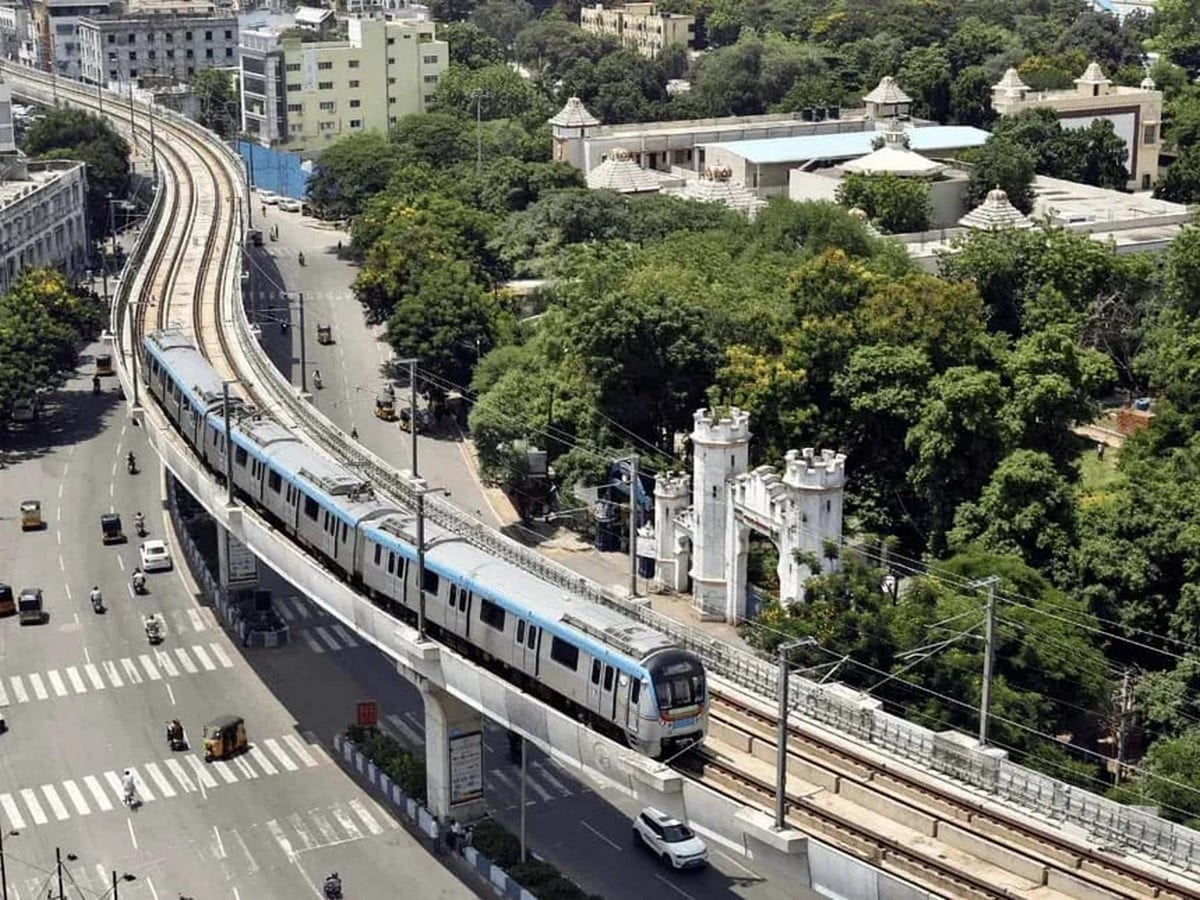
Its construction work was undertaken in two phases:-
Phase I
The project consists of 3 lines covering a distance of approximately 72 kilometres. The metro rail line between Nagole and Secunderabad was initially scheduled to open by December 2015, it was partially opened on 29 November 2017, and the 67 km phase 1 was completed in 2020. Earlier in 2010, all India Majlis-e-ittehadul Muslims suggested an alternate route for the metro in the old city via Purana Dul, muslimjung, bahadurbura, Zoo Park, Tadbun Junction, Kalapathar, Misriganj, and Shamsheerganj to Falaknuma in the old city but this route was not accepted.
In June 2022, Hyderabad Metro Rail began a new survey of MGBS to the old city route for underground utilities.
Line 1 is the red line – in this Miyapur – LB Nagar, 29 km and 27 stations
Line 2 is the green line – In this JBS – Falaknuma, 15 km, and 15 stations
Line 3 is the blue line – in this angle – raiding 28 km and24 stations
Phase II
It will be completely constructed by the state government instead of the Public-Private Partnership(PPP) mode in Phase I. The Delhi Metro Rail Corporation (DMRC) was tasked with giving a Detailed Project Report(DPR) for the second phase. The metro rail phase II expansion plan is about 63 km, including a link to Shamshabad RGI Airpot. In November
2022, the Telangana Government asked the central government to approve metro Rail Phase-II, jointly owned by Telangana and the centre, with external financial assistance. The Government of Telangana proposed metro rail connectivity from BHEL to Lakdikapul for about 26 km with 23 stations and an extension from Nagole to LB Nagar covering a distance of about 5 km with four stations. The Telangana government has asked the central government to sanction 8,453 crores for metro works in the upcoming union budget for 2023-24. Airport metro limited and HMDA will build an upgraded Hyderabad bus rapid transit system between kokapet nepolis and KPHB colony metro station, covering a distance of 20 km. In March 2023, KT Rama Rao said the metro line from Nagole would be extended to LB Nagar, which would be further extended to Hayathnagar. The centre has pointed out shortcomings in the Telangana government’s plan to construct the BHEL-Lakdikapul and Nagole to LB Nagar metro routes. In the future, LB Nagar will be extended up to Rajiv Gandhi International Airport, shamshabad. The Hyderabad airport metro limited company was incorporated on 26 March 2018 to develop the Hyderabad airport metro express. There are nine elevated stations and one underground station on the way to the airport. 27 km elevated, 1km on-ground, and 2.5 km underground sections are proposed to connect the Airpot terminal with the 31 km Airpot express metro corridor. To be built at a cost of about 6,250 crore. Telangana chief minister Chandrasekhar Rao did the groundbreaking for the airport express line on December 9 2022.
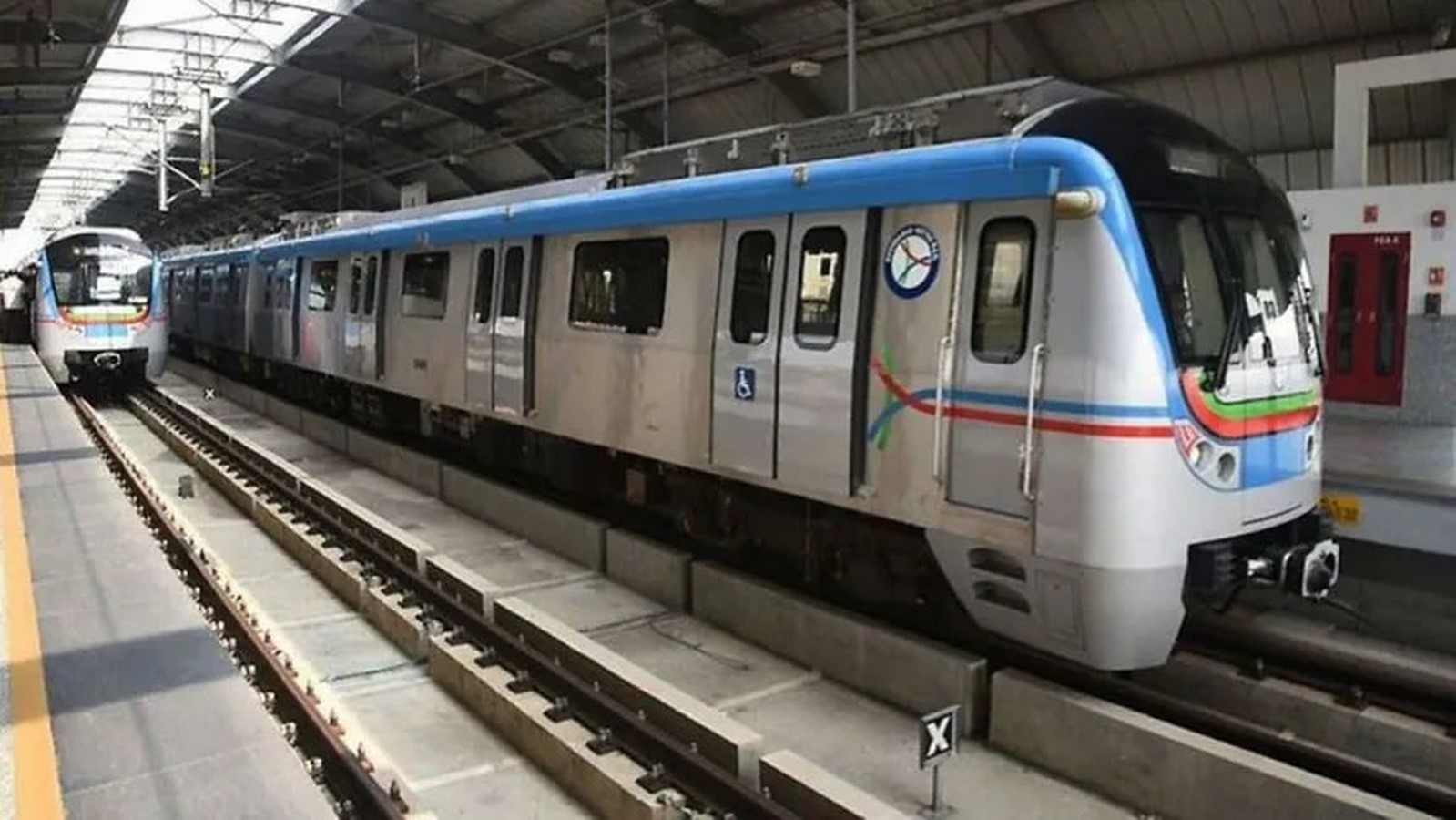
4.50 lakh people use the Hyderabad metro daily. Raidurg, Ameerpet, and LB Nagar are the busiest metro stations in the Hyderabad metro. Hyderabad metro rail will earn two billion Indian rupees in the year 2021. its websites L & T Metro and HMRL. Its average speed is 35 to 40 km/h, and its top speed is 80km/h. KVB is the chief executive officer & managing director (MD) of Hyderabad metro rail. Hyderabad metro was suffering losses due to low ridership. The L&T company lost 1,745.85 crores in 2021-22 in the Hyderabad metro project. Hyderabad metro’s total length is 67.21 km (operational), 5.5 km (under survey) 63km (phase 2 DPR submitted). It has World class station buildings almost every kilometre. It connects major office, retail and residential areas. Its 2tracks pass through the city’s main roads and link to MMTS services at Bharatnagar, Falaknuma, khairatabad, and malakpet. GoAP plans a feeder bus service from different city areas to the station. Hyderabad metro rail has planned three maintenance facilities to stabilise and maintain trains, train systems, and engineering maintenance vehicles. Each line has an auxiliary depot where all trains on that line will be stationed at night. These maintenance depots are manned round the clock and are equipped with all facilities and resources required for efficient and effective maintenance of rail system assets. Covered & open stabling lines, automatic train wash plant, electronic repair shops, training, conference rooms, cafeteria, depot control centre, electrical & mechanical facilities, and wheel profiling lathe these some major facilities in Hyderabad metro depots. Hyderabad Metro did its first trial run of 8 km in 2014.
After just 2.5 years of construction, the Hyderabad Metro Rail (HMR) completed its maiden trial run on the viaduct in July 2014 over an eight-kilo-meter section between Nagole and Mettuguda.
There are six stages to the delivery of the whole Hyderabad Metro project. AECOM team’s creative station designs ensured that construction caused the public the least amount of disturbance possible. As a result of our energy-saving features and creative metro design concepts, such as using a single pier in the middle of the road to support the elevated viaduct and stations, less space was needed, which made it possible to build larger roads and pathways. At the sixth annual Global Infrastructure Leadership Forum Conference in New York, the project was named the Best Engineering Project of the Year for 2013.
When the 72-kilometre metro rail is finished in December 2017, it will include three elevated corridors of standard gauge track, 64 stops, and three depots. It is the biggest public-private partnership (PPP) project ever undertaken in the metro area. It is intended to have a capacity of 35,000 PHPDT for Corridor II and 50,000 PHPDT for each corridor I and III during peak hours.
https://metrorailtoday.com/article/hyderabad-metro-phase-i-project-information-cost-contractors-and-system-details
AECOM handled preliminary design, bid preparation, and bid assessment. The company is now working on design review, construction supervision (except civil), inspection, testing, and commissioning of the entire project.
Three high-density train routes will be delivered using a public-private partnership approach as part of India’s US$17.6 million Hyderabad Metro train project.
LA (24 February 2011) — The Hyderabad Metro Rail project in India has awarded AECOM Technology Corporation (NYSE: ACM), a top provider of professional technical and management support services for government and commercial clients worldwide, a five-year, US$17.6 million planning and design contract.
As the owner’s engineer for the Public-Private Partnership (PPP) project, which employs a design, build, finance, operate, and transfer model, AECOM will handle interface management, including inspection, testing, and commissioning of the project, as well as overall planning and conceptual design of the systems, design review, system assurance, and system integration. The project involves building, operating, and maintaining three high-traffic-density metro rail lines in Hyderabad, the state capital of Andhra Pradesh, with 66 stations and around 45 miles of elevated train viaduct.
This project was awarded to AECOM, acting as the consortium’s lead, together with Feedback Ventures Private Limited by the concessionaire, L&T Metro Rail (Hyderabad) Limited, a Larsen & Toubro Limited subsidiary.
AECOM President and Chief Executive Officer John M. Dionisio remarked, “AECOM is happy to play a role in improving India’s transport infrastructure and seeing such an initiative being executed using the PPP model.
The Government of Andhra Pradesh approved a concession for the Hyderabad Metro Rail project.
It’s anticipated that the Metro Rail will start running in 2016.
References:
https://aecom.com/projects/hyderabad-metro/
https://en.m.wikipedia.org/wiki/Hyderabad_Metro
https://www.ltmetro.in/hyderabad-metro-rail/project-highlights/depots/
https://publications.aecom.com/rail/projects/hyderabad-metro
https://investors.aecom.com/static-files/0ede4f9d-98e6-4d27-a04c-3d01aca71ad3