The Panama Canal is bestowed the honour of being one of the Seven Wonders of the Modern World by the American Society of Civil Engineers. The canal contributes to 6% of global trade and plays a critical role in transporting primarily petroleum products, motor vehicles, grains, coal, and coke between the East and West coasts. Since the expansion in 2016, the Panama Canal has carried an average of 14,000 ships every year.
The canal has a speculating and dramatic history that dates back to the 1880s.

French Roots of the Panama Canal
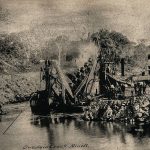
Initially, the maritime trade between the East and West coasts took place by the ships carrying a journey around the Southern tip of South America, Cape Horn. The trip was roughly 8,000 nautical miles. Ferdinand de Lesseps, a French diplomat who was at the forefront of the construction and success of the Suez Canal, saw potential in the Panama isthmus; he was the father of the idea of constructing this humongous, earth-moving engineering project which could change the economics of the then existing and future shipping business. In contrast to the geographical features surrounding the Suez Canal, the Panama Canal site was nestled in mountains covered with rainforests and wetlands, home to thousands of wildlife species. The French started the construction in 1881 with the concept of designing a sea-level canal. The construction began, and more than 22,000 workers died on-site due to the ruthless spread of malaria and yellow fever. The funding for this project stopped in 1888, and the French finally gave up after seven years of trying.
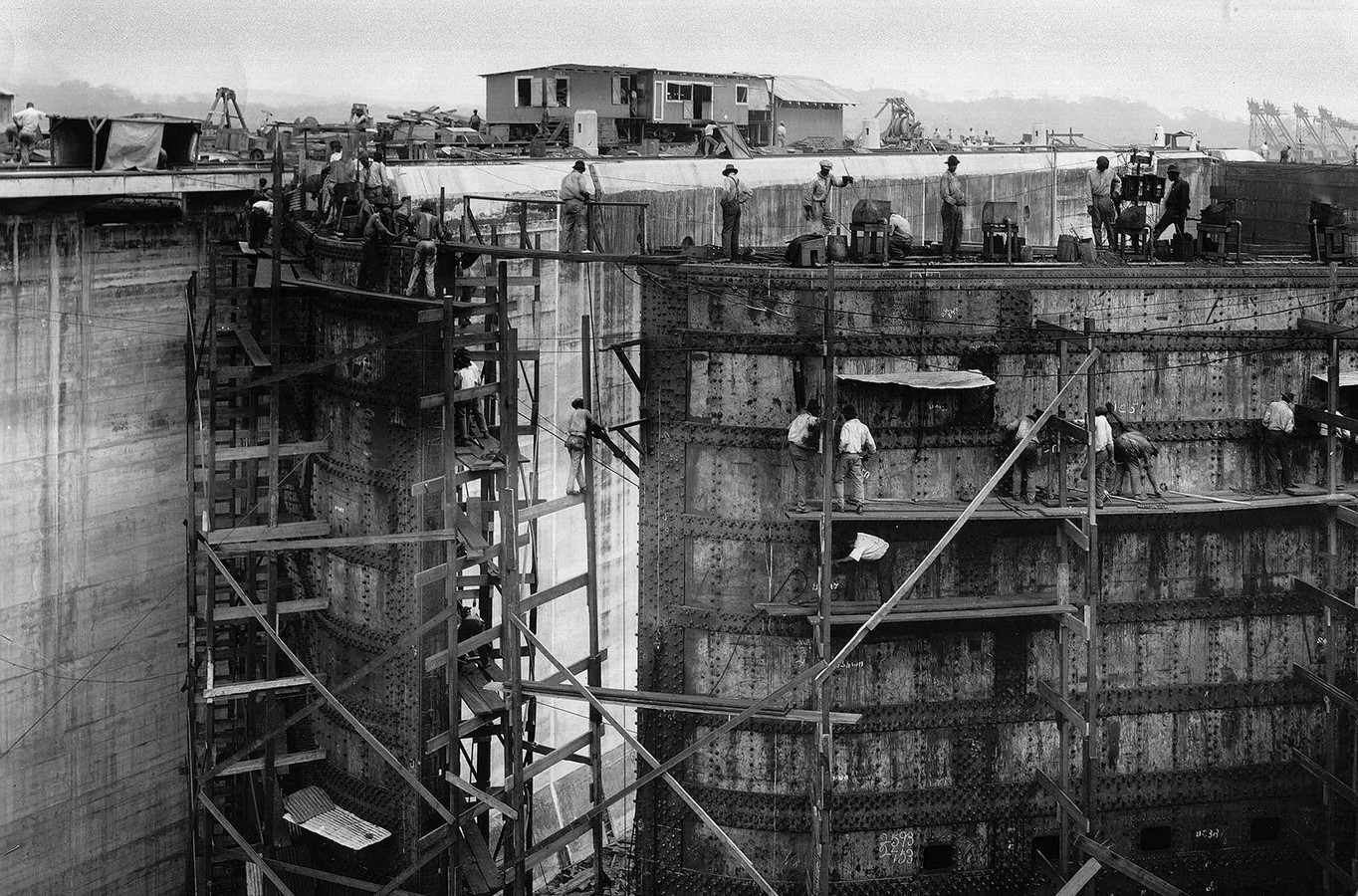
The American Takeover
After the French surrendered the canal construction, considering the deteriorating health of the laborers and the alarming deaths, the United States purchased the French assets in the work-in-progress canal zone for $40 million in 1902. US President Theodore Roosevelt took swift action, recognized The Republic of Panama, and signed the treaty of Hay-Bunau-Varilla granting America exclusive and permanent possession of the Panama Canal Zone in 1903. Panama, in exchange, received $10 million and an annuity of $250,000 beginning nine years later. Under the supervision of chief sanitary officer Dr. William Gorgas, immediate stringent measures were taken to elevate the working conditions on the construction site. Quinine was administered to the workers, recognizing the grassroots culprit of the fatal diseases. Swamplands were drained, and grasslands near the workers were grazed to eliminate mosquito breeding grounds. The medical success laid the foundation for the engineering marvel.
The Panama Canal Design
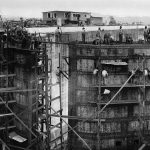
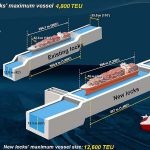
The construction revived by the US government started in 1904; approximately 300 million yards of dirt and rock were excavated, handling the massive never-ending landslides on the textured land. The sea-level canal design was scrapped, and a new invention with lock systems was designed and executed. The ships were carried between the Atlantic and Pacific oceans through Gatun Lake, the reservoir constructed over the Chagres River, to ensure a constant water supply for the functioning of the gigantic locks. The canal stretched for 51 miles; the locks measured 110 feet in width, 1000 feet in length, and 41.2 feet deep in draft. The term ‘draft’ indicates the vertical distance from the water surface to the bottom of the ship’s hull. The vessels designed to pass through the Panama bottleneck were labeled ‘Panamax ships.’ The required measurements of Panamax ships were limited to 106 feet in width and 965 feet in length, along with a draft of 39.4 feet. The vessels moving through the passage between the locks were held in place with mild setbacks by the four locomotives riding along, two on each side.

Expansion of the Panama Canal
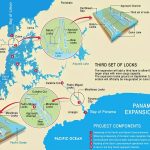
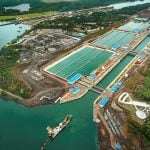
Studying the increasing load on the canal, which concentrated on the United States maritime industry, the Panama Canal Expansion was proposed in 2006. The ‘Third Set of Locks’ project was finalized in no time, and its construction commenced in 2007. The lock systems in the expansion project varied from the old design; instead of feeding them through the natural flow of water to keep vessels afloat, an introduction of water reservation basins was done on both the Atlantic and Pacific mouths, with the intention of a sustainable approach to bring in reusability, in turn lessening the pressure on the adjoining rivers. The Panama Canal now sustains successfully, hinged on the Gatun and Agua Clara locks on the Atlantic side and Pedro Miguel, Miraflores, and Cocoli locks on the Pacific Ocean side.
The locks on the Atlantic and Pacific sides are 70 feet wider and 18 feet deeper than the old waterways. The measurement of the locks in this new second lane is 1,400 feet in length and 180.5 feet in width with a 60 feet draft. The larger ‘New Panamax’ or ‘Neo Panamax’ ships are fabricated to travel across this wider lane with the requirements to be no more than 1,200 feet in length, 160.7 feet in width, and with a draft of 49.9 feet. These vessels use four tugboats to guide themselves through the canal. The basic principle of gravity and buoyancy remains constant in the expanded canal design and old design.


Future of Panama Canal through the Sustainability Lens
The construction of this iconic Canal welcomed uninvited invasive species from different coasts, which were harmful to the native ecosystems of Panama from the initial days of its work till date. The use of the canal significantly reduced the carbon footprint of the shipping industry on a global level, but due to traffic congestion in regions of the canal’s vicinity, a deterioration in the surrounding ecosystems is observed. Due to climate change and the recent El Nino event, the place has seen its driest monsoon in the year 2023, leading to the evaporation of Gatun Lake and the water reservoir basins at the locks, unwinding a heavy toll on the maritime business with the disruption in the working of the canal. With the exponentially increasing burden on the existing canal, it is expected that a new canal might be considered to be built for a smooth shipping experience, leaving the Panama Canal, distinguishably one of the busiest waterways, with some slack!
References
- Online sources
Port Economics, Management and Policy. (2019). Comparative Characteristics of the Panama Canal Expansion | Port Economics, Management and Policy. [online] Available at: https://porteconomicsmanagement.org/pemp/contents/part1/interoceanic-passages/characteristics-panama-canal-expansion/ [Accessed 2 Sep. 2023].
Donovan, J. (1970). How the Panama Canal Makes Water Flow Uphill. [online] HowStuffWorks. Available at: https://science.howstuffworks.com/engineering/structural/panama-canal.htm?srch_tag=z7qdjblyw2taxsp6woo7heqojz4rbaha [Accessed 28 Aug. 2023].
Kingsland, P. (2018). Panama: the environmental legacy of the world’s key canal. [online] Ship Technology. Available at: https://www.ship-technology.com/features/panama-environmental-legacy-worlds-key-canal/?cf-view [Accessed 29 Aug. 2023].
Appleton, A. (2015). Panama Canal: Superhighway for Invasive Species? [online] History. Available at: https://www.nationalgeographic.com/history/article/150223-panama-canal-expansion-invasive-species-environment.
Livingstone, G. (2022). Climate change is impacting the Panama Canal — and the trade that moves through it. [online] Marketplace. Available at: https://www.marketplace.org/2022/09/05/climate-change-is-impacting-the-panama-canal-and-the-trade-that-moves-through-it/ [Accessed 29 Aug. 2023].
Baertlein, L., Parraga, M., Baertlein, L. and Parraga, M. (2023). Focus: Historic drought, hot seas slow Panama Canal shipping. Reuters. [online] 21 Aug. Available at: https://www.reuters.com/business/environment/historic-drought-hot-seas-slow-panama-canal-shipping-2023-08-21/ [Accessed 1 Sep. 2023].
Moreno, E., Parraga, M. and Parraga, M. (2023). Panama Canal’s bottleneck eases, some vessels detour. Reuters. [online] 22 Aug. Available at: https://www.reuters.com/world/americas/panama-canals-bottleneck-eases-some-vessels-detour-2023-08-22/ [Accessed 30 Aug. 2023].
GoComet (2023). The Panama Canal Drought Of 2023: A Comprehensive Analysis. [online] GoComet. Available at: https://www.gocomet.com/blog/panama-canal-drought/#:~:text=Future%20of%20Panama%20Canal%20Unclear [Accessed 1 Sep. 2023].
Budner, A. (2023). Climate crisis impacting global trade through Panama Canal. [online] Marketplace. Available at: https://www.marketplace.org/2023/07/31/panama-canal-climate-change-drought/ [Accessed 1 Sep. 2023].
Daniel, R. (2016). Panama Canal opens its gates to more and larger vessels. [online] pp.2–16. Available at: https://www.researchgate.net/publication/310707907_Panama_Canal_opens_its_gates_to_more_and_larger_vessels_in_English_Inzynieria_Morska_i_Geotechnika_Maritime_Engineering_Soil_Technology_No_42016_Gdansk_JulyAug_2016 [Accessed 30 Aug. 2023].
History.com Editors (2018). Panama Canal. [online] HISTORY. Available at: https://www.history.com/topics/landmarks/panama-canal [Accessed 1 Sep. 2023].
Pratesi, G. (2019). What Are Panamax and Post-Panamax Cruise Ships? [online] www.cruisecritic.com.au. Available at: https://www.cruisecritic.com.au/articles/what-are-panamax-and-post-panamax-cruise-ships?stay=1&posfrom=1 [Accessed 30 Aug. 2023].
- Images/visual mediums
Citations for YouTube videos:
TomoNews US (2014). Panama canal expansion: how it works. YouTube. Available at: https://www.youtube.com/watch?v=cB3tfM7ISgY [Accessed 2 Sep. 2023].
Top Luxury (2020). Panama Canal: The Biggest Megaproject in History. YouTube. Available at: https://www.youtube.com/watch?v=K_XIX8d_om8 [Accessed 2 Sep. 2023].
Harris, J. (2021). Control The Choke Point: How The US Stole The Panama Canal. YouTube. Available at: https://www.youtube.com/watch?v=D_PtYPnKBJs [Accessed 1 Sep. 2023].
Hilario, V. (2018). Megastructures Panama Canal – Extreme Engineering (2018 Documentary). YouTube. Available at: https://www.youtube.com/watch?v=Dp8hlIn7eFQ [Accessed 31 Aug. 2023].
The B1M (2016). Expanding Panama Canal with BIM | The B1M. [online] www.youtube.com. Available at: https://www.youtube.com/watch?v=B48CkD8b1QA [Accessed 30 Aug. 2023].
marineinsight (2022). Why Panama Canal is Important? YouTube. Available at: https://www.youtube.com/watch?v=ao5jNSd1CwU [Accessed 28 Aug. 2023].
The Panama Canal (2014). Difference Between Panama Canal New Locks Project Proposals. [online] www.youtube.com. Available at: https://www.youtube.com/watch?v=L2x3WTb5Jn8 [Accessed 1 Sep. 2023].
Citations for images/photographs – Print or Online:
thepanamacanal (2016). https://twitter.com/thepanamacanal/status/733407219081863169/photo/1. [online] X (formerly Twitter). Available at: https://twitter.com/thepanamacanal/status/733407219081863169/photo/1 [Accessed 3 Sep. 2023].
Lindahall.org. (2023a). Building the Panama Canal- French Attempt. [online] Available at: https://panama.lindahall.org/wp-content/uploads/sites/2/2014/08/panex2712e-cropped.jpg [Accessed 31 Aug. 2023].
Wayne , B., Burton, G., Padelford, N., Worthington, W. and Aileen , C. (2023). Panama Canal. [online] (Last updated 31 Aug 2023) Britannica.com. Available at: https://cdn.britannica.com/82/71082-050-AF372A0C/Men-locks-Panama-Canal.jpg [Accessed 3 Sep. 2023].
Daniel, R. (2016). Panama Canal opens its gates to more and larger vessels. [Online report] ResearchGate. Available at: https://www.researchgate.net/figure/Map-of-the-Panama-Canal-Expansion-Project_fig1_310707907 [Accessed 29 Aug. 2023].
U.S. Army Corps of Engineers, I. for W.R. (2012). U.S. Port and Island Waterways Modernization: Preparing for Post-Panamax Vessels. [Online Document] Institute for Water Resources . Available at: https://www.iwr.usace.army.mil/portals/70/docs/portswaterways/rpt/june_20_report_summary_u.s._port_and_inland_waterways_modernization.pdf [Accessed 8 Sep. 2023].