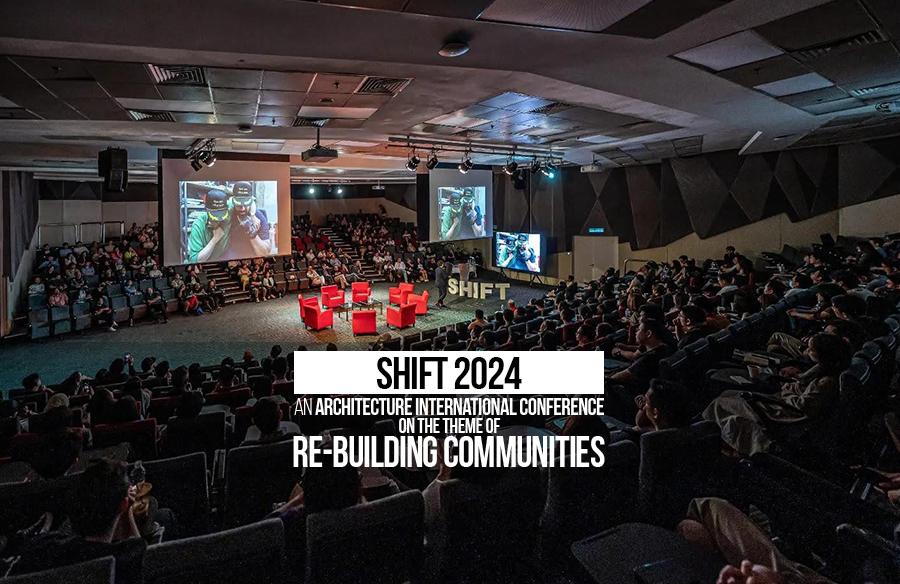
The SHIFT 2024 International Architecture Conference was held in Taylor’s Lakeside Campus on the 21st and 22nd of September. Organised by DOMA Initiatives Architecture Foundation and supported by the Aga Khan Award for Architecture and Taylor’s University, curators Ar. Chan Mun Inn and Dr Veronica Ng convened nine architectural practices from across the region to discourse on “rebuilding communities”.

As part of the conference, DOMA collaborated with the Aga Khan Award for Architecture AKAA to have a special session called the AKAA Forum Discussion and a satellite exhibition at the GDP Campus in collaboration with GDP Architects. The exhibition served as a compendium that aims to heighten awareness of the importance of architecture in bringing positive impact to communities.
A discourse on re-building communities
SHIFT 2024, a conference with a global impact, explored the theme of rebuilding communities. Today, the relationship between “architecture” and “community” is inextricably complex and evolving. The diverse contemporary conditions and circumstances of the 21st century impact how the notion of “community” is defined. On the one hand, the impact of technology, such as social media, has enabled virtual communal space, forming global communities across borders and continents. These circumstances have opened up a contemporary discourse on the role of architecture in building communities. Conversely, globalisation, migration, and climate change have resulted in concepts of local communities, displaced communities, and resilient and contested communities. It is this intertwined relationship that the SHIFT 2024 International Architecture Conference humbly explored.

On the first day, Pacharapan Ratananakorn and Varat Limwibul from PAVA Architects, Thailand, were the first speakers to open the session with their talk, Reviving in Progress, touching on time and context. The projects touched on the importance of designing with people, the senses, and the sensibilities of the geographical, social, and environmental contexts. Subsequently, Jay Chiu from AxB, Taiwan, continued his talk on indirect mutualism, defined as an exchange of sight between closed and open systems observed through the everyday phenomenon of cities. He presented an in-depth Experimental Building No. 1, articulating the indirect coexistence between the museum/gallery space and the bookstore.
The afternoon segment continued with a talk from Samira Rathod, who shared her community-based projects in India. She began with the School of Dancing Arches, One Tree Hill Community Centre. Then, she narrated how she worked with local communities to complete the design for the Pavilion for Kochi Muziris Biennale Foundation. Yerin Kang and ChiHoon Lee from the Society of Architecture, South Korea, continued with the broad question of: “What is community?” They explored how spaces can contribute to sustaining community in everyday life, including urban insertions such as Garden Collective, Mirae Nongwon Public Garden, Madang as Urban Void, Yoonseul Inverted Courtyard, Shinchon Community Centre and Park for the Youth and Sung-su Silo: A shared factory for urban small manufacturers. The first day of the conference ended with the final speaker, Chang Huai-Yan, from Salad Dressing, Singapore. He passionately shared his appreciation of the beauty of tropical Asia, inspired by his times with Made Wijaya in Bali and a series of landscape projects that explore the sensory aspects of space through immateriality and building with plants.
The second day began with a talk from SHAU, Nicolas Moreau, and Hiroko Kusunoki, Moreau Kusunoki. Architect couple Daliana Suryawinata and Prof. Dr. Florian Heinzelmann are known for their performance-driven environmental and societal design agendas. They shared public space projects in West Java and the micro libraries—a series of contextually designed, low-cost, and environmentally friendly reading facilities. Next, Nicolas and Hiroko shared several projects—Guggenheim Helsinki, Powerhouse Parramatta Museum, and the reconversion of Centre Georges Pompidou in Paris—fueled by the belief that architecture is best conceived through reserve and introspection. This allowed for the emergence of poetic visions aimed towards an architectural ‘in-between’ that empowered future users to activate and appropriate this, ensuring the projects’ relevance and value over time.

The Aga Khan Award for Architecture Discourse
The afternoon continued with the AKAA segment, a unique and inspiring part of the conference. Led by two speakers who were winners of the Aga Khan Award for Architecture in the 15th Cycle: Ahmadreza Schricker from Ahmadreza Schricker Architecture ASA presented about his practice and the AKAA winning project – Argo Contemporary Art Museum and Cultural Centre, Tehran, Iran; and Nicolas Fayad from East Architecture Studio presented his winning project on the Renovation of Niemeyer Guest House, Tripoli, Lebanon.

Subsequently, the session concluded with the AKAA Forum Discussion. Led by Farrokh Derakhshani, Director of the Award. The forum panellists were Laurence Loh, Kevin Mark Low, Kamil Merican, Nicolas Fayad, and Ahmadreza Schricker. Farrokh began by recounting his encounters with the panellists. The discussion was framed around the nexus of the meticulous processes of shortlisting, review and jury of the AKAA. Arising from the discourse are a few key themes.
The first was the meticulous review of each project, which was shortlisted. Recalling his experience as a reviewer for the awards, Laurence Loh commented on the tradition of AKAA, which paid a lot of attention to the proof of the project’s validity and eligibility. He reinforced the importance of understanding the spirit of the place in appreciation of cultural heritage. He recalled going to Geneva and presenting to the panel with other evaluators who were photographed and videographers and how the process changed his perception of understanding others’ culture and heritage. Kevin echoed this importance and reinforced the importance of self-honesty instead of ego as a reviewer – as a reviewer, one is not to look but to analyse.
The second theme that emerged from the discussion was the uniqueness of the AKAA. Kamil, who has been part of the AKAA steering committee, a technical reviewer, and a past award winner, commented that only 1-2% of work is unique when we travel in cities and spaces. This uniqueness, he referred to, was the story of each building.
The third theme was the process. Farrokh explained the attitude of the awards, particularly the nomination, review, and jury processes. He reminded me that the award is given to the building, and the architect is the person who negotiates between the client, craftsmen, and builder and gives credit to them as part of the process.
The AKAA 15th Cycle Exhibition

The evening of 21st September also saw the AKAA 15th Cycle Exhibition launch held at the GDP Campus and open to the public for two weeks from September 23rd – October 6th, 2024. The AKAA 15th Cycle Exhibition, held in conjunction with the Forum, displayed the six winning projects, which illustrated promise for communities, innovation and care for the environment. They were the Urban River Spaces, Jhenaidah, Bangladesh; Community Spaces in Rohingya Refugee Response, Cox’s Bazar; Banyuwangi International Airport, Blimbingsari, East Java, Indonesia; Argo Contemporary Art Museum and Cultural Centre, Tehran, Iran; Renovation of Niemeyer Guest House, Tripoli, Lebanon; and Kamanar Secondary School, Thionck Essyl, Senegal.

The ethical role of architecture is to recreate places for people. Conferences such as SHIFT 2024 and the AKAA Exhibition became platforms to initiate a rethinking of how this role is familiar yet different, flexible yet fixed. While diverse architects and designers from other cultures and backgrounds, as well as building typologies, create architecture and built environments that are unique to a place, they are consistent in their commitment to bringing together people and offering a sense of place.
References:
Doma Initiatives (2024). SHIFT 2024. [online]. Available at: https://www.domainitiatives.org/shift2024[Accessed 2 October 2024]
AKDN (2022). Winners of the 2022 Aga Khan Award for Architecture announced. [online]. Available at: https://the.akdn/en/resources-media/whats-new/news-release/winners-of-the-2022-aga-khan-award-for-architecture-announced [Accessed 2 October 2024]