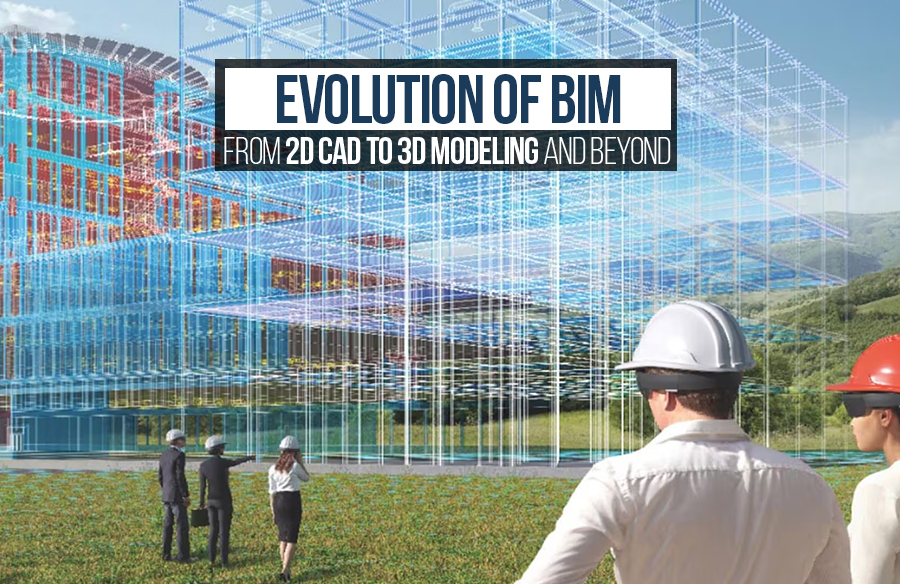
Over the past few decades, Building Information Modelling (BIM) has grown and revolutionized the building sector in fairly amazing ways. From its beginnings in the 1960s to the present, BIM evolution has been shaped by several historical turning points that have affected not only how we conceptualise projects but also how we carry them out and manage them. This essay will follow the evolution of BIM, highlighting key moments along the road, from its conception to the most current adoption of cutting-edge technologies.

Initial Concepts
The earliest concepts that emerged in the 1960s contributed to the establishment of the basis for Building Information Modelling (BIM). Pioneering engineers and visionaries such as Charles M. Eastman and Douglas Engelbart began experimenting with the revolutionary idea of showing data linked to construction in three dimensions. They laid the foundation for a more comprehensive approach to construction information management, sowing the seeds for what would become a significant upheaval in the construction industry this decade. These experts’ ground-breaking contributions in the 1960s laid the core conceptual framework that shaped BIM during the succeeding decades.
The Boom in Software
Building information modelling (BIM) experienced great growth in the 1970s, a critical decade for implementing concepts from the previous decade, mostly due to the introduction of specialised software. Pioneers such as Charles M. Eastman persisted in being instrumental in creating cutting-edge information modelling software for the building industry. Astute businesses like IBM started to devote resources to technologies that would enable the integration of massive volumes of data and the development of increasingly complex models. As the industry came to understand the value of digital tools for data organisation and three-dimensional model creation, specialised software gained popularity.
Establishing a Consolidated Concept
In the 1990s, building information modelling (BIM) advanced significantly and became a cornerstone concept in design and construction. At this time, industry leaders such as Autodesk created software solutions that were revolutionary for the time, such as AutoCAD and later Revit. These software tools allowed for the creation of complex three-dimensional models that combined essential data into a single virtual realm.
When architects, engineers, and builders realised that Building Information Modelling (BIM) might completely change the way building projects are planned and executed, a huge change happened in the 1990s. The construction sector made BIM a fundamental practice by emphasising cross-disciplinary cooperation and interoperability.
Extensive Adaptation
The early years of the twenty-first century saw a significant increase in the use of Building Information Modelling (BIM), as more building specialists and large organisations adopted the methodology. Large companies, like Turner Construction in the US, also set the standard for the broad use of BIM. More companies realised how critical it was to boost productivity and reduce the hazards associated with building projects as the advantages of BIM were more generally recognised. This age has seen a substantial expansion in the use of BIM worldwide, establishing its position as a standard practice in the building sector.
BIM Handbook

A major turning point in the evolution of Building Information Modelling (BIM) was the publication of the “BIM Handbook: A Guide to Building Information Modelling” in 2007. Chuck Eastman, Paul Teicholz, Rafael Sacks, and Kathleen Liston worked together to produce this innovative handbook, which highlights Eastman’s important role from BIM’s beginnings. The handbook is an invaluable resource that provides academics and industry experts with a comprehensive grasp of BIM.
Government Mandates
Building information modelling (BIM) experienced a significant uptick at the beginning of the decade with the establishment of government laws in various countries throughout the world in 2010. Leading this movement, the UK launched BIM Level 2 for government projects and was among the first countries to pass legislation supporting the use of BIM in public buildings. This project was supported by BIM experts and professionals, including consultants David Philp, who played a crucial role in creating and carrying out this plan.
Emerging Technologies
Building Information Modelling (BIM) has advanced over the last 10 years and beyond due to the integration of new technology, which has ushered in a creative time for the building industry. Innovative professionals have enabled the integration of technologies such as augmented reality (AR), artificial intelligence (AI), and the Internet of Things (IoT) into the building information modelling (BIM) ecosystem.
The Way Forward

In retrospect, the emergence of construction Information Modelling (BIM) demonstrates not just the progress of technology but also a fundamental change in the planning and execution of construction projects. It is evident from looking at the historical evolution of this timeline that understanding key BIM terms and ideas is essential for all industry participants.
References:
- The evolution of BIM over time: A Brief History – BIM Trends. (n.d.). https://bimtrends.com/bim-civil-construction/the-evolution-of-bim-over-time-a-brief-history/