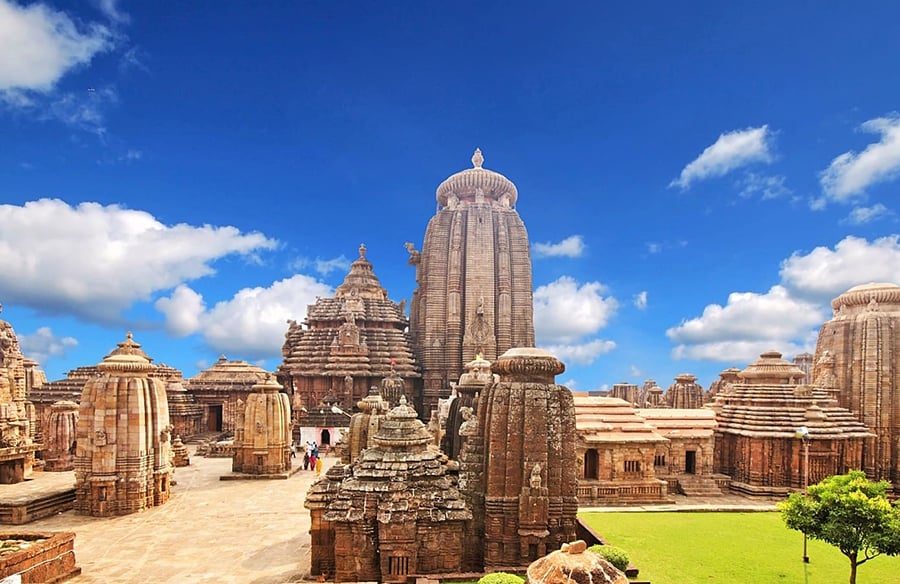
The Lingaraja temple stands as the grandest temple in Bhubaneswar. Renowned critic and historian James Fergusson (1808–86) hailed it as “a prime illustration of a purely Hindu temple in India.” Lingaraj Temple, located in the bustling city of Bhubaneswar, Odisha, India, stands as a testament to the rich cultural and architectural heritage of the region. Dedicated to Lord Shiva, this magnificent temple is one of the most prominent and revered shrines in Hinduism.

Historical Significance
The current temple structure can be traced back to the late 11th century, while historical proof suggests that a portion of it was constructed in the 6th century CE, as mentioned in Sanskrit texts from the 7th century. According to some reports, the temple is believed to have been authorised by King Yayati I of the Somvanshi dynasty (1025-1040) during the 11th century CE.Interestingly, Jajati Keshari II, relocated his capital from Jajpur to Bhubaneswar, which was then known as Ekamra Kshetra .

When the Lingaraja temple was finally finished, the Jagannath (a form of Vishnu) sect had already gained popularity in the area. This is evident because the worship of Vishnu and Shiva coexisted in the temple. The kings of the Ganga dynasty, devotees of Vaishnavism, Shaivism and Shaktism, built the Jagannath temple at Puri in the 12th century.
Architectural Style and Significance.
At an astonishing height of 180 metres, the Lingaraja Temple is a true marvel of Kalinga architecture. This holy temple is a remarkable testimony to the vibrant cultural and religious heritage of the region.
Architectural style: Kalinga Architecture that features in the temples is divided into two main parts: the Deula tower and the Jagmohan hall. the walls of which are richly sculpted with architectural motifs and a profusion of figures. One of the oldest and most ancient forms seen in this temple is the image of a horse, which can be seen in the large windows of the Chaitya-Grihas.
It is the Deula which makes three distinct types of temples in Kalinga Architecture: Rekha Deula, Pidha Deula, Khakhara Deula.

The first two are linked to temples dedicated to Vishnu, Surya, and Shiva, whereas the third is primarily associated with Chamunda and Durga temples..
Design and Materials: The main entrance of The Lingaraja temple is located in the east, while there are small entrances in the north and south. The template has four components namely
The vimana (structure containing the sanctum), a 60-metre high pyramidal tower above the sanctum, has intricate decorative designs and a majestic sitting lion protruding from its walls. Inside, the shrine measures 22 feet (6.7 metres) by 22 feet (6.7 metres), while outside it covers 52 feet (16 meters) by 52 feet (16 metres). The walls of the tower are decorated with carved female figures appearing in various poses and adding to the magnificence of this architectural wonder.
Jagmohan (assembly hall), measures 35 ft (11 m) × 30 ft (9.1 m) from the inside, 55 ft (17 m) × 50 ft (15 m) from the outside, entrances from south and north and has a 30 metres (98 ft) tall roof. The facades leading to the entrances are beautifully adorned with perforated windows, featuring majestic lions sitting on their hind legs. Additionally, the inverted bell above the second unit is embellished with a kalasa and more lion motifs.


Natamandira (festival hall), measures 38 ft (12 m) × 38 ft (12 m) from the inside, 50 ft (15 m) × 50 ftThe hall has a main entrance and two additional side entrances. The side walls are decorated with intricate sculptures that show women and couples and add elegance to the space. Inside you will find sturdy pillars that add to the overall grandeur of the hall. (15 m) from the outside.
Bhoga-mandapa (hall of offerings), measures 42 ft (13 m) × 42 ft (13 m) from the inside, 56.25 ft (17.15 m) × 56.25 ft (17.15 m) from the outside and has four doors in each of the sides. Adorning the exterior walls of the hall are intricate sculptures depicting both men and beasts. At the top, the roof proudly displays an inverted bell and a kalasa.


The temple gazes towards the East, standing tall with its four structures aligned in descending order perfectly. Made of sandstone and laterite stones, this architectural marvel displays exquisite craftsmanship. The main entrance doors of the temple are made of sandalwood. The enchanting scent of sandalwood greets you at the entrance setting a blissful mindset. Interestingly, instead of the usual trident, the Pinaka bow proudly holds the temple flag. The temple courtyard is a vast area decorated with many small shrines that create a peaceful atmosphere. Moreover, the dance hall holds an important place in history as it symbolises the rise of the Devadasi system in that era .

Socio-Political Relevance.
The reign of Yayati II marked a turning point for the Somvanshi dynasty as they not only regained their power but also defeated the Kolas and began a period of effective rule. Known for his martial skills and devout religious practices, he played an important role in the revival of Vedic customs in India, especially in the eastern regions. As a tribute to his legacy, Jajpur was renamed Abhinava Jajati Nagar.

He summoned 10,000 Brahmins from Kanyakubaj (Kannauj, UP) and conducted the Ashwamedha Yajna at Dashashwamedh Ghat in Jajpur along the sacred Baitarani River, showcasing his faith, strength, and authority. By building Vaishnava and Shaiva temples, he diminished the influence of Buddhism in the eastern regions of India. In Bhubaneswar, known as Ekamrakshetra, he started the construction of the world-famous Shiva Mandir “Lingaraj temple”.
Cultural and Religious Essence.
It is believed that Lord Shiva goes by the name Lingaraja, dwells within the temple. Numerous ancient Hindu scriptures, including the Skanda Purana, Brahma Purana, and Kapila Samhita, have highlighted the temple’s spiritual significance.
Mahashivaratri is a significant celebration with elaborate rituals, an all-night vigil and has drawn a sizable following.
Pana Sankranti is a festive occasion that signifies the start of the Odia New Year and the arrival of summer, which is commemorated with a unique beverage
Dola Purnima, akin to Holi, features idol processions and joyful color play.
During Chandan Yatra, the deities are decorated with sandalwood paste to avoid the scorching heat. In addition, they take part in a pleasant boat ride in the evening in the refreshing waters of Bindusagar in the old town of Chapa Khela.
These festivals showcase the rich traditions and culture of Odisha, attract devotees and visitors to the Lingaraja Temple.


The Bindusagar Tank.
The Bindusagar tank, north of the Lingaraja temple complex, has an interesting belief. It is said to contain a drop of water from every major Indian river, making it truly unique. This sacred tank is also called an ocean drop tank. There are embankments everywhere and it is closely intertwined with the rituals performed at the Lingaraja temple. According to locals, the lake was created by Lord Shiva himself, who collected water from various shrines to quench the thirst of Goddess Parvati. The water in this tank is considered blessed by Lord Shiva and is believed to possess the power to heal both physical and spiritual ailments. Devotees and monks visiting the temple also have the privilege of using and receiving this sacred water. The Lingaraja temple is most likely constructed over this natural spring with purported therapeutic qualities.

The construction of the Lingaraja temple dates back to the 11th century and has seen numerous renovations throughout the years. Efforts are continuously made to preserve and restore the temple complex in order to safeguard its cultural significance. With thousands of devotees visiting annually from around the globe, the Lingaraja temple stands as a sacred destination for Hindu pilgrims. It serves as a beautiful tapestry of cultural elements, intertwining intricate designs and spiritual symbolism. Every detailed carving tells a story of history and spirituality, transcending time to enchant hearts worldwide.
Reference lists:
Lingaraja Temple-History, architecture, and religious practices. (no date) Testbook. Available at: https://testbook.com/ias-preparation/lingaraja-temple (Accessed: 14 April 2024).
Thakur, S. (2017) The Lingaraj Temple, Bhubnashwar, Odisha, India. Available at: https://unexploredbihar.blogspot.com/2017/07/the-lingaraj-temple-bhubnashwar-odisha.html (Accessed: 14 April 2024).
In news: Lingaraj Temple (2021) CivilsDaily. Available at: https://www.civilsdaily.com/news/in-news-lingaraj-temple/ (Accessed: 14 April 2024).
History of khandayats (no date) Facebook. Available at: https://www.facebook.com/106188274262402/posts/somavansh-is-one-of-the-branch-of-the-various-branches-of-chandravansh-the-somba/545349480346277/ (Accessed: 14 April 2024).
Lingaraj Temple, Lingaraj Temple history, Significance, Architecture & Festivals (no date) Astroved Astropedia. Available at: https://www.astroved.com/astropedia/en/temples/east-india/lingaraj-temple (Accessed: 14 April 2024).
Lingaraj Temple (no date) Lingaraj Temple – The history of Lingaraj Temple Bhubaneshwar. Available at: https://www.mahashivratri.org/shiva-temples/lingaraj-temple.html (Accessed: 14 April 2024).