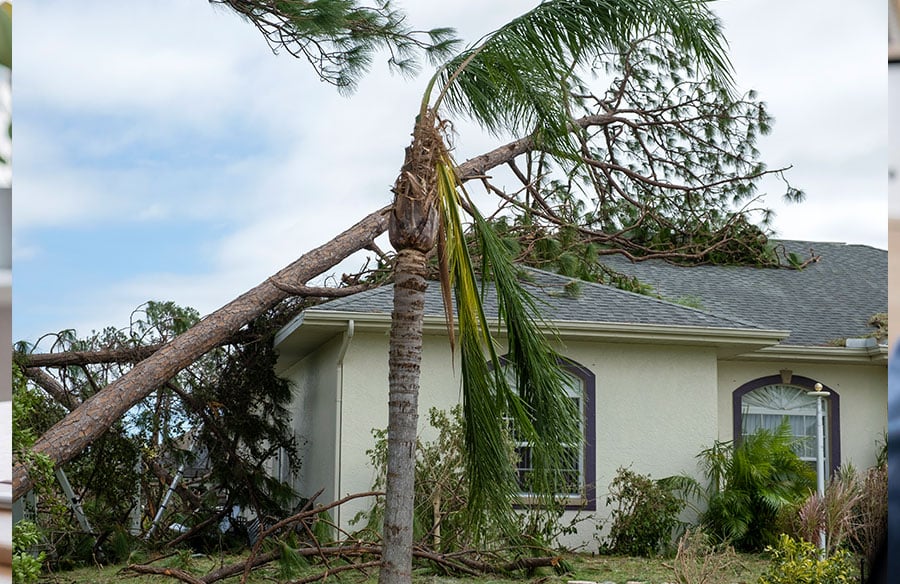
A major storm has a way of revealing just how much the trees on a property are doing. You do not think about them much on ordinary days. They are just there, shading the garden, softening the street edge, holding the soil together quietly beneath the surface. Then a storm tears through and suddenly there is a split trunk, a canopy leaning at a wrong angle, or a root mass heaving up from the ground, and you have a decision to make that turns out to be more complicated than it first looks.
The question of whether to remove or restore a damaged tree is not always one with a tidy answer. It depends on the extent of the damage, the species, the tree’s location, its age, and the risk it presents going forward. Getting that judgment right matters a lot, both for safety and for the longer-term health of the site.
Why the Decision Is Harder Than It Looks
People tend to err in one of two directions after a storm. Either they panic and want everything cleared immediately, treating any broken branch as evidence that the whole tree is a liability. Or they hold on instinctively, reluctant to remove something that has been growing for decades, even when the structural integrity is genuinely compromised.
Both responses are understandable. Neither is always right.
For homeowners in Victoria who are navigating this after a significant weather event, the starting point is always a professional assessment rather than a visual guess from ground level. Tree Removal in Melbourne requires qualified arborists who can evaluate what the internal structure of a tree looks like after damage, not just what is visible from the outside. A trunk that appears intact can have deep internal splits. A tree that looks like it only lost a few limbs might have suffered root damage that makes it fundamentally unstable going forward.
The case for restoration, when it is possible, is not just sentimental. Mature trees are genuinely difficult to replace. A tree that has been growing for forty years provides a level of canopy coverage, carbon sequestration, habitat value, and cooling that a newly planted sapling will take another forty years to match. The broader case for this is well made in research and writing on urban forestry, where the loss of mature trees in cities and residential areas carries ecological costs that outlast the immediate disruption of the storm itself.
What Pushes a Tree Toward Removal
There are specific damage profiles where removal is the only responsible path. A split at a major scaffold branch or the main trunk is one of them. Trees that have split down through the central structure are compromised in a way that remediation cannot fix. The wood fibres are broken and the wound site becomes an ongoing entry point for fungal infection and decay.
Root damage is similarly terminal in many cases. If the root plate has shifted significantly or if a large portion of the anchoring root system has been torn up, the tree has lost the structural foundation it needs to stand safely. This is especially critical for large trees situated near structures, paths, or areas with regular foot traffic.
Hanging limbs, sometimes called widow-makers by arborists, are an immediate safety issue that needs to be addressed before anything else. A large limb suspended in a canopy after partial breakage can fall unpredictably and with significant force.
What Points Toward Restoration
On the other side of the ledger, many storm-damaged trees are genuinely restorable. Limb loss, even significant limb loss, does not necessarily mean the tree is finished. If the central trunk is sound and the root system is intact, an arborist can assess whether the remaining crown is enough to sustain the tree through recovery.
Structural pruning after storm damage involves removing the compromised sections cleanly, reducing load on weakened areas, and allowing the tree to redistribute its energy toward recovery growth. Some species handle this process better than others. Eucalypts, for example, are extraordinarily resilient and can regenerate from quite severe damage given the right conditions. Native species that have adapted to Australian weather patterns tend to have better recovery profiles than some ornamental species introduced from more stable climates.
The age and position of the tree matter too. A young to middle-aged tree with a strong root system and a clean central trunk has far better restoration prospects than a very old tree that was already under stress before the storm hit.
The Bigger Picture for Urban Trees
It is worth situating these individual decisions within a broader context. The role that mature trees play in urban environments goes well beyond any single property. As explored in work on urban green spaces as climate buffers, the collective canopy of established trees in residential areas provides measurable cooling, stormwater management, and biodiversity support that no built infrastructure can replicate at the same cost. Removing trees indiscriminately after storm events slowly degrades that collective resource in ways that compound over time.
This does not mean every damaged tree should be kept at all costs. Safety has to come first, and a structurally compromised tree in proximity to buildings or people is a real hazard. But it does mean that the default position after a storm should be assessment and selective restoration where possible, rather than clearing everything damaged and starting again.
The trees that survive and recover from storm damage often become some of the most structurally resilient on a site. They have been tested. The ones that came through have roots and wood that have responded to stress. That counts for something, and it is worth understanding before reaching for the chainsaw.