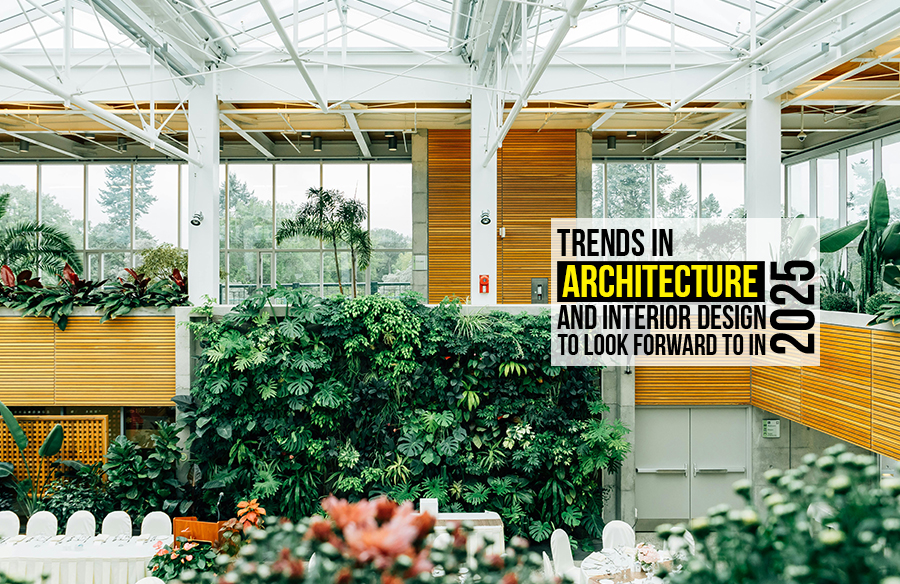
The ever-changing trends in the world of architecture and design are deeply reflective of the area’s geographic demands, the customers’ aesthetic sense, and the need for functionality in spaces. While trends are ever-changing and dynamic, the varying architectural trends have provided a deep understanding of the earlier times and how they continue to change. They provide the designers and architects of today with a deep insight into what was relevant before and how the trends and demands have changed over time. This reflective understanding of trends also allows designers to somewhat predict what future demands can arise, hence allowing designers to create innovative, market-friendly designs.
The upcoming trends in Architecture and Interior Design can also shape and impact the upcoming demands of the clients and can shape the market for the subsequent years. Designers and Architects can strongly shape trends by analyzing the market demands and by understanding what a community will appreciate. For example, a collapsible dining table that can accommodate up to twelve people can be a popular design trend that fulfills the demands of limited space and a growing population. While a design like this can be highly popular among families, a dining table that doubles up as a table tennis table can be more popular among young adults and couples looking for some entertainment.

Biophilic design: nature within design
Biophilic design integrates nature within interior spaces and has been gradually emerging as an approach that targets human well-being and environmental restoration. While the idea of biophilic design has popularly been perceived as integrating earthy colors like green, brown, and blue in the design, in the year 2025, the concept seems to be taking the shape of creating spaces that reduce environmental impact and contribute to ecological restoration (Browning et. al, 2024).
Architects and interior designers are focusing on blurring the boundaries between an internal and an external environment by cohesively blending their elements. These elements include walls with vertical plants, integrated indoor gardens, and using materials and textures that mimic nature. These designs are an upcoming trend because they improve the occupant’s overall well-being, reduce stress levels, and improve cognitive performance by 26 percent (Thompson & Rodriguez, 2024). To give shape to this upcoming trend, locally sourced and sustainable materials are used, advanced air purification systems are used with indoor plant ecosystems, and spaces are made to adapt and respond to environmental changes. Some of the innovative sustainable materials used are mycelium-based composites, recycled ocean plastics, and carbon-negative materials. These materials not only bring about a narrative of ecological responsibility but also reduce environmental impact (Chen et. al, 2025).

Moody and Earthy Colour Palettes
With the biophilic design gaining popularity, 2025 will likely see interior spaces dominated by moody and earthy hues reflecting a sense of being grounded. The Colour of the Year for 2025, PANTONE 17-1230 Mocha Mousse, is a warm and rich brown hue that is a testament to this upcoming trend. The post-pandemic effect has left humans longing for a connection to nature and a sense of comfort in their homes as well as workspaces. Spaces with layered textures and earthy tones such as browns, terracotta, and muted greens will add warmth to interior spaces and cater to this desire for comfort. These hues will also reflect the shift in focus towards eco-conscious design strategies that use sustainable and recycled materials.

Smart home technology
Another upcoming trend for 2025 is integrating smart home technology with adaptive living spaces. This approach focuses on creating spaces that actively respond to the occupants’ physical and emotional needs and aims to go beyond simple home automation services.
Upcoming technologies like Artificial Intelligence (AI) and the Internet of Things (IoT) can enable spaces to adjust lighting, temperature, acoustic environments, and spatial configurations in real time. Kim and Patel (2024) recently demonstrated how AI-driven spatial algorithms can optimize living spaces for a variety of activities by efficiently transforming a single room to support work, relaxation, and a social meetup within a few minutes. To create such spaces, surfaces are embedded with touch and gesture controls, advanced computing systems are integrated, emotional intelligence interfaces are incorporated, and energy systems are installed that learn to optimize consumption patterns. Privacy concerns and data security are some of the critical considerations of this technological integration. Multiple attempts and trials have been made to balance technological convenience with individual privacy protection (Wang et. al, 2025).

In 2025, interior design and architecture will not simply be about creating visually appealing spaces, but about creating complex, adaptive, and responsive ecosystems that focus on human health, environmental impact and sustainability, and technological innovation. The future of design lies in creating spaces that are intelligent, creative, flexible, and regenerative.
The current professional arena requires designers who not only have an eye for aesthetics, but also possess technological skills and are ecologically conscious. To achieve these innovative and upcoming design trends, deep interdisciplinary collaboration between architects, technologists, ecologists, designers and psychologists will be crucial.
References:
- Browning, W.D., Ryan, C.O. and Clancy, J., 2024. Regenerative Design: Transforming Built Environments. New York: Sustainable Futures Press.
- Chen, L., Rodriguez, M. and Thompson, S., 2025. ‘Innovative Materials in Sustainable Architecture’, Journal of Green Design, 42(3), pp. 112-129.
- Kim, J. and Patel, R., 2024. ‘Adaptive Spatial Technologies in Residential Design’, Architectural Intelligence Review, 35(2), pp. 45-62.
- Thompson, E. and Rodriguez, S., 2024. ‘Biophilic Design and Human Well-being’, Environment and Psychological Research, 28(4), pp. 76-93.
- Wang, X., Li, Y. and Nakamura, H., 2025. ‘Privacy Paradigms in Smart Home Ecosystems’, Technology and Privacy Journal, 39(1), pp. 22-40.
Image References:
- Zhang, L. (2024). 2025. Available at: https://unsplash.com/photos/a-number-twenty-twenty-twenty-twenty-twenty-twenty-twenty-twenty-twenty-twenty-twenty-twenty-twenty-twenty-kbgoyL5pXuw [Accessed 1 Dec. 2024].
- Webb, S. (2017). Biophilic Design. Available at: https://www.pexels.com/photo/green-leaf-plants-539403/ [Accessed 1 Dec. 2024].
- Pantone (n.d.). Colour of the Year 2025. Available at: https://www.pantone.com/color-of-the-year/2025 [Accessed 7 Dec. 2024].
- Scholz (Nuki), S. (2019). Smart Home Tech. Available at: https://unsplash.com/photos/gold-apple-iphone-smartphone-held-at-the-door-IJkSskfEqrM [Accessed 1 Dec. 2024].