The interpretation of buildings has often been linked to ’The Process of Reading’ in which architecture can be understood by analogy to language; either as a code capable of communicating the architect’s intentions or more literally as a spoken or written language in its own right. Historically speaking, architecture and its meaning have been based on two approaches. One is the ‘Normative Approach’, whereby values were considered permanent across time. The second is the ‘Relativistic Approach’, where values possess relative truth depending upon the context of the place and time. Humans owing to their communicative nature decipher and deduct meaning from all that they do and see or experience in their everyday lives. As a building is planned, built, inhabited and interpreted; so, its meaning changes as per the perspective of each individual.
Understanding Symbolism in Museum Architecture
Symbolism in architecture is an attempt to capture ideas, rituals, history and culture, philosophy, outlook and notions among others and transfer these symbolic attributes to a built form so that these structures hold and convey meaning to the user of any specific society through designing local museums that act as mediators between historical identity and today’s realistic societal scenarios.
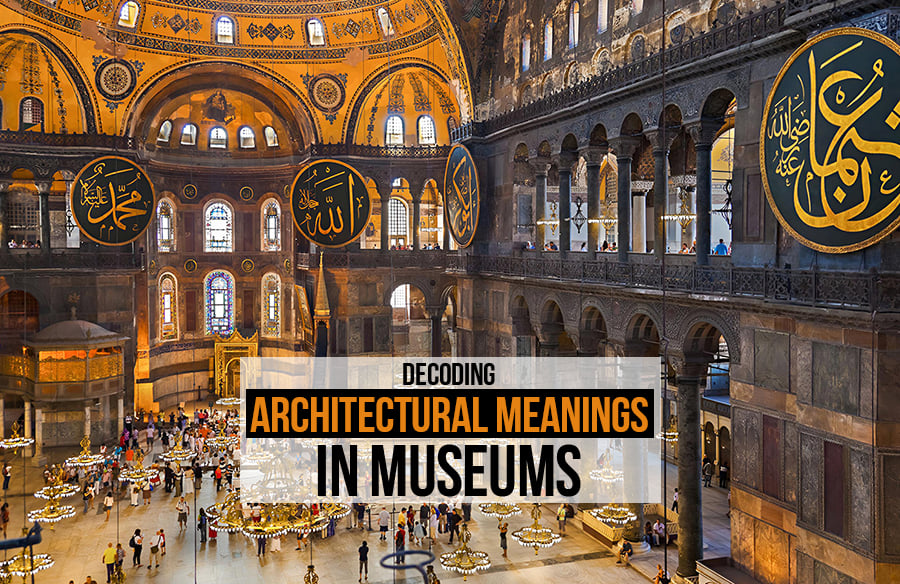
Traditional Symbolism in designing museum structures is used to reflect a rich tapestry of cultural beliefs, values and narratives that have helped to shape society throughout history. It incorporates symbols that are deeply rooted in the culture and region of the society. Take the example of Hagia Sophia, originally built in the 6th century as a Christian Cathedral by using design elements of Byzantine Style churches, later the structure was converted into a mosque in 1453 and imbibed Islamic design elements like the use of textured materials and dome construction. Lately, Hagia Sophia is currently serving society as a museum structure thus symbolizing a unique blend of Christian and Islamic architecture and culture in a historically significant way.

Modern Symbolism in museums seeks to convey meaning through innovative design forms and unique choice of materials to represent the society’s rich heritage and culture, thus reflecting and responding to the complexities and challenges of contemporary society. Nowadays, museum design in modern architecture uses abstract and conceptual symbols that represent ideas or concepts rather than images or motifs. Modern museums can also incorporate symbols related to technology and innovation symbolizing progress and capabilities of modern engineering, thus reflecting advancements of the modern era.
Throughout the historical course the intentions of the architect or the ‘Intended Meaning’ can be conveyed through varied combinations of symbols representation in the form of motifs and frescos, and now in contemporary times, these meanings are conveyed through the composition of forms and shapes, patterns and rhythms, textures and materials, volumes and geometric proportions. Architects designing for society have always faced the dilemma of what formal language to use for architecture to truly represent people’s beliefs, traditions, culture and identity; to showcase a reflection of today’s society in spatial forms. Architects from the time being have conveyed various purposes of society through tangible built forms. These purposes are- to convey a message to God by building temples, churches and other religious structures majorly pointing upwards inbuilt design to represent the communication between humans and the Almighty. Another purpose is to convey the human scale and proportions through the ‘Concept of Entasis’- Perfection and Power which are generally in civic, public and government structures. The purpose is to convey cultural ideas by designing museums in vernacular styles that vary individually through regions.

The perceived meaning at the end of the user is dependent on the vision of the observer/ visitor and his or her capability to understand and grasp the hidden intention of the architects within the built structure. This meaning can also be associated with ‘Perceived Emotional Content’ which is hidden beneath and can be related to the viewer, if he or she has been through that particular event for which the meaning is intended to convey, thus creating a strong relationship between viewer/ user with its spatial built environment.
Understanding Modern Museum- Virasat-e- Khalsa
The Khalsa Museum or Virasat-e-Khalsa is located in Anandpur Sahib- also known as the ‘Holy City of Bliss’ in Punjab state of India. Architecturally, the museum conveys an incisive stand taken on behalf of the Sikh Guru’s faith and the grandeur of the community’s history. The vision of the museum was commissioned in 1998 to Moshie Safie (a Canadian-Israeli- Israeli Architect) by the then chief minister of Punjab after visiting Yad Vashem Holocaust Memorial located in Jerusalem, Israel. The museum’s monumental scale design is woven aesthetically with the vernacular fabric of the Holy Town highlighting the robust living culture of the society to which the museum is dedicated. The design concept is based on a strong set of Sikhism values which are reflected through arrays of meaningful geometric patterns like in boat-shaped petal-shaped and sword-shaped built forms, thus universally conveying the Sikh community’s ideas, valour narratives and cultural identity through various architectural elements.

The built design creates a sense of ‘Spiritual Engagement’ for the visitors and ‘Devotional Feeling’ for the locals. The whole complex has taken lots of cultural and architectural references from Sikhism architecture, thus including different types of built forms, water cascades and zonings. The main museum building is in curved forms that represent a fort’s bastion thus symbolizing the strength and stability of the community throughout its history. The meaning of each built form and shape is only conceived well at the end of the journey- understanding the knowledge instilled in terms of viewing architecture through historical and sacrificial eyes, thus helping to perceive the hidden intention of the architect to justifiably convey the story of the Sikh community.

Symbolism in architecture transcends mere functionality, allowing architects to convey deep meanings of cultural, social and political messages, thus reflecting upon societal values and aspirations. The major purpose of an architect is ‘To Encode’ symbolic meaning in a building, so that it conveys its true functional form to the observers, helping them to decode its hidden soul and meaning concerning the building’s associational and emotional content. As we decode the language of buildings, we gain a deeper appreciation for a rich tapestry of symbolism that defines our architectural heritage and shapes our urban landscapes.
References:
- How do buildings mean? Some issues of interpretation in the history of architecture. Available at : https://onlinelibrary.wiley.com/doi/full/10.1111/j.1468-2303.2006.00355.x
- Decoding the Language of Buildings: A Journey into Architectural Symbolism. Available at : https://volzero.com/news/view/decoding-the-language-of-buildings-a-journey-into-architectural-symbolism