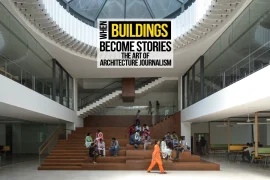
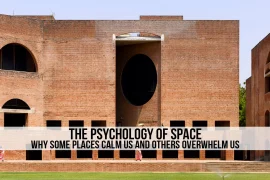
This article explores the holistic framework of architecture through an experiential lens. The inherent need for spaces to have ‘robustness’ (Dee, 2001, p.16), where a wide range of people and activities need to be accommodated for, forms the basis of this exploration.
Defining The Key Experiential Qualities of A Place:
Fundamentally, four key qualities shape a person’s experience of landscapes and spaces, as suggested through environmental behaviour research, conducted by Rachel and Stephen Kaplan in 1989. These are mystery,
legibility, complexity, and coherence. Legibility refers to how easily one can make sense of a space, mystery encourages exploration of the space, and complexity refers to how details and components of a space enrich its diversity. Finally, the coherence of a space refers to the familiarity one has with a space, and how one perceives the order of it. (Dee, 2001, p.17).

While we may link these qualities to the traditional senses, one may additionally perceive memory and relatability as a sense (Philhour, 2020). In essence, the simultaneous juxtaposition of familiarity and curiosity about places creates a richer and more diverse spatial experience. A crucial aspect to note regarding the quality of experiencing architecture is the difference between space and place. Space is measurable, whereas place refers to the ‘cultural meanings people invest in or attach to’ (Lawrence-Zuniga, 2017). However, the growing trends on social media have cultivated aesthetics that are replicated in an emerging ‘experience economy’ (Gattupalli, 2023). Using storytelling as a tool to convey a spatial language through pop-up shops and service centres creates an identity (Gattupalli, 2023), which is inherently translatable to any human-centric design. Intrinsically, the sense of ownership and identity over a space is what makes it a place, defining one’s personal experience towards it.
How Experiential Theories Form A Narrative of Identity:
Prospect-Refuge Theory, conceptualised by geographer Jay Appleton, is particularly visible in landscape architecture and allows humans to naturally seek spaces that provide new opportunities (prospect), but also provide a sense of safety and allows them to blend in with their surroundings (refuge) (Manolakelli, 2023). In spatial language, the theory supports the fact that people prefer edges rather than the middle of a space, or spaces that display ‘unobstructed views from multiple vantage points’ (Butterworth, 2020) with protected sides. In essence, the aforementioned ‘robustness’ coincides well when noticing the prospects and the refuge points of spaces, creating value in experiencing a place. Another aspect that further signifies this theory is the ‘opportunity to be alone’ (Owens, 1988, p.21) in a space. This was one of the most valued qualities about a place, particularly amongst teens, along with ‘places they can call their own’ (Owens, 1988, p.20), reinforcing the idea of identity and connection towards a place.

Another pedagogical understanding of experiencing a space is Access Analysis, which allows built spaces to be viewed as patterns of movement rather than ‘a static view from above’ (McMahon, 2013, p.163) However, this can be seen as formulaic, discounting human behaviour, which negates the experience of the space. (McMahon, 2013, p.163). Structuration Theory, conceptualised by Antony Giddens, allows us to analyse spaces by taking individual actions resulting from constraints produced by social structures (McMahon, 2013, p.163), as opposed to Access Analysis, which looks at human movement through a space in a two-dimensional way. It is, perhaps, this aspect that, inherently, allows us to analyse experiential architecture through an activist approach.
An example of this would be an exhibition conducted by MVRDV and The Why Factory in France, titled ‘Agir’ (Aastha, 2022), meaning ‘to-act’. Experiencing architecture through design activism, creates a sense of agency, reinstating a collective, social identity, which is what the exhibition aims to do.

The research that was undertaken, as an extension of the exhibition, received opinions about visualisations of future cities, questioning why ‘profit-driven spaces’ (Aastha, 2022) were prioritised more.
Complexity in Design Narratives:
The richness that the complexity of a space provides people with lies in the details. The quality of these details lies in texture, pattern, colour light, and shadow. To have the most optimal experience, identifying the problems within the context of the site, or identifying client needs allows designers to respond using the above-listed details, which ultimately forms a narrative. For example, ArchAdemia uses the analogy of building in a flood-prone area, where the solution may be through elevated design and water-resistant materials, telling ‘the story of resilience’ (ArchAdemia, 2023). Instead of incorporating many different details and concepts to form a convoluted narrative, focussing on one detail and deepening the understanding of it will create a more engaging narrative, thus communicating the experience of the space.

Thus, in summary, the narratives formed in experiential architecture and design aren’t always atmospherically ‘mise-en-scène’ (Clarke, 2012, p.8) or theatrical, however they are oftentimes practical and human-centric. Experiential architecture acts as a product of human behaviour and psychology, based on the fundamental idea of a space needing to be ‘robust’ enough, in order to be a place.
References:
- Aastha, D. (2022) Architecture as a function of agency [online] Available from: https://www.stirworld.com/think-opinions-architecture-as-a-function-of-agency2 [Accessed 26th October 2024]
- ArchAdemia. (2023) The importance of Architectural Narrative for every project [online] Available from: https://archademia.com/blog/architectural-narrative/?srsltid=AfmBOoovM5oojXGSgVeFXl7hTcRxx3zxBOYyQq8DBjtd4CyHGzgh2U1p [Accessed 26th October 2024]
- Butterworth, D. (2020) Prospect-Refuge Theory; How You Chose Your Favourite Seat [online] Available from: https://dianebutterworth.com/articles/prospect-refuge-theory-how-you-chose-your-favourite-seat/ [Accessed 26th October 2024]
- Clarke, A. (2012) Spatial Experience Narrative and Architecture [online] Available from: https://www.architects.nsw.gov.au/download/BHTS/Clarke_A_Spatial_Experience_Narrative__BHTS2012.pdf [Accessed 26th October 2024]
- Dee, C. (2001), Form and Fabric in Landscape Architecture: A Visual Introduction, Oxford: CRC Press LLC. Available from: ProQuest Ebook Central. [Accessed 25 October 2024].
- Gattupalli, A. (2023) Crafting Spatial Experiences: Service Design in Architecture [online] Available from: https://www.archdaily.com/995352/crafting-spatial-experiences-service-design-in-architecture [Accessed 25th October 2024]
- Gattupalli, A. (2023) What are Branded Environments? [online] Available from: https://www.archdaily.com/992486/what-are-branded-environments [Accessed 25th October 2024]
- Lawrence-Zuniga, D. (2017) Space and Place [online] (Last modified: 30th March 2017) Available from: https://www.oxfordbibliographies.com/display/document/obo-9780199766567/obo-9780199766567-0170.xml [Accessed 25th October 2024]
- Manolakelli, A. (2023) Prospect-Refuge Theory [online] Last updated Sep 9th 2023. Available from: https://www.archpsych.co.uk/post/prospect-refuge-theory#:~:text=His%20theory%20proposes%20that%20humans,Appleton%2C%201975%2C%201984). [Accessed 26th October 2024]
- McMahon, A. (2013) Space, Sound, and Light: Toward a Sensory Experience of Ancient Monumental Architecture. American Journal of Archaeology, 117(2), 163–179. Available from: https://doi.org/10.3764/aja.117.2.0163 [Accessed 26th October 2024]
- Owens, P. E. (1988). Natural Landscapes, Gathering Places, And Prospect Refuges: Characteristics Of Outdoor Places Valued By Teens. Children’s Environments Quarterly, 5(2), 17–24. Available at: http://www.jstor.org/stable/41514669 [Accessed 25th October 2024]
- Philhour, C.H. (2020) Experiential Architecture [online] Available from: https://tkarch.com/experiental-architechture/#:~:text=Experiential%20architecture%20is%20design%20that,lasting%20impression%20on%20your%20customers. [Accessed 25th October 2024]
URLs/references for the images (in case I have referenced the copyright incorrectly):
Image 1
Screenshot taken from the E-Book version of Dee, C. (2001), Form and Fabric in Landscape Architecture: A Visual Introduction, Oxford: CRC Press LLC. Available from: ProQuest Ebook Central. [Accessed 25 October 2024], p.17
Image 2
https://dianebutterworth.com/articles/prospect-refuge-theory-how-you-chose-your-favourite-seat/
Image 3
https://www.stirworld.com/think-opinions-architecture-as-a-function-of-agency2
Image 4
https://spin.atomicobject.com/complex-software-simplicity/