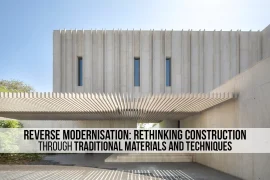
The design and architecture industry plays a pivotal role in shaping our world, but with climate change, resource depletion, and urbanisation escalating, professionals in these fields face a new reality. Environmental responsibility is no longer a choice—it’s an essential part of the job. While sustainability is a hot topic in the industry, embedding these principles into design education is no simple task. Moving from traditional design approaches to ones that put the environment first presents both hurdles and exciting new possibilities for future architects and designers.
The Need for Sustainability in Design Education
Design and architecture are closely connected with the environment, with the ability to either harm or help it. However, many schools haven’t yet fully incorporated sustainability into their teaching. Given that the built environment is responsible for a significant chunk of global carbon emissions, the next generation of designers must be trained to create spaces that are kinder to the planet.

Challenges in Integrating Sustainability Principles
One of the biggest challenges is shaking up existing curricula. Many design programmes have long focused on aesthetics or functionality without giving enough attention to environmental impact. Shifting these programmes towards sustainability requires a complete change in mindset, and not everyone is ready for that. There’s often resistance from both faculty and administrators who were trained in more traditional methods.
Then there’s the issue of resources. Some schools simply don’t have access to the materials, tools, or industry connections needed to teach sustainability practically. Faculty members, unless they’ve specialised in this area, may also find it tough to weave new sustainability trends into their teaching.
Another tricky aspect is finding the balance between theory and practice. It’s one thing to teach about reducing carbon footprints and using renewable energy, but another to translate these ideas into real-world projects. This is a complex skill that can’t easily be taught in a classroom setting.

Cultural and regional differences also come into play. In some parts of the world, sustainability still isn’t a top priority, either because of economic factors or lack of awareness. It takes more than education to get buy-in from students, educators, and industry stakeholders – it often requires a shift in cultural values too.
Opportunities in Design Education
Despite the challenges, bringing sustainability into design education opens up plenty of opportunities. For one, it’s a great catalyst for innovation. When faced with environmental challenges, designers are forced to think outside the box, experimenting with new materials, renewable technologies, and circular economy concepts. Rather than limiting creativity, sustainability can fuel it.
This shift also paves the way for interdisciplinary learning. By combining fields like environmental science, urban planning, and technology, design students can be better equipped to tackle the complex environmental issues of the future. Plus, with the growing demand for sustainable design in the industry, graduates who understand sustainability are highly attractive to employers.

Collaborations between schools and industry partners can further enrich learning. Partnerships with sustainability-focused organisations, green building certifications, and governmental agencies can give students the chance to apply what they’ve learned in real-world settings.
Detailed Course Examples Addressing Sustainability in Design Education
Some universities are already leading the way, offering courses that combine environmental responsibility with innovative design thinking. These serve as great examples for others looking to revamp their programmes.
Environmental Architecture at the Royal College of Art (RCA), London
This course is centred on real-world projects, challenging students to design spaces that tackle environmental crises. It covers everything from sustainable urbanism to climate-responsive architecture, and students work with local communities and industry partners, making sustainability a key part of their process.
Sustainable Urban Planning and Design at KTH Royal Institute of Technology, Sweden
KTH’s master’s programme focuses on energy-efficient housing, green infrastructure, and environmental impact assessments. By blending urban ecology, landscape architecture, and resource management, it gives students a comprehensive understanding of how to design environmentally responsible cities.
Sustainable Design Thinking at Stanford University, USA
This course looks at sustainability as a design problem. Students are encouraged to work on interdisciplinary teams to find creative solutions to global issues like plastic waste and low-carbon products. The focus is on designing systems where materials can be reused indefinitely – a concept known as “cradle-to-cradle” design.

Ecological Design at the University of Oregon, USA
The University of Oregon’s course takes a holistic approach to sustainable architecture, exploring how the built environment interacts with natural ecosystems. Through hands-on projects, students learn how to create designs that not only reduce harm but actively improve ecological health.
Materials for Sustainability at ETH Zurich, Switzerland
This course dives deep into the environmental impact of materials used in construction and design. Students learn about life-cycle assessments, the energy footprint of materials, and how to select low-impact or renewable options. This knowledge equips them to make informed decisions when designing sustainable spaces.
Design for Sustainability at Delft University of Technology (TU Delft), Netherlands
TU Delft’s course covers everything from circular economy principles to renewable energy integration. Students work on real-world projects, learning how to design products and systems that minimise environmental impact throughout their entire life cycle.
These courses highlight the various ways sustainability can be integrated into design education, from a focus on materials to a broader look at urban planning and interdisciplinary collaboration. By taking cues from these examples, other institutions can start embedding sustainability more deeply into their curricula.
As the effects of climate change become more evident, the need to integrate sustainability into design education is more pressing than ever. By addressing the challenges and seizing the opportunities, schools can play a crucial role in preparing the next generation of architects and designers to not only create beautiful spaces but also be stewards of the environment. It’s a call to action for educators, students, and industry professionals alike to take bold steps toward a more sustainable future.
References:
Design for Sustainability (no date) TU Delft. Available at: https://www.tudelft.nl/io/over-io/afdelingen/sustainable-design-engineering/section-design-for-sustainability/design-for-sustainability (Accessed: 20 October 2024).
Sustainability Course Catalogue (no date) ETH Zurich. Available at: https://ethz.ch/en/the-eth-zurich/sustainability/sustainability-in-research-and-education/sustainability-course-catalogue.html (Accessed: 20 October 2024).
Environmental architecture (no date) RCA Website. Available at: https://www.rca.ac.uk/study/programme-finder/environmental-architecture-ma/ (Accessed: 20 October 2024).