The Enigma- Mc Bull Hussain

Maqbool Fida Hussain (1915-2011), one of India’s most prominent and controversial artists of the 20th Century. Hussain was born on 17th September 1915 in Pandharpur, Maharashtra in a Sulaimani Bohra Muslim family. He lost his mother when he was only one and a half years old, after which he was sent to Siddhpur Gujrat to attend his grandfather’s Madrassa (religious school) to learn religious teachings. It is here that Hussain learnt Urdu language and literature and started practising Calligraphy in Kufic script.
Hindu Mythology Influence and Art
Later, he joined his father and his step mother in Indore where he learnt Hindu mythology by observing the theatrical folk tradition of Ram Lila. His interest in performing arts and movies as a medium of expression also stemmed from here. In Indore he also participated in Mushairas or poetry competitions which provided him an adequate sublet for his creativity. In 1932 Hussain started attending evening painting classes at School of Art, Indore, where he made Landscapes influenced by European Naturalism which was being taught in Art Schools. Then, in 1934 he enrolled at J.J. School of Art, Mumbai but could not finish his course due to financial constraints and came back to Pandharpur.
After his father lost his job and M.F. Hussain again decided he would shift to Mumbai and practise his art. His father was not ecstatic about this decision but had also realised by then that he could not stop this creative genius. Hussain was hungry enough to practise and improve his art. He slept on pavements and started painting film posters for a few years. Till he met a widow who offered him to come home and have food at her house everyday and later on stay with them. Her daughter was Fazila Bibi whom Hussain married in 1941 and had six children with. Two of his sons Shamshad Hussain, Owais Hussain, became artists and his two daughters Raeesa and Aqeela Hussain continued to be his muses till the very end. These varied influences growing up helped Hussain gain the knowledge and confidence which he portrayed in his own way through his paintings.


Progressive Artists Group
Hussain’s signature style of clear strokes defining sculptural figures emerged from his experience of painting billboards where he learnt how to paint large scale figures quickly and clearly. After his marriage Hussain worked in a South Bombay based furniture company to support his family financially, but continued with his painting practice. It was then in 1947 Hussain came into prominence as an emerging artist after he was awarded at the Bombay Art society’s Annual show. Later that year he met the art stalwarts SH Raza, F N Souza and SK Bakre and joined them in the formation of the Progressive Artists Group (P.A.G.), Bombay. These artists wanted to move Indian art away from the influence of European Realism. Thus emerged an amalgamation of European Modernism and Indian Traditional techniques. It was also the year India got its freedom and the angst of these painters towards British rule spearheaded the formation of this ‘Avante Garde’ group of Indian art that defined its course in the coming years.


Traditional Indian Influences in Hussain’s Art
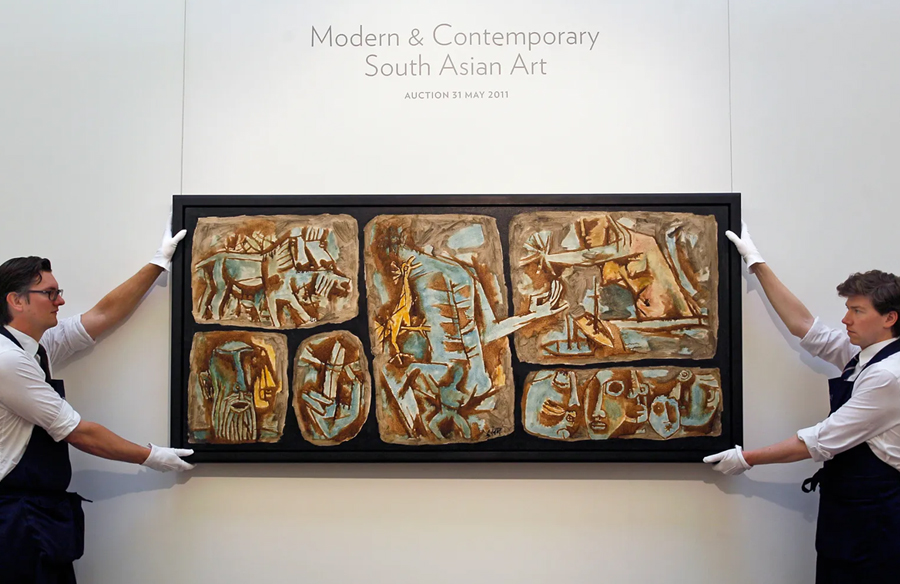
The art of M.F. Hussain was influenced by all of his life’s learnings but primarily his commanding female form was learnt through the study of Mathura Sculptures. The vivid colours, hot orange , yellow and brown he used in his paintings came from the miniature paintings of The Basholi School of early 17th and 18th century Punjab. The Jain miniatures and his ’Kufic’ calligraphy skills led him to create strong and sculptural figures with his trademark strong black lines and strokes. These traditional Indian art forms strongly influenced his style of painting which he then combined with his inherent modern sensibility and created abstract forms, which were his own interpretations of the age old traditions, people, religion. He created various collections on Hindu deities and scriptures such as Ramayana, then Mother Teresa, British Raj and also his version of Mother India which was the most controversial and he was forced to leave India due to protests by the Nationalists in India.
Hussain always created his versions of traditions and never shied away from presenting them to the world. This made him controversial yet this boldness was celebrated in the world of art. He started presenting his art abroad soon after P.A.G. was formed and held various shows in Zurich, New York yet never wanted to leave India.
Painter, Filmmaker
Hussain was also not only a painter but a keen filmmaker, so much that he made a movie ‘Through the eyes of an Artist’ which was awarded a golden bear at the Berlin Film Festival in 1967. He found filmmaking to be an art form with the widest public appeal and it was again in 1994 when he again got into filmmaking and made Gajagamini with Madhuri Dixit, his then muse and then he directed ‘Meenaxi-a tale of three cities’ with Tabu, which ran into trouble with Muslim religious organisations.
Hussain had creativity in his veins and viewed the world as his canvas, he was not only a painter, but also dabbled in furniture design, filmmaking. He also expressed and used his art by creating murals on walls, posters for Air India , India’s National airlines and printed work on textiles.

A Life well lived
‘A maverick who walked barefoot and created wonders on every canvas he touched’.
Hussain lived an active social and public life and still is one of the most visible and celebrated artists that India has ever produced. His initial struggles were compensated later on when he was awarded the National Award by Lalit Kala Academy in 1955. Later on he was also awarded Padma Shri in 1967, Padma Bhushan in 1973 and Padma Vibhushan in 1991. Hussains work was secular in spirit and based on religious iconography. He continued to paint till the very end and in 2008 he was working on a series of 96 paintings on the Indian Civilization which he was not able to complete as he passed away in exile in London in 2011, suffering a heart attack.
References:
- MF Hussain. Available at: https://dagworld.com/m.f.husain.html (Accessed: 27.09.2024)
- MF Hussain, Article, Published 21st April,2022. Available at: https://mapacademy.io/article/mf-husain/ (Accessed: 27.09.2024).
- MF Hussain’s obsession with fame was matched only by his genius for art by Anil Relia, Published 9th June 2022,Available at: https://www.theestablished.com/community/viewpoint/mf-husains-obsession-with-fame-was-matched-only-by-his-genius-for-art (Accessed: 23.09.2024)
- Exploring M F Husains secret legacy in childrens furniture design, Nuriyah Johar, 26th December 2023, Available at: https://www.architecturaldigest.in/story/exploring-mf-husains-secret-legacy-in-childrens-furniture-design-saffron-art-art-mumbai-dinesh-minal-vazirani/(Accessed: 23.09.2024)
- A painter of our time- Hussain (1976). [Film] Directed by Santi P Chaudhary , Film’s Division