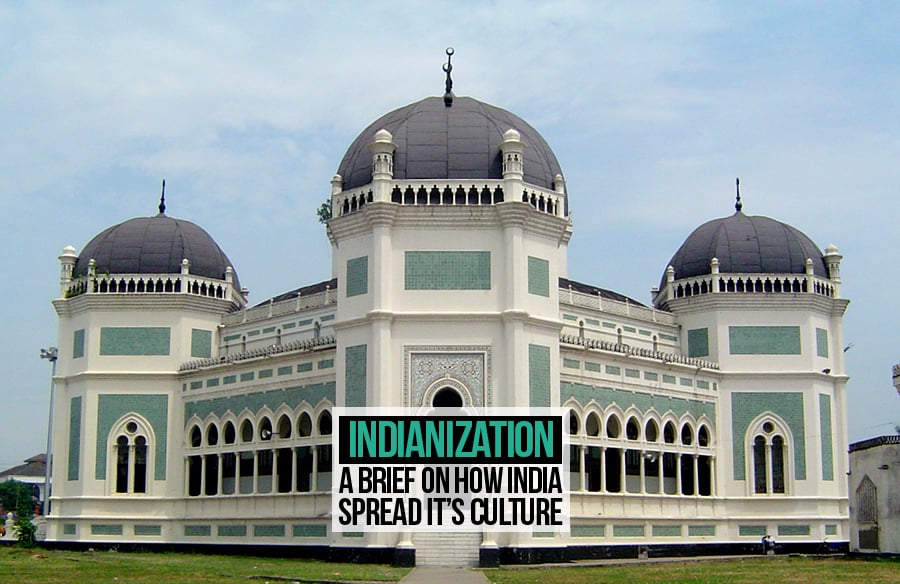
Have you ever wondered why there are so many similarities in Southeast Asian countries? Well the reason for that is Indianization. Between the 5th century to the 15th century, the spread of Indian languages, culture, economic reach, etc to countries in Southeast Asia was happening. This process is often referred to as Indianization. Most of this influence happened through spread along trade routes. This article explores in brief some countries that were influenced by India and the similarities that came to be.
India, today as we know it is just a country but in history it is often referred to as a subcontinent. The influence of India was farther spread than the boundaries of what it is today. It encompassed Pakistan, and Bangladesh but also at points in history had even Nepal, Afghanistan and other countries. Though India was the target of many invasions due to its rich wealth as well as the richness in terrain that provided for an abundance of harvests, India itself did not seek out for expansion further beyond the Indian subcontinent. There was only a peaceful exchange of cultures.
There was already a well established contact between several ports in the Indian Ocean and Indian merchants would come here to settle. Through the trade, traders brought various Indian practices and ideas. The ideas would be about politics and society. Indian influence is traced back to as far as the 5th century but became stronger in the 8th century. It was during this time that Hinduism, Buddhism and Islam, in that order, spread to other countries. This was also how Sanskritization happened. The rulers of Southeast Asia were eager to adopt any techniques that could help to strengthen their power. The Brahman scholars of India helped them achieve this by providing insights on politics, Indian legal systems, etc. It is important to note that the practices were not exactly replicated. Many techniques, thoughts, etc were learnt and then adapted to local needs.
Indonesia
If you have ever been to Indonesia or consumed Indonesian media, you might have realised that a lot of Indonesian names are similar to that of Indians’. For example, Dewi, Aditya, Ratna, etc. In Bali, one finds statues of Vishnu and other Hindu gods on road intersections. There are also many shows performed about the Ramayana. Indonesia has its own versions of the Ramayana as well. There are also similarities in the traditional fabrics donned by Indonesians. Like the Ikat fabric. This is due to the influence on Indonesia that was brought by Indians.
The only reason Indian explorers were dispatched to Indonesia was for trade. Trade between India and Indonesia provided Indonesians with an opportunity to learn about Indian Hinduism and its various facets of culture. The understanding of Indian Hinduism in Indonesia altered the social structure of the country and various aspects of its art and religion. Hindu temples, like those in Java and Bali, as well as literary and creative works of art demonstrate how this has influenced the culture.
The Indian Epics, the Ramayana and the Mahabharata, have had a profound influence on Indonesian history and culture and are still read by readers there. On full moon nights, Javanese Muslims perform the Ramayana dance in the open-air theatres of Prambanan, Java. The relationship between the two nations persisted even after Islam was adopted, and not just because India is home to a sizable Muslim population. The Baiturrahman Grand Mosque in Aceh and the Great Mosque in Medan are two examples of how Indian Mughal design has had a significant influence on Indonesian Islamic architecture, particularly in Sumatra.

Thailand
India’s interaction with Thailand can be traced back to the fourth century BCE, as indicated by artefacts such as rouletted ware, knobbed vessels, glass beads, semi-precious stones, and ivory found in both regions. When Buddhism arrived in Thailand, it merged with existing religious practices, resulting in a unique form of Buddhism distinct from Indian traditions. Thai society integrated Indian cultural elements while preserving its own distinct character. Many Thai festivals, such as Loy Krathong (“the festival of light”), Songkran (the traditional New Year festival), and Loh Chingcha (swing ceremony), have been significantly influenced by Hindu and Buddhist traditions. Although some aspects of these festivals may originate from India, they have been adapted to reflect a distinctly Thai identity.
Indian arts and legends are a major source of inspiration for Thai drama and literature. Thailand shares the same level of popularity as India with the Hindu epic Ramayana. In the past, Thailand has modified the Ramayana to fit its own way of life, creating the Ramakien, a unique rendition of the story. The languages of Thailand and Dravidian and Sanskrit are closely related. Common Thai words like Ratha Mantri, Vidhya, Samuthra, Karuna, Gulab, Prannee, etc. are nearly exact replicas of their Indian counterparts, indicating the close linguistic ties between India and Thailand. The majority of the words in the Thai language are monosyllabic and have entire meanings on their own.
Cambodia
The historical relationship between Cambodia and India dates back to ancient times. India’s impact on Cambodia is evident in the Hindu-style architecture of Angkor Wat and in the Khmer script, which evolved from the Pallava script of southern India. Developed in the 6th century, the Pallava script influenced the written Khmer language.
The Khmer people of Cambodia predominantly practise Theravada Buddhism, closely linked to the original teachings of the Buddha. Approximately 95% of Cambodians adhere to Buddhism. However, many cultural and religious aspects in Cambodia still reflect Hinduism, which, like Buddhism, originated in India. This connection is most visibly represented in the ancient temples of Cambodia, including the renowned Angkor Wat Temple in Siem Reap. The design of Angkor Wat symbolises Mount Meru, considered the centre of the universe and the dwelling place of gods, encircled by mountain ranges and oceans—a concept rooted in Indian temple architecture. Temples often feature motifs like the ‘churning of the ocean’ by deities and images of Garuda and other Hindu gods. Additionally, similarities extend to customs and traditions, such as the belief in reincarnation and the practice of horoscope matching in traditional marriages, which echo Hindu practices.

References:
- Mishra, P. (2021). India’s Historical Impact on Southeast Asia. [online] Association for Asian Studies. Available at: https://www.asianstudies.org/publications/eaa/archives/indias-historical-impact-on-southeast-asia/.
- History of International Relations. (2019). Indianization. [online] Available at: http://ringmar.net/irhistorynew/index.php/welcome/introduction-5/3-1-vedic-india/classical-india/3-3-indianization/ [Accessed 20 July. 2024].
- ICWA (n.d.). Mapping India’s Historical Ties with Southeast Asia – Indian Council of World Affairs (Government of India). [online] www.icwa.in. Available at: https://www.icwa.in/show_content.php?lang=1&level=1&ls_id=10322&lid=6583 [Accessed 21 July. 2024].
- Vijay, S.N. (n.d.). Finding India in Cambodia. [online] Deccan Herald. Available at: https://www.deccanherald.com/lifestyle/travel/finding-india-cambodia-711324.html.