Finally, having a vision not limited to sports, the International Olympic Committee selected Paris as the Summer Olympics host in 2024. This summer, Paris will turn into a sports festival, with the Olympics commencing in August, and then the Paralympics in the last week of August. This time, Paris has taken a new approach to minimising its carbon footprint by using existing buildings or creating temporary structures.

The Paris Olympics will have a total of 35 venues, housing over 11,000 athletes from different NOCs and refugee teams.
Let’s explore some of the venues and their architectural significance.
- Grand Palais, renovated by Chatillon Architects

The Grand Palais is an iconic structure situated in Paris, and it is a multifaceted cultural facility that functions as a museum and hosts various cultural events. These include exhibitions, fashion shows, and sports events. This architectural marvel is made from as many as 6,000 tonnes of steel and features grand glass roofing and a beautiful Art Nouveau-style staircase. For the Olympics, the Grand Palais will host fencing and taekwondo events most fashionably.
- Aquatics Centre by VenhoevenCS and Ateliers 2/3/4

OAC _©Simon Guesdon

The Aquatics Center, built exclusively for the main sporting event, is one of the few permanent structures. It is designated to host diving and synchronised swimming competitions during the Paris 2024 Games.
The structure is mainly composed of timber, which includes the 80-metre-long roof that flows over the pool, creating a stunning visual.VenhoevenCS and Ateliers 2/3/4’s way of integrating wood into its design process were instrumental in the adoption of French legislation that mandated all new constructions of public buildings to comprise at least fifty percent of timber or another raw material. Another interesting element of the building design of the Aquatics Centre is the photovoltaic solar panels installed on the roof of the building; according to the studios, it is one of the largest solar farms in France.
- Eiffel Tower Stadium

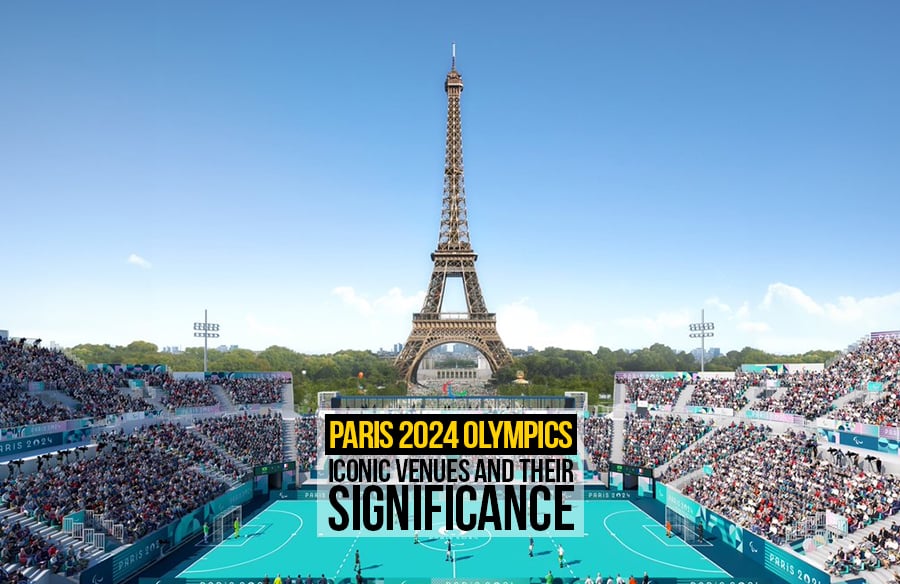
The temporary facility, nicknamed the Eiffel Tower Stadium, was constructed above the grass of Champ de Mars to accommodate beach volleyball and blind football games. Champ Reims plays and practices in a 12,000-seater stadium that has a sand court in the middle, and the views of the court give a direct view of the Eiffel Tower.
- Adidas Arena by SCAU and NP2F

Newly constructed with approximately 12,500 seats, the Adidas Arena is one of the two installations in the city that have been put up for the Olympics. This grand stadium will be used for badminton events during the Olympics as well as rhythmic gymnastics.
The architecture and structure of the arena are a symbol of eco-friendly practices and creative design, which was done by the French studios SCAU and NP2F Architectes with great precision. The arena has 8,000 seats of recycled plastic material, and the outer facade comprises recyclable aluminium cladding. Quite notably, the concrete used in its structure was locally mixed, to avoid emission and have a small carbon footprint. Moreover, the construction waste generated during construction was recycled.
- The Olympic and Paralympic village

The master plan of the Athletes Village was done by Dominque Perrault Architecture which is in the Seine-Saint-Denis district of the city. With the master plan including 2400 apartments and 119 thousand sqm of various activities, offices, and services it is already a part of the Paris Games’ heritage. When the Games are held, the location of the Village will also reduce transport as the Stade de France, and the aquatic centre is just a bus ride away. There are six urban units known as ‘island boats’; such a relevant reference project is the Cité du Cinéma.
This architectural style of the tower block was selected to maintain the greater hierarchy of sustainability with the optimal possibility of lighting and a nice sight out to the Seine. These flexible buildings will accommodate different uses including residential, commercial, administrative, hotel use, student accommodation, and shops. Moreover, they envisioned construction spaces that are open to the public domain and inner courtyards with some scenic outlooks.
- Stade de France by SCAU

As for the Paris 2024 Olympic and Paralympic Games, the largest stadium in France, called Stade de France, will be converted into the Olympic Stadium after being home to France’s largest sports competitions for the last three decades. The stadium is located in Saint-Denis and was designed by the architects Macary, Zublena, and Costantini. It was developed in 1998 for the Football World Cup that was hosted in France.
The distinctive feature of this stadium is the 18 steel masts on top of the roof. It will host various athletic events as well as rugby.
Paris has a unique opportunity to plead its case with the Olympics 2024 as an architecture that is expected to revolutionise the city. Every facility in Great Paris will manifest an intention to combine music and entertainment spaces, social changes, history, and the sustainable development of new architectural masterpieces.
Thus, while serving as Olympic venues in Paris, the architectural role of such places does not end. In this aspect, they convey a large paradigm for improving urban design, proving how major events encourage change and define superior benchmarks for future operations. What is more, the Paris 2024 Olympics are already envisaged not only through the achievements in the sports arena but the constructions to be created in the face of the city of Paris.
References:
- Masri, Sara El. Paris Olympics 2024: A Close-up of This Year’s Sports Venues. 17 June 2024, parametric-architecture.com/paris-olympics-2024-a-close-up-of-this-years-sports-venues/#google_vignette. Accessed 31 July 2024.
- “Dezeen’s Guide to the Architecture of the Paris 2024 Olympics.” Dezeen, 24 July 2024, www.dezeen.com/2024/07/24/paris-2024-olympics-venues-architecture-olympic-impact/. Accessed 31 July 2024.
- “A Look into the Construction of the Paris 2024 Olympic Village.” AEM Trade Shows – ConExpo Con/Agg, www.conexpoconagg.com/news/a-look-into-the-construction-of-the-paris-2024-oly. Accessed 31 July 2024.
- “Timber Aquatics Centre Completes in Paris for 2024 Olympic Games.” Dezeen, 4 Apr. 2024, www.dezeen.com/2024/04/04/timber-aquatics-centre-paris-2024-olympic-games/.