• Careers
  • About
  • Submit Your Story
  • Subscribe
Search for:
  • Facebook
  • Twitter
  • Pinterest
  • LinkedIn
RTF | Rethinking The Future
  • RTF Awards 26
    • Rethinking The Future Awards 2026
    • Previous Awards
      • 2025
        • RTF Awards 2025 | Results
        • GADA 2025 | Results
      • 2024
        • RTF Awards 2024 | Results
        • GADA 2024 | Results
      • 2023
        • RTF Awards 2023 | Results
        • GADA 2023 | Results
      • 2022
        • RTF Awards 2022 | Results
        • GADA 2022 | Results
      • 2021
        • RTF Awards 2021 | Results
        • GADA 2021 | Results
      • 2020
        • ACD Awards 2020 | Results
        • RTF Awards 2020 | Results
      • 2019
        • GADA 2019 | Results
      • 2018
        • ACD Awards 2018 | Results
        • GADA 2018 | Results
      • 2017
        • RTF Awards 2017 | Results
        • RTF Sustainability Awards 2017 | Results
      • 2016
        • RTF Sustainability Awards 2016 | Results
      • 2015
        • RTF Sustainability Awards 2015 | Results
      • 2014
        • RTF Awards 2014 | Results
    • Competitions
      • RTF Writing Competition 2021
      • Architectural Photography Competition May 2020 – Results
      • RTF Architectural Visualization Competition 2020 – Results
      • RTF Essay Writing Competition April 2020 – Results
      • Designer’s Days of Quarantine Contest – Results
      • Urban Sketching Competition May 2020 – Results
  • Articles
    • Architecture+
      • Architectural Community
      • Architectural Facts
      • RTF Architectural Reviews
      • Architectural styles
      • City and Architecture
      • Fun & Architecture
      • History of Architecture
    • Design+
      • Design Studio Portfolios
      • Designing for typologies
      • Product Design
      • RTF Design Inspiration
    • Art
    • Architecture News
    • Construction & Materials
    • Covid and Architecture
    • Know Your Architects
    • RTF Fresh Perspectives
    • Career Advice
    • Case Studies
    • Landscape Architecture
    • Narratives
    • Sustainable Architecture
    • Technology & Architecture
    • Top Architects
    • Travel and Architecture
    • Technologies
    • Architectural Insights
    • Articles
  • Courses
  • Future Talks
  • Projects
    • Architecture
      • Cultural
      • Commercial
      • Educational
      • Healthcare
      • Hospitality
      • Housing
      • Institutional
      • Mixed Use
      • Office Buildings
      • Public Building
      • Recreation
      • Residential
      • Sports & Recreation
      • Temporary Structure
    • Interior Design
      • Commercial Interior Design
      • Corporate Interior Design
      • Healthcare Interior Design
      • Hospitality Interior Design
      • Residential Interior Design
    • Landscape
    • Product Design
    • Skyscraper
    • Sustainability
    • Transportation
    • Urban Design
  • Submit
  • More
    • Architectural Writing Training Programme | WFH
    • Careers
    • About RTF
      • Contact RTF
      • Work with RTF
        • Host your Course with RTF
        • Internships at RTF
          • Editorial Internship | In-office
          • Graphic Design Internship
          • Research Internship | WFH
          • Research Internship | New Delhi
      • Advertise on RTF
      • Subscribe
  • Search for:
Join Rethinking The Future Awards 2026
In Architectural Community

Measuring the Impact of Social Projects in Rural settings

7 Mins Read
Share
Share on Facebook Share on Twitter Pinterest Email

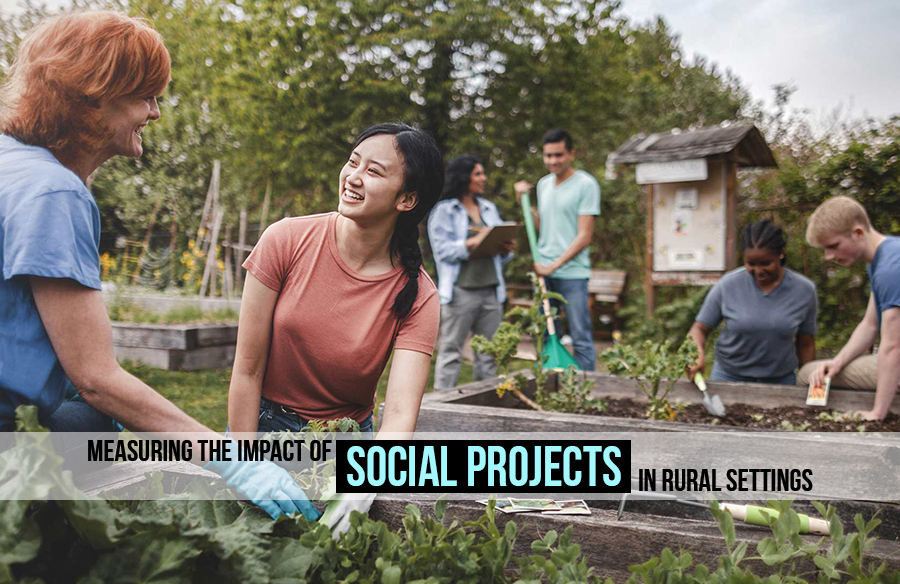
Rural settings are the hub of social development projects. However, there are diverse focus areas in place targeted at addressing living conditions, accessibility to basic facilities, and avenues for economic sustenance. They include well construction to avail clean water, construction of schools and health care, and introducing methods of sustainable farming. While all these initiatives are well-intentioned, the need to consider the actual effectiveness of such programs has never been more acute. How do we tell if they are producing lasting change? Is a social project successful because the number of resources delivered has been counted or is there more to it than that?

Measuring the Impact of Social Projects in Rural settings-Sheet1
Social projects Objectives_© Sehgal foundation

Indeed, it requires a judicious mixture of quantitative and qualitative methods of evaluation, added to a deep understanding of the community and cultural contexts in which such projects are developed, together with concerns about the long-term sustainability of changes. Let us proceed further to understand how we go beyond numbers to come up with a real capture of whether these rural social projects will make a difference.

My Understanding of the Context

Before addressing the mechanisms for measuring impact, a pre-understanding is necessary: no two rural communities are similar. Much more is involved in the success of a project than a checklist of resources or services provided. It depends on how well the project fits into the cultural, economic, and social context of that particular community.

As one example, establishing a medical program that brings modern medicine to a sparsely populated region may make perfect sense. However, if the initiative fails to take into consideration local beliefs about health and healing, then the services may be rebuffed or underutilised even though the services are available. Similarly, the new irrigation system may be technically functional, but unless it takes into account traditional farming practices and issues of community water rights, it may fail to achieve its objectives.

Understanding the rural setting culturally is very essential in designing projects that would have sustainable impacts. Projects with local knowledge and values are usually the most effective and, hence sustainable, over a longer period.

Quantitative Measures: Counting Success

Quantitative metrics often provide the most straightforward way to assess the reach of a social project. For many organisations, success is initially measured by counting outputs: How many wells were built? How many vaccines were administered? How many children enrolled in school after the project started?

These Image rules are meaningful because they give an instantaneous snapshot of the extent or size of a project. If you build 10 wells in a community that had no previous wells, the numerical increase in access to clean water is palpable and clearer; if you have distributed textbooks to 500 children, there is undeniably an uptick in educational resources.

But while quantitative measures are helpful, they often tell only part of the story. Input and output indicators can only provide a picture of the scope, but not the depth of the project. For example, knowing that 100 women were trained in a new skill cannot provide insights into whether they can use those skills to earn a living or improve their quality of life. Numbers alone do not account for long-term effects or the lived experiences of the people involved.

Qualitative Measurements: Listening to the Community

That is where qualitative approaches become very important. Numbers give us the basis, but qualitative measurement gives us the actual life that is happening behind those Image ures. Yes, constructing schools is one thing, while knowing if the kids are coming to school regularly, and being given quality education is quite another.

Qualitative approaches, such as interviews, focus groups, and ethnographic studies, make possible insights that cannot be derived from numbers alone: whether members of the community in which the project is situated feel that the project has improved their lives; whether there is an unexpected impact-for example, increased workload for women after the introduction of new technology. If the local population can maintain the project themselves, or whether they are dependent on outside help.

By listening to the voices of those directly affected, we gain a much deeper understanding of whether a social project truly meets the needs of a community. For instance, an initiative for clean water may be seen as a technical success when construction is found to be far away from people’s houses or some sort of complicated maintenance is involved, it would not benefit as much as earlier thought. It helps to understand daily people’s experiences affected by the project and thus presents a fuller vision of success.

Long-Term Impact: Moving Beyond Immediate Gains

Arguably, the most challenging part of measuring the processes of social projects involves their long-term impact. Where it is easy to count the immediate outputs of the project, such as the number of schools built or the food distributed, many times, the natural and true measure of success often comes months or years later.

This means that an agriculture improvement project, for example, might have an immediate objective relating to yield, but it can take several years to determine if the yield increase results in long-term increases in income, nutrition, and general standard of living. In education projects, the ultimate impact might not be observable until some years have passed when the children either move on into further or higher education or the workforce.

Long-term impact, of course, can only be measured through follow-up evaluations that extend beyond the immediate post-project period. In some cases, this may mean tracking key indicators longitudinally, such as changes in income, health outcomes, or educational attainment. This does presuppose patience, resources, and a long-term commitment that many shorter-term projects may not have designed into their structure.

Sustainability: The Ultimate Test of Success

Sustainability may be the most important measure of success in rural social projects. A project that functions well during the period when outside support is available but which then collapses when funding dries up has failed in one of the most significant ways. The question then is: Are the changes sustainable without continuous external input?

Social projects take a foothold and become successful when the local community is empowered. By building capacity, it means teaching skills, transferring knowledge, and fostering local leadership. A successful project is one that at one point may run itself with minimum outside intervention.

For instance, take a clean energy project that is providing solar panels to a remote village. That may be on paper, but if the village gets electricity, it is considered a success. But if there is no maintenance plan or if the local people are not trained to repair the panels once they break, the project benefits are not going to last. Sustainable projects are those projects that, in addition to bringing an immediate solution, invest in the people who are going to maintain and build upon those solutions over time.

Measuring Success Holistically

Measuring the Impact of Social Projects in Rural settings-Sheet2
Social Projects in Rural Areas_© The print

Ultimately, measuring the impacts of social projects in rural settings demands a balance of quantitative and qualitative approaches. It involves not only counting how many people are served but also comprehension of how lives changed. It means looking over the short-term gains to assess the long-term sustainability and ensuring projects are empowering communities, not building dependency.

Success in rural social development is not simply a function of numerical targets met but of desired and lasting change in the lives of real people. By embracing a more holistic approach to impact measurement, we will have an even deeper insight into what works, what doesn’t work, and how to do it better in the next cycles of efforts toward building stronger, healthier, and more resilient rural communities.

Measuring the Impact of Social Projects in Rural settings-Sheet1
Social projects Objectives_© Sehgal foundation
Measuring the Impact of Social Projects in Rural settings-Sheet2
Social Projects in Rural Areas_© The print
clean water initiativesCommunity Empowermenteducation projectslong-term impactproject sustainabilityqualitative measurementquantitative measurementRural communitiesrural healthcarerural social projectsSocial Developmentsocial impact evaluationsustainable developmentsustainable farming
Author Shanu Rathi

Shanu Rathi is someone who is mesmerised by the innovation created by human minds. She has many ambitions starting from writing a book to exploring the secrets of architecture.

Prev Post

Where Craft Meets Minimalism by Beni Rugs x FRAMA

3 Mins Read
Next Post

An architectural review of Stree 2

6 Mins Read

Related Posts

Building Brands: DOMS Industries Ltd

June 12, 2026

Soundscapes of Cities: How Noise Shapes Spatial Experience

June 12, 2026

Building Brands: Maped Group

June 12, 2026

Building Brands: 3M Company

June 10, 2026

Building Brands: Staples, Inc

June 10, 2026

Building Brands: ITC Limited – Classmate

June 10, 2026
  • Join Now
  • How to Design Architecture Portfolio
  • The Ultimate Thesis Guide
  • Complete Architecture Package for Design Studios
  • Complete Architecture Package for Students
  • How to Get Your Projects Published | Online Course
  • How To Build A Brand For A Design Studio | Online Course
  • Introduction to Architectural Journalism | Online Course
  • Design Thinking in Architecture | Online Course
  • Introduction to Landscape Architecture | Online Course
  • Introduction to Urban Design | Online Course
  • How to Use Biomimicry in Architecture | Online Course
  • Introduction to Product Design | Online Course
  • How to Design Streets | Online Course
  • Introduction to Passive Design Strategies | Online Course
  • Introduction to Skyscraper Design | Online Course
  • How to Design Affordable Housing | Online Course
  • Complete Guide to Dissertation Writing | Online Course
  • The Ultimate Masters Guide For Architects | Online Course
  • The Perfect Guide to Architecting your Career | Online Course
  • Complete Architecture Package for Design Studios v 3.0
  • Complete Architecture Package for Students v 3.0
  • Test
  • About RTF

    Contact RTF

    RTF Content Policy

    RTF Privacy Policy

    RTF Terms & Condition

  • Facebook
  • Twitter
  • Instagram
  • Pinterest
  • Dribbble
RTF | Rethinking The Future

©2025 Rethinking Internet Media Pvt Ltd All registered. Sitemap

Top
  • Articles by RTF
    • Architecture+
      • Architectural Community
      • Architectural Facts
      • RTF Architectural Reviews
      • Architectural styles
      • City and Architecture
      • Fun & Architecture
      • History of Architecture
    • Design+
      • Design Studio Portfolios
      • Designing for typologies
      • RTF Design Inspiration
    • Art
    • Architecture News
    • Career Advice
    • Case Studies
    • Construction & Materials
    • Covid and Architecture
    • Interior Design
    • Know Your Architects
    • Landscape Architecture
    • Materials & Construction
    • Narratives
    • Product Design
    • RTF Fresh Perspectives
    • Sustainable Architecture
    • Top Architects
    • Technology & Architecture
    • Travel and Architecture
    • Technologies
    • Architectural Insights
  • Awards
    • Rethinking The Future Awards 2022
    • Previous Awards
      • 2021
        • RTF Awards 2021 | Results
        • GADA 2021 | Results
      • 2020
        • RTF Awards 2020 | Results
        • ACD Awards 2020 | Results
      • 2019
        • GADA 2019 | Results
      • 2018
        • ACD Awards 2018 | Results
        • GADA 2018 | Results
      • 2017
        • RTF Awards 2017 | Results
        • RTF Sustainability Awards 2017 | Results
      • 2016
        • RTF Sustainability Awards 2016 | Results
      • 2015
        • RTF Sustainability Awards 2015 | Results
      • 2014
        • RTF Awards 2014 | Results
    • Competitions
      • RTF Architectural Visualization Competition 2020 – Results
      • Architectural Photography Competition 2020 – Results
      • Designer’s Days of Quarantine Contest – Results
      • Urban Sketching Competition May 2020 – Results
      • RTF Essay Writing Competition April 2020 – Results
      • Architectural Photography Competition 2019 – Finalists
  • Courses
    • The Ultimate Thesis Guide
    • Introduction to Landscape Architecture
    • Perfect Guide to Architecting Your Career
    • How to Design Architecture Portfolio
    • How to Design Streets
    • Introduction to Urban Design
    • Introduction to Product Design
    • Complete Guide to Dissertation Writing
    • Introduction to Skyscraper Design
  • Projects
    • Architecture
      • Cultural
      • Commercial
      • Educational
      • Healthcare
      • Hospitality
      • Housing
      • Institutional
      • Mixed Use
      • Office Buildings
      • Public Building
      • Recreation
      • Residential
      • Sports & Recreation
      • Temporary Structure
    • Interior Design
      • Commercial Interior Design
      • Corporate Interior Design
      • Healthcare Interior Design
      • Hospitality Interior Design
      • Residential Interior Design
    • Landscape
    • Product Design
    • Skyscraper
    • Sustainability
    • Transportation
    • Urban Design
  • More
    • Work with RTF
      • Host your Course with RTF
      • Architectural Writing Training Programme | WFH
      • Internships at RTF
        • Editorial Internship | In-office
        • Graphic Design Internship
        • Research Internship | WFH
        • Research Internship | New Delhi
      • Careers
    • RTF | About RTF
    • Submit Your Story
    • Contact
    • Advertise
We use cookies to ensure that we give you the best experience on our website. If you continue to use this site we will assume that you are happy with it.