What is Cosmopolitan Living
In today’s world, all big cities are becoming cosmopolitan. In India’s context, it is divided into states based on different languages, cultures, food, customs, etc. India stands for Unity in this Diversity. While there is diversity, there is also migration for better growth, facilities, and comfort. Migration opens opportunities for cultural exchange. Neighbourhoods with people from different regions and cultures should open so many doors to curiosity and socialisation. But, this migration leads to villages and small towns becoming emptier and cities becoming crowded. And as the need arises to accommodate more and more people, cities have started expanding vertically.
Humans are Social Animals
Much has been discussed about how the surrounding environment affects people’s mental and physical well-being. As humans are social creatures, their well-being is also impacted by their social life and cultural belonging. There are three major factors contributing to socio-cultural belonging: Social network, social cohesion, and place attachment.
A social network is formed by like-minded people making a community, a group of friends, a community of a particular workplace, a group of people living in the same neighbourhood, a group of people belonging to the same region, a group of people speaking the same language, and so on. A commonality that is shared by people makes them a community and becomes their network.
Cohesion is defined by shared values. It forms an attachment with the network. People sharing values in a network develop attachment and hence sense of belonging. They might also have common aims which they work towards together, which develops cooperation and participation.
Place attachment is about attachment to a physical space. Mostly, in senior citizens, this is seen. They would have lived in their town and house their whole life and it would have created attachment in them which makes them feel that they belong there. It has become their comfort and their whole life they would have made so many networks and would have developed deep cohesion with people, that idea of shifting to a partially isolated apartment seems harsh.
Lifestyle and Design
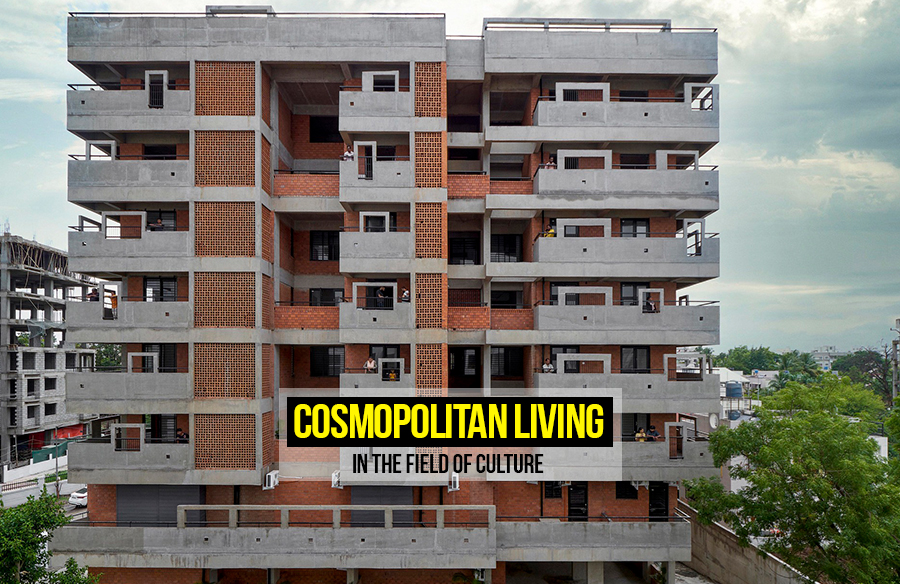
The cities growing vertically have advantages economically and provide fast construction to fulfil the rising need. But also, as humans move away more and more from the ground, it isolates them. High Rise buildings provide a great amount of privacy and keep one away from traffic noises along with cutting them off from the ground. Humans have dwelled on the ground forever. The connection with the ground has not only been for dwelling but also occupation and food. Earth is the ultimate place of attachment for humans. Living underground or high above ground has brought discomfort physically, psychologically, socially, and culturally.
Nowadays, in the busy metro lifestyle, people hardly interact with their neighbours. The design holds the power to provide or not provide the opportunity to socialise in a space. Space configuration can easily guide users to either keep moving or take a pause. Wherever there is a pause, there is an opportunity for interaction. Design becomes an essential tool to foster interaction between people. There have been attempts at making community spaces as common terraces and amenities.


Some of the apartment designs incorporate balcony extensions, overlooking spaces, and atrium as elements to provide an opportunity for people to pause and look around. However, it still doesn’t satisfy the social needs of residents. These attempted solutions encourage more formal interactions which are shallow and don’t lead to social networking, cohesion, and attachment. Most of the apartment buildings are mixed-use, which again limits the activities on the ground for residents.
Community Living
Indian lifestyle has always been inclusive of social interactions and group activities. The houses used to be connected and at different levels, people used to share spaces. At the house level, central courtyard spaces were there towards which all the other spaces such as the living room, kitchen, and bedrooms used to open up. Outside the house, verandahs were there which were adjoined to neighbour’s verandahs, where people could sit and talk to their immediate neighbours. For every cluster of a few houses, common hawks were there, where people from the whole cluster could come together. These chawks used to have some kind of common tree or a temple which gives the motivation to people to come together for a common goal. This kind of community living can not only foster social and cultural values but can also preserve them for coming generations.
Vernacular architecture is unique to its geography, people’s lifestyle, and culture. It provides them with their social needs, and cultural exposure and keeps them connected to their soil. Space planning is such that all these necessities come built into it.

Cultural Preservation
A design can be adaptive or crisp. Meaning, that some designs offer the flexibility to users to customise while some direct them exactly how they should be occupied. So the question of one size fits all is relevant for architecture as well.
Humans dwell in groups with family, a community of like-minded people. When migration happens, people change their location but they still have their roots in their culture where they come from. The opportunity to preserve the culture has to be offered for people to stay and feel connected to their roots. Imagine living in a building where a Punjabi family’s home looks the same as a Malayali family’s. Designs have become so modular for the ease of fast construction and mass production, that people are losing their cultural identities.

For example, Aranya housing designed by B.V. Doshi offers the adaptability to users to make interior changes as per their needs and also allows future expansion vertically and horizontally. In today’s time having this kind of a housing scheme spanned across land might not be possible in cities but the ideas and concepts used can be adapted in some ways for vertical housing as well to offer flexibility. The ability and flexibility to bring and preserve one’s culture wherever one might dwell is something that should be offered in today’s cosmopolitan living.
Looking at the growth in population, migration to cities, and scarcity of land availability, vertical housing satisfies the need for accommodation, cost-effective housing, fast construction, and minimum land footprint. The idea is not to discard the concept of vertical living but to keep people connected to the ground and provide them with their social and cultural needs with affordability. The housing societies having many amenities and community spaces very well designed might not be affordable to middle-class people who make up the majority of the population of India.
References:
(No date) Full article: Reflections on IAIA 2024 annual conference. Available at: https://www.tandfonline.com/doi/full/10.1080/14615517.2024.2370639 (Accessed: 11 August 2024).
Mollard, M. (2022) Revisit Aranya low-cost housing, Indore, Balkrishna Doshi, The Architectural Review. Available at: https://www.architectural-review.com/buildings/revisit-aranya-low-cost-housing-indore-balkrishna-doshi (Accessed: 11 August 2024).