Cities of today are hosts to the aspirations of millions of people that reside there and thus are always under development, moving towards new heights of growth and expanding to accommodate the up-and-coming demands of urban living. This constant evolution of cities combined with the urban lifestyle has resulted in never seen densities in the urban fabric and the congregation of people of different cultures, creating a melting pot of diversity and innovation. As cities continue to grow and change, the need for more loose points—public spaces—in these fabrics becomes evidently important.

“Public spaces are all places publicly owned or of public use, accessible and enjoyable by all for free and without a profit motive.”
The United Nations Charter for Public Spaces
Importance of Public Spaces in Developing Countries
The developing cities in the growing economies of Southern Asia are not only windows of opportunity for its population, which hopes for qualitative urban environments in the future, but are equally hosts to an abundant and rich accumulation of culture, heritage, and traditions. These cities are often socially fragmented, and people are moved into isolation from their roots in their day-to-day modern lifestyles. In such times, public spaces, apart from being places of respite in the fast-moving urban landscape, also play a pivotal role in fostering communal connections, promoting socialisation, and strengthening congregation-dependent informal economies in these cities.

Social Development Catered by Public Spaces
For Recreational Purposes and Community Engagement: Public spaces are crucial elements of the urban form of a developing city, as they attract people from various backgrounds to occupy spaces for personal recreational activities as well as for engaging with other members of the community. Parimal Garden in Ahmedabad or the Lodhi Gardens in Delhi serve as examples of public spaces being utilised for relaxation, picnics, and leisure. Many such parks, lakefronts, riverfronts, and green spaces are examples of the integration of ecology in public spaces, which offer a temporary disconnect to the residents from the hustle and bustle of city life.

Hosting Cultural Festivals and Celebrations: Developing countries are often culturally rich and diverse in their populations, offering an evenly spread calendar of festivals and events that celebrate the traditions and heritage of the civilization. During such nationwide celebrations, it’s these public spaces that are completely taken over by the general public. Songkran Festival in Thailand is one such example where in mid-April every year the open spaces of the city come alive with everyone coming on street to engage in water fights in this celebration of purification.

Space for Democratic Citizen Expression: Public spaces are platforms for the residents of democracies to exercise their right to freedom of speech. August Kranti Maidan, previously known as Gowalia Tank Ground, is an example of a public space that is synonymous with the history of protests that have arguably shaped the political landscape of India, both pre-independence and even post-independence. It has served as a stage from the beginning of the Quit India Movement by Gandhiji in 1942 to being the host of Anna Hazare’s protest and the CAA protests, along with many others in between. Many such spaces that host democratic expressions of the country tend to be considered landmarks of civic engagement and become part of national history.

Improving Quality of Life of Citizens: A large number of studies today have linked the deteriorating health conditions of the residents of cities to the poor quality of urban public spaces. The Centre for Urban Design and Mental Health associates urban living with increased rates of mental health issues. This has forced the cities of today to design public spaces that improve the physical and mental health of their citizens so as to contribute to a larger improvement in the index for qualitative life.
Economic Development Catered by Public Spaces
Positive Impact on Informal Economy: Economies in South Asia are constituted by a large share of informal business patterns that often have an interdependent relationship with the public spaces that host them. Public spaces come with a variety of features, such as openness, greenery, and central accessibility, amongst many others, that make them usually more attractive to a larger public congregation activity. This goes on to eventually help such informal markets and businesses to thrive and, in turn, contribute to the overall economic growth of the working class in society. An example of this would be the temporal vendors at the Bhaktapur Durbar square in Nepal, that set up their stalls daily in the morning and evening, selling essentials and utilising the peak hours of footfall in this historic public space.

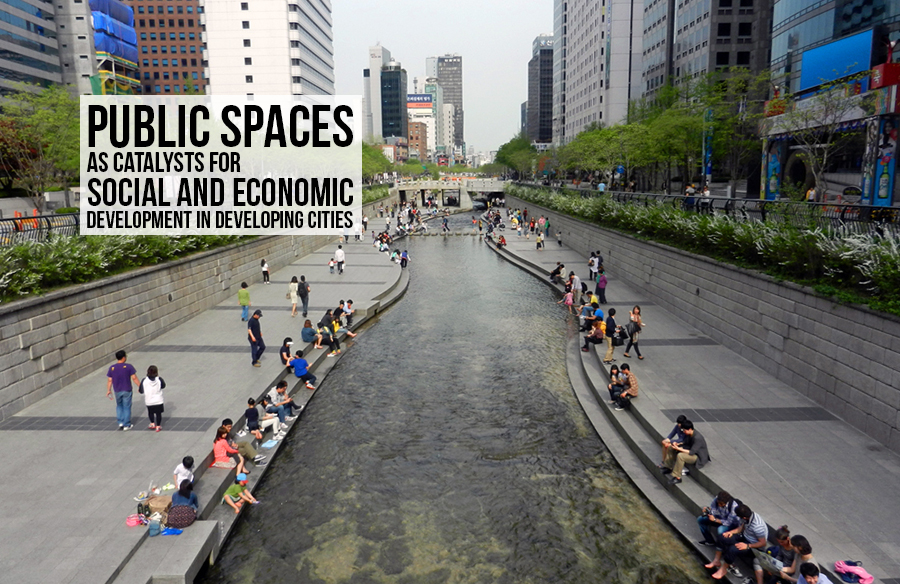
Appraisal in Land Values around the Public Space: The presence of qualitative public spaces in a surrounding vicinity can positively impact the place’s real estate values. Seoul’s Cheonggyecheon River Revitalization Project is a prime example of how developing a green waterfront park amidst the commercial centre of the city has led to an appraisal of property values. Such public spaces, which attract people for recreational and social connections, stimulate the economic growth of the surrounding neighbourhood.

Increase in Tourist Footfall: Public spaces that are well-designed and/or well maintained, make them prime attractions for tourists. These spaces, apart from being recreational, can also reflect the culture and heritage of the city. Waterfronts, beachfront, and public plazas are a few examples of such public spaces that attract tourists and also contribute to the local informal economy in and around these places.
There has been a rising interest amongst government bodies around the world to develop better public spaces for cities, especially after the pandemic. But the developing cities of South Asia still have a long way to go, as except for a few major public spots congregated in a few major neighbourhoods, there are a lot of underdeveloped existing public spaces that need to be revitalised and transformed into vibrant community hubs. Cities also need to focus on considering contextual needs and identifying programs specific to a neighbourhood in the developing and growing areas of the city. Investments in such spaces will go on to enhance the quality of life of residents as well as increase opportunities for economic activity and tourism. This can lead to more inclusive urban development that benefits all residents.
References:
Anzola, F. (2014) People going about their day in Bhaktapur , Wikimedia Commons.
Biennial of Public Space (2011) ‘Charter of Public Space’. Isituto Nazionale di Urbanistica. https://inu.it/wp-content/uploads/Inglese_CHARTER_OF_PUBLIC_SPACE.pdf
Chimalapati, V., Kapoor, H. and Mehta, P.V. (2024) Reaching for urban prosperity: A public space opportunity, WRI INDIA. Available at: https://wri-india.org/blog/reaching-urban-prosperity-public-space-opportunity#:~:text=Catalyzing%20Social%20Change,%2C%20non%2Dtransactional%20social%20interaction (Accessed: 08 August 2024).
CP Kukreja Architects (2021) Impact of urban designs on Mental Health, Impact of Urban Designs on Mental Health | Project – CP Kukreja Architects. Available at: https://www.cpkukreja.com/blogs/impact-of-urban-designs-on-mental-health.html (Accessed: 10 August 2024).
Grayswoodsurrey (2014) CheonggyecheonSeoul, Wikimedia Commons.
Halun, J. (2023) Times Square, New York City, Wikimedia Commons.
Kim, S. (2015) Why public spaces are a basic need for cities, World Economic Forum. Available at: https://www.weforum.org/agenda/2015/04/why-public-spaces-are-a-basic-need-for-cities/ (Accessed: 07 August 2024).
McCay, L. and Litman, T. (no date) Facts and figures, Centre for Urban Design and Mental Health. Available at: https://www.urbandesignmentalhealth.com/facts-and-figures.html (Accessed: 09 August 2024).
Parab, G.V. (2018) The India Gate, All India War Memorial, Wikimedia Commons.
Rahilarious (2023) Mini bridge Parimal Garden, Wikimedia Commons.
Rodrigues, L. (2024) ‘August Kranti Maidan’. Mumbai: Bruhand Mumbai NagarPalika. https://www.mcgm.gov.in/irj/go/km/docs/documents/D%20Ward/Heritage-Sites/Heritage-14.pdf
Shedrick, J. (2013) The Water-fight in Chiang Mai during Songkran_2011-32, Flickr.
Universal History Archive (1942) Mohandas Gandhi was driven to Gowalia Tank Maidan, 1942, Wikimedia Commons.