Indian history exemplifies the resilience and agility of its people, who have been residents of this peninsula from one of the first civilizations of humankind to the contemporary times of urban development. The land of India has seen multiple forms of governance, ranging from the autonomous territories of princely states to colonial rule and then the dawn of an independent nation. These varying eras of influence, combined with interactions with multiple cultures and civilizations facilitated by travel and trade, along with the local context and diverse geographic conditions, have all weaved together the complex and ever-evolving cultural fabric of India. With each changing course of history, Indian culture has accumulated and built amid the influential forces around it resulting in a richer and more vibrant tapestry.

Pact With Nature
There certainly exists a cyclic relationship between the built environment of any region, its culture, and its people, and if one is under change and influence, this is certainly reflected in other counterparts. An example of this is the reverence for nature and unwavering respect for all living beings in Indian culture. These are logical responses to civilization’s climate, which is hot and humid, raising the need for more open and greener spaces where flora, fauna, and civilization coexist.

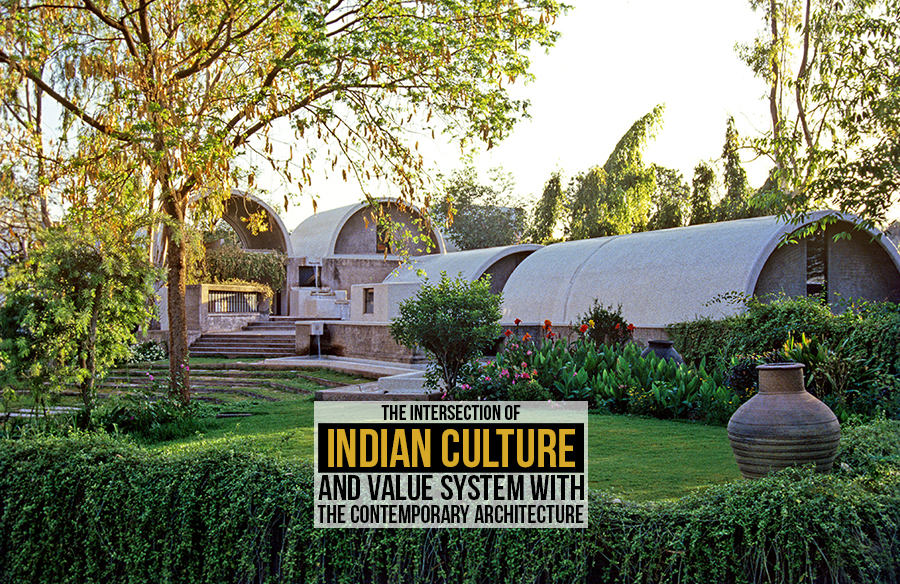
Sangath by Ar. B.V. Doshi is one of the most exemplary interpretations of harmony with nature, our culture, and climate while producing a timeless piece of architecture. The sunken office floor for insulation against the hot climate, the water body and the greens to create a cooler microclimate, and the flooring in the memory of a dead mango tree, Sangath, display the Indian culture’s sensitised values for nature accompanied by a modern interpretation for a workspace. This paints a larger perspective on the intrinsic values of our civilization, which attempts to develop a pact with nature as we share our lives with it.
Community-Centricity

For centuries, Indian societies have been centred around community, where social life thrives on the thresholds of residence. This community-centricity has proved to be the backbone of these societies, as it offers its residents benefits like a shared pool of resources, an informal social support system, and a strong sense of belonging and identity. The Pol Houses of Ahmedabad did this with the extended plinths that open up on the pathways, while the Bhunga housings in Kutch achieved this with shared plinths, but at the core of it remained the idea to be connected with whom we reside and share a part of our lives with.

The advent of modernization has not only compartmentalised and formalised our residences; it has also taken the informal value and life from our community spaces through a sheer lack of empathy for the social interactions that ought to take place in such surroundings. Though examples like Aranya Low-Cost Housing and Belapur Housing by Ar. B.V. Doshi and Ar. Charles Correa, respectively, highlights that even in a formalised setup of an evolving society, informal community spaces, the incrementally of an Indian family, and qualitative and contextually relevant living spaces can all be created that re-interpret the Indian culture. In contemporary times of crafting more and more urban environments, the Sanjaynagar Slum Rehabilitation Project by Community Design Agency illustrates the role of various scales of shared spaces and participatory design processes to uniquely shape the outcome, which enhances the social fabric and uplifts the quality of life of residing citizens.
Art as Identity

India has a rich history of arts that have evolved to become part of the culture. The paintings in Ajanta-Ellora, the ancient carvings of Khajuraho, the Madhubani paintings, and the Warli Arts are not just merely decorative works but are tools of documentation of the culture, beliefs, customs, traditions, and daily lives of the civilization through exquisite craftsmanship. Contemporary architectural practices have often sought to re-integrate these crafts into the public eye through thoughtful integration with regional crafts. The Krushi Bhavan in Bhubaneshwar, Odisha, by Studio Lotus, has an outer perforated skin crafted from three different colours of brick that creates a pattern reminiscent of a traditional weaving craft, Odisha Ikkat. This integration is a celebration of the rich cultural heritage of the region as well as a tool to create a sense of identity and belonging for the community, where the past and present exchange a dialogue.
Today, the cities of India are evolving rapidly, and the factors influencing our cultures and, thus, our built environment are at their peak. However, the question we are facing today is whether we will continue to allow our built environment to be influenced by local culture, or if we will isolate it and make it invariable, regardless of the surrounding context. This certainly makes our built environment monotonous and identity-less, which in turn will go on to reflect our lost trust in our centuries of accumulated knowledge to not utilise them in our contemporary exercise of crafting meaningful architecture. Therefore, we must recognize the value of preserving and celebrating our vibrant culture in our built environment, so that we can contribute to creating a more harmonious and pluralistic society. This attempt goes a long way towards creating spaces that resonate with people on a deeper level and stand the test of time.
References:
Abdel, H. (2020) Krushi Bhawan / studio Lotus, ArchDaily. Available at: https://www.archdaily.com/941738/krushi-bhawan-studio-lotus (Accessed: 27 July 2024).
Abdel, H. (2022) Sanjaynagar Slum Redevelopment Project / Community Design Agency, ArchDaily. Available at: https://www.archdaily.com/982534/sanjaynagar-slum-rehabilitation-project-community-design-agency (Accessed: 26 July 2024).
Choksi, A. (2021) Traditional Indian art & crafts in architecture and interior design, Design Dekko. Available at: https://www.designdekko.com/blog/traditional-indian-art-crafts-in-architecture-and-interior-design (Accessed: 28 July 2024).
Publishing, M. (2022) Introduction : Modern architecture and Indian tradition, Issuu. Available at: https://issuu.com/mapin/docs/balkrishna_doshi/s/16427566 (Accessed: 26 July 2024).
Sabu, S. (2021) Cultural identity in Indian architecture: A key to sustainability and inclusivity, Design Dekko. Available at: https://www.designdekko.com/blog/cultural-identity-in-indian-architecture-a-key-to-sustainability-and-inclusivity (Accessed: 27 July 2024).