Understanding Community realms
Community is a very diverse world, full of aspirations and togetherness, and delves into uniting all groups irrespective of their gender, religion, culture, and background but simultaneously perpetuating the respect and integrity of one’s identity. This diverse and multifaceted group of people or community gives a broader and denser definition to their space of working, living, and for younger generation learning and playing, neighbourhood. A sustainable and functional neighbourhood works on the principles of ethical and incorporative methods of living and working with a diversified community.
WRI India is a research organisation that works on the vision of building a better community in the realms of environmental and economic opportunities and human well-being. WRI delineates a ‘Livable Neighbourhood’ as a plaque card to the multiverse of the healthy environment through equal access to all the services. This vision comes through the research and multiple studies of what a ‘livable neighbourhood’ means to the community, for some might only be a word, and for some a part of that reality.
Adversity in diversity
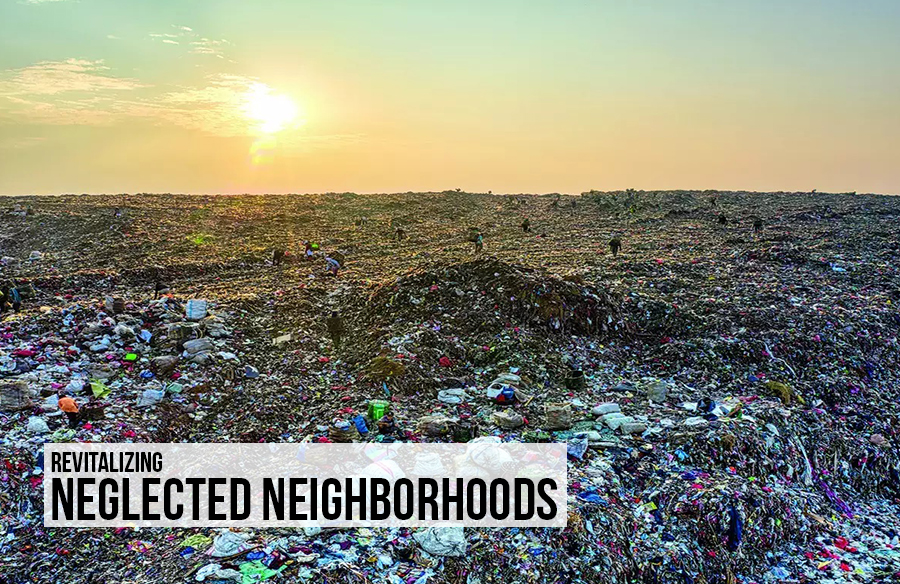
Certain case studies determine that only through some drawbacks a neighbourhood could be labelled as uninhabitable. Bhalswa Landfill is an unhealthy neighbourhood in northwest Delhi that ascends 53 metres over the Bhalswa colony, Bhalswa Dairy, and Shrahddhand colony. According to WRI India around Bhalswa Landfill resides the resettlement community who were relocated under the Resettlement Program in 2001. The matter in question is the amount of waste that is being generated and disposed of near the resettlement colony leading to a foetid smell, polluting water facilities leading to water-prone diseases, and higher chances of frequent fire. The community migrated here, particularly working blue-collar jobs or in the landfill area. Similarly, various cities are prone to similar situations such as Kodungaiyur in Chennai which shelters 71,000 slum households in unhealthy surroundings, Dhapa in Kolkata suffers from an identical crisis and so does Mavallipura in Bangalore.
Multiple cities with similar resettlement neighbourhoods near landfill areas continue working and living in undesirable environments. The site’s alarming condition and bounded access to public services are drawbacks of the ‘Uninhabitable Neighbourhood’ in these various cities.


A step towards ‘Livable Neighbourhood’
Amidst of uninhabitable neighbourhoods few have taken steps for the community’s better working and living conditions, such as Vasant Udyaan in New Delhi. It is labelled as a “garden of pride’ ; the space truly justifies its name. The site was in ruins, a prominent crime scene, and an insecure junction for women and children; the garden was secured fruitfully through the support of devoted individuals of Vasant Vihar, Munirka Hill View Apartments, Police Colony, and CBI Colony. made into the hub of social and educational entities Vasant Vihar Garden is not only for evening walks but a definition, hub for that neighbourhood.
The Ministry of Urban Development in the year 2018, introduced the Livability Index for the Initiative towards ‘Livable Neighbourhood’. The index breaks down the framework into 4 verticals – Institutional, Social, Economic, and Physical, a detailed and illustrative flowchart delineates every vertical weight and sub-indices.

Certain more measures for the redevelopment and efficient functioning of rural neighbourhoods the Government of India designed a scheme for 300 Rurban clusters. The scheme primarily focuses on the progression of these clusters with enhancement on the functioning of components in sanitation, public transport, infrastructure, housing, and social welfare.
AMRUT, Atal Mission for Rejuvenation and Urban Transformation is a scheme launched by Prime Minister Narendra Modi in June 2015 under the Government of India. The scheme predominantly anchors the implementation of civic amenities in the urban area and improves the quality of life for the disadvantaged, poor people. HRIDAY, The National Heritage City Development, and Augmentation was launched in January 2015 to rejuvenate the urban planning through enhancements in different sections and preserve the heritage character of 12 cities – Ajmer, Amritsar, Amarvati, Badami, Dwarka, Gaya, Kanchipuram, Mathura, Puri, Varanasi, Velankanni, Warangal. Through this scheme, the Government of India endeavoured to achieve holistically not only the heritage but also regenerate civic amenities in the livelihood of the neighbourhood.