The studio was hushed, the only sounds were the scratching of pencils and the rustling of vellum as a dozen students hunched over their drafting tables. Among them sat Amanda, an architecture major pouring over her latest assignment – sketches for an urban revitalisation project in a rundown neighbourhood.

Her mind kept wandering from the gridded blueprints, her gaze drifting up to the tattered movie posters plastering the concrete walls. That`s wherein she discovered her creative muses, inside the fantastical geographical regions of cinema and literature that sparked her creativeness past the inflexible practicalities of her selected field.
Amanda has been passionate about movies for so long as she ought to remember. As a child, her preferred films were no longer the everyday whimsical lively adventures, but the grand, visually hanging dramas and technology fiction epics that transported her to richly conceived worlds. While other kids got lost in the storylines, Amanda became fascinated by the meticulous architectural backdrops, from the harsh urban decay of 1980s New York in Once Upon a Time in America to the minimalist space station sterility of 2001: A Space Odyssey.

It was in exploring these fictional spaces that she first discovered architecture’s power to shape moods, to underscore thematic ideas through their very construction. The rigid, oppressive feel of the underground metropolis in Fritz Lang’s Metropolis mirrored the totalitarian society it contained. The Overlook Hotel’s dizzying, maze-like interiors in The Shining personified the psychological unravelling of Jack Nicholson’s character.
Literature opened further portals into imagined architectural realms. The fantastic, naturalistic designs of Catalan architect Antoni Gaudí were said to be inspired by John Ruskin’s transcendental writings on geometry and the built environment as extensions of the natural world. Gaudí’s famous buildings – like the undulating stone facades of the Sagrada Familia cathedral – did indeed seem to have grown organically from the earth, rather than crafted by human hands. Amanda was captivated by their rippling, biomorphic forms.
In her more surreal moods, she would turn to authors like Italo Calvino and Jorge Luis Borges, who conjured cities of pure metaphysical abstraction only to dismantle them through the very act of writing. In books like Invisible Cities and The Aleph, architecture became an exercise in conceptual paradoxes, of reconciling the finite with the infinite, the physical with the metaphorical. Each new reading revealed hidden spatial dimensions in their fictional labyrinths.
Even dystopian visions of dark satire like those found in Mary Shelley’s Frankenstein or the works of Aldous Huxley and Kurt Vonnegut intrigued Amanda. There was truth in their sinister portrayals of architecture’s capacity for social control, how structures could be employed as instruments of dehumanising governance just as easily as they provided shelter. It was a sobering reminder of an architect’s profound responsibility to those who would ultimately inhabit their creations.

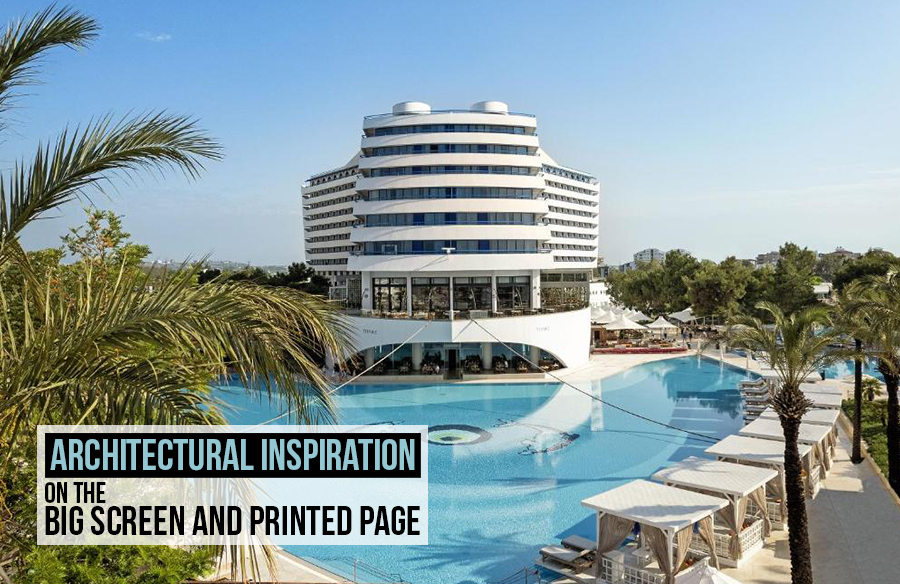
Yet the influence of these fictional architectural works on real-world design proved equally fascinating to Amanda. She was well-versed in the histories of actual landmark buildings like Turkey‘s Titanic Hotel resort, an ostentatious full-scale reproduction of the ill-fated liner from James Cameron’s blockbuster movie. Postmodern architects like Ricardo Bofill in Spain and John Portman in America had co-opted the stylistic motifs of classic Hollywood movies and film noir for ambitious housing and commercial projects. The moody, shadow-laden angles and contrasted lighting schemes of Chinatown and L.A. Confidential were unmistakable influences.
Beyond mere aesthetic imitation, many of architecture’s most innovative ideas originated in speculative fiction centuries earlier. The first real proposals for completely modular, prefabricated housing sprang from 18th-century philosophers and novelists pondering utopian “ideal cities.” The very notion of arcologies – vast self-contained habitats combining residential, industrial, and agricultural components into a single sustainable ecosystem – arose from sci-fi writers like Paolo Soleri envisioning how humanity might colonise inhospitable environments like deserts or other planets.
To Amanda, this dialogue between imagined and actualized architectural works was thrilling, a dynamic exchange continually redefining the relationship between human beings and the built environment. As she absorbed these myriad inspirations splashed across the walls around her, she found renewed creative energy flowing back into her drafting sketches. Her latest design began taking on an almost sculptural form, eschewing traditional boxy units for curvaceous, organic contours that seemed to sprout upwards like a living entity.
Amanda smiled to herself as she worked late into the night, fueled by visions of buildings not just as utilitarian shells, but wondrous structures blurring the lines between reality and imagination. She couldn’t wait to one day join the lineage of daring architects – like Gaudí, Soleri, and the many other film and literary-inspired innovators before her – who would construct worlds previously confined to dreams.
In films and literature, architects find boundless inspiration for innovative built environments. Fictional worlds rendered in vivid detail spark ingenious design thinking unrestrained by real-world limitations. This cross-pollination between imagined and actual architectural works is a catalytic cycle – bold writers and filmmakers envision radical new spaces that inspire daring architects, whose groundbreaking constructions then influence the next generation of storytellers. From naturalistic forms inspired by transcendental literature to modular cities first theorised in utopian sci-fi, our surroundings become imbued with conceptual richness drawn from humanity’s fertile fictional imagination. As architects and artists continually reimagine the spaces we inhabit, our potential for inhabiting sublime, audacious environments expands.
Citations:
- Ancill, R. (no date) Ryan ancill (@ryanancill): Unsplash Photo Community, Beautiful Free Images & Pictures. Available at: https://unsplash.com/@ryanancill (Accessed: May 2024).
- Magazine, A. (no date) Fritz Lang’s Metropolis: How the Iconic Silent Film Took Inspiration from Art Movements. Available at: https://magazine.artland.com/fritz-langs-metropolis-how-the-iconic-silent-film-took-inspiration-from-art-movements/ (Accessed: May 2024).
- News, A. (ed.) (no date) Take a Peek at Turkey’s ‘Titanic Hotel’, ABC News. Available at: https://abcnews.go.com/Travel/peek-turkeys-titanic-hotel/story?id=32874125 (Accessed: 26 May 2024).