In today’s rapidly evolving and interconnected society, technological advancements have emerged as the primary catalyst driving our daily lives. These advancements have brought about a revolution, fundamentally altering the way we live, work, and communicate. Notably, recent years have witnessed the emergence of groundbreaking innovations such as 5G, artificial intelligence (AI), and the Internet of Things (IoT). These technologies have played a pivotal role in instigating a profound global transformation, particularly in terms of connectivity. They stand at the forefront, reshaping the landscape of global interconnectivity and propelling us into the digital age. Within this article, we delve into the profound impacts of these cutting-edge technologies, meticulously examining their roles in transformation, their redefinition of digital connectivity, and the influential role they play in shaping the trajectory of our interconnected world.

5G: Paving the Way for a Hyperconnected World
The emergence of 5G, the fifth-generation mobile network, heralds a transformative era for digital connectivity. Unlike its predecessors, 5G boasts unparalleled speed, minimal latency, and remarkable capacity enhancements. These attributes collectively lay the foundation for a hyperconnected world, where data transmission occurs at unprecedented speeds and real-time communication between devices becomes a reality. This next-gen technology transcends individual users, extending its reach to a spectrum of industries poised for radical change.
Applications of 5G span across diverse sectors, from the optimization of urban infrastructure in smart cities to the seamless communication necessary for the operation of autonomous vehicles. Medical fields also reap the benefits, with applications ranging from remote surgeries to immersive augmented reality experiences and improved telemedicine services. This technology empowers economies by fostering enhanced productivity and a culture of innovation (Yarkan & Al-Fuqaha, 2020).
The influence of 5G isn’t limited to high-tech industries alone. It also extends its reach to remote and underdeveloped regions, effectively bridging the digital divide by granting access to information and services previously out of reach. However, the widespread implementation of 5G infrastructure demands substantial investment and careful regulatory considerations to ensure equitable access and mitigate potential health concerns.
Indeed, 5G’s enhanced capabilities permeate not only the experiences of individual users but also the fundamental dynamics of various industries. This profound transformation drives the evolution of smart cities, autonomous vehicles, medical practices, and economies at large, setting the stage for a future where connectivity knows no bounds.
5G’s Impact on Industries
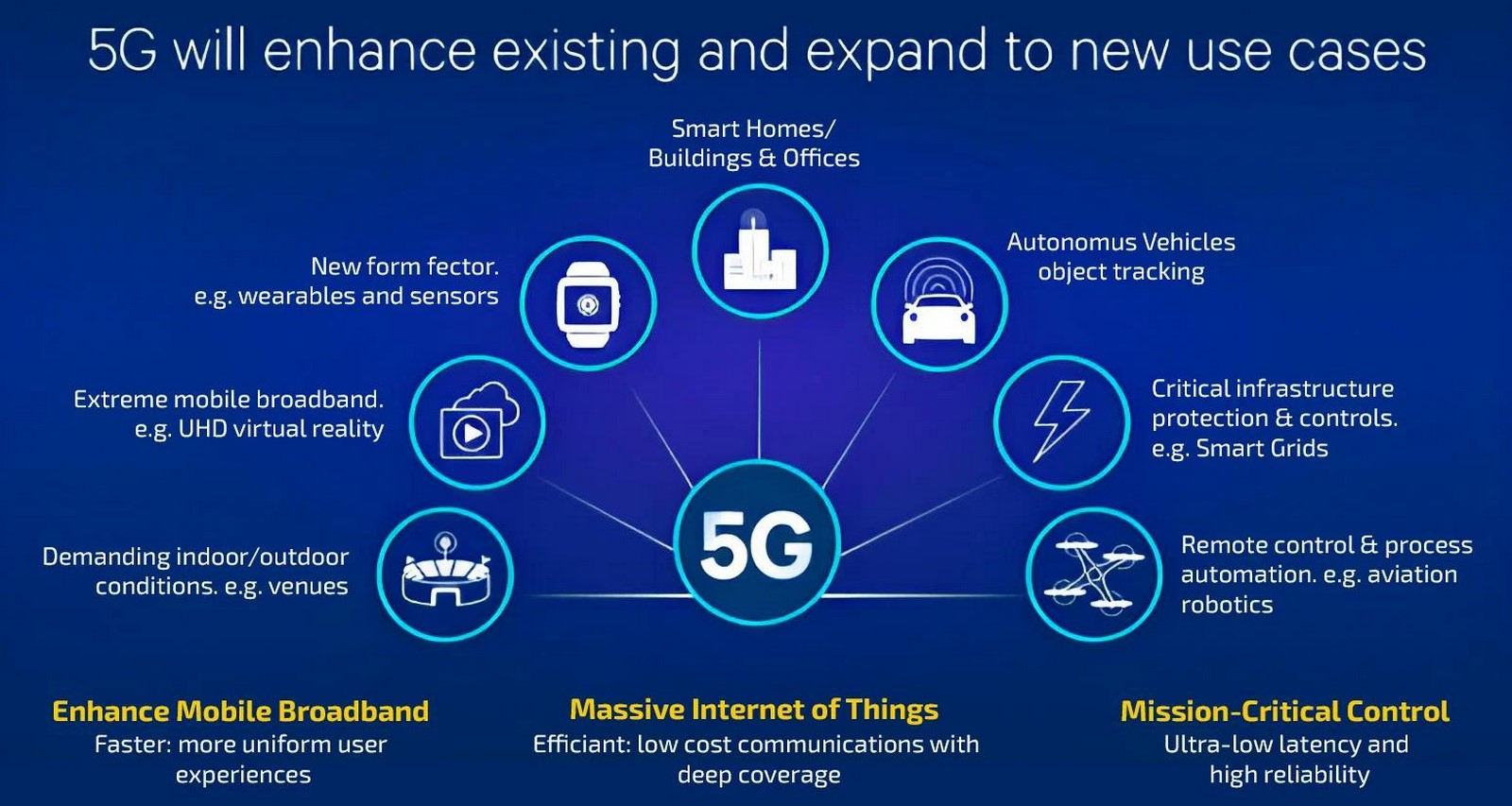
Applications of 5G span across diverse sectors, from the optimization of urban infrastructure in smart cities to the seamless communication necessary for the operation of autonomous vehicles. Let’s take a closer look at how 5G is reshaping various industries:
- Smart Cities: Smart cities are at the forefront of urban development, and 5G plays a pivotal role in their realization. With 5G’s lightning-fast speeds and low latency, cities can efficiently manage traffic, reduce energy consumption, and improve public services. From smart traffic lights that adjust in real-time to reduce congestion to waste management systems that optimize collection routes, the possibilities are endless.
- Healthcare: The medical field benefits immensely from 5G technology. It enables remote surgeries where surgeons can perform procedures from thousands of miles away with virtually no delay. Additionally, the combination of 5G and augmented reality (AR) offers immersive experiences for medical training and telemedicine services. Patients in remote or underserved areas can access high-quality healthcare through telehealth, bridging the healthcare gap.
- Economies and Innovation: The deployment of 5G networks fosters enhanced productivity and a culture of innovation. It opens doors to new business models and opportunities. Industries, particularly those heavily reliant on data transfer and real-time analytics, experience significant gains. From financial institutions optimizing their trading operations to manufacturing companies enhancing their supply chains, the impact is widespread.
- Autonomous Vehicles: Autonomous vehicles depend on seamless communication between various sensors and systems. 5G’s low latency and high data transfer rates are crucial for safe and efficient autonomous driving. These vehicles can react to changes in their environment in real time, significantly reducing the risk of accidents and making transportation more efficient.
5G for Digital Inclusion
The influence of 5G isn’t limited to high-tech industries alone. It also extends its reach to remote and underdeveloped regions, effectively bridging the digital divide by granting access to information and services previously out of reach. The low latency and high speeds of 5G can transform education, agriculture, and healthcare in remote areas. Farmers can access real-time weather data and market information, students can participate in online education with ease, and healthcare providers can offer telemedicine services even in remote villages.
However, the widespread implementation of 5G infrastructure demands substantial investment and careful regulatory considerations to ensure equitable access and mitigate potential health concerns. The deployment of 5G towers and equipment must be balanced with environmental and health considerations. This requires a collaborative effort between governments, telecommunications companies, and local communities to ensure that the benefits of 5G are accessible to all.
Artificial Intelligence: Empowering Connectivity and Decision-Making Artificial Intelligence (AI) profoundly alters how we engage with technology, enhancing its intuitiveness and personalization. AI-driven algorithms allow machines to process data, detect patterns, and tailor experiences, enriching digital connectivity. This concept, once fictional, now seamlessly integrates into our digital lives, reshaping our tech interaction.
AI’s Power in Personalization
AI’s power lies in processing data, identifying intricate patterns, and adapting to users’ preferences, redefining digital connectivity as an intuitive, personalized experience. Through AI, machines understand complex human behaviors, crafting personalized interactions.
AI finds prominence in virtual assistants, chatbots, and predictive algorithms, streamlining access to info and services aligned with users’ real-time preferences. Sectors like healthcare, finance, and marketing benefit as AI aids decision-making by deriving insights from extensive data (Yarkan & Al-Fuqaha, 2020).
- Virtual Assistants: Virtual assistants like Siri, Alexa, and Google Assistant are prime examples of how AI has revolutionized our daily lives. They can understand and respond to natural language, making interactions with technology more conversational and user-friendly. They offer personalized recommendations, weather updates, and can even control smart home devices.
- Chatbots: In customer service, AI-driven chatbots provide immediate responses to inquiries, improving the customer experience. You integrate them into your website easily by using different tools or WordPress ChatGPT plugins. They can handle routine tasks, freeing up human agents to focus on more complex issues.
- Predictive Algorithms: AI is behind the predictive algorithms that power content recommendations on streaming platforms like Netflix and Spotify. These algorithms analyze your viewing or listening history to suggest content you’re likely to enjoy, enhancing your overall entertainment experience.
AI in Industries
AI’s impact extends to various industries, and it’s not limited to entertainment and virtual assistants. Let’s explore how AI is transforming sectors such as healthcare, finance, and marketing:
- Healthcare: In healthcare, AI aids decision-making by deriving insights from extensive data. It can analyze medical images, such as X-rays and MRIs, more quickly and accurately than humans. This enables early detection of diseases and more precise treatment plans. Additionally, AI-driven diagnostics are making healthcare more accessible and cost-effective.
- Finance: In the financial industry, AI is used for fraud detection, algorithmic trading, and risk assessment. Machine learning models can analyze vast amounts of financial data to identify patterns and trends that would be impossible for humans to discern. This leads to more informed investment decisions and reduced financial risks.
- Marketing: Marketers are increasingly turning to AI to personalize their campaigns. AI can analyze customer behavior and preferences to deliver targeted advertising and product recommendations. This results in higher conversion rates and improved customer satisfaction.
- AI in Education : AI’s impact extends to education, where adaptive learning platforms tailor content to individual learning styles, fostering personalized and efficient learning. These platforms analyze a student’s performance and adjust the difficulty and content of lessons accordingly. This approach not only helps students learn at their own pace but also provides teachers with valuable insights into their students’ progress. However, it’s essential to address ethical concerns tied to AI’s decision-making, data privacy, and bias in educational AI. Integrating AI in education requires striking the right balance between convenience and data protection. In essence, AI revolutionizes our tech interaction, offering unprecedented personalization and responsiveness. It enhances user experiences and decision-making. Embracing AI means navigating ethical complexities for an innovative and ethically sound digital evolution. Ethical concerns tied to AI’s decision-making, data privacy, and bias require careful consideration. Integrating AI requires balancing convenience and data protection.
Internet of Things: Interconnecting Devices and Environments
The Internet of Things (IoT) is a revolutionary force reshaping global connectivity. It involves interlinking everyday objects and devices through the internet, facilitating automatic data gathering, analysis, and exchange. This extends beyond gadgets to encompass environments, enabling seamless interactions.
In smart homes, integrated IoT devices like thermostats, security cameras, and voice assistants create a cohesive ecosystem, allowing remote management for convenience and energy efficiency. On a larger scale, smart cities utilize IoT to optimize urban living, managing traffic, energy, and waste.
However, the rapid IoT proliferation raises concerns about security and privacy due to numerous interconnected devices, making data breaches more likely. Addressing these challenges is crucial for maintaining an innovative, secure, and trustworthy digital ecosystem.
In essence, IoT links objects and devices via the internet, ushering in an era of smart environments collecting, analyzing, and sharing data. From smart homes to cities, IoT applications revolutionize daily life, offering convenience and efficiency. Yet, challenges, mainly in security and privacy, require addressing for a secure and innovative IoT landscape.
- IoT in Smart Homes : In smart homes, integrated IoT devices like thermostats, security cameras, and voice assistants create a cohesive ecosystem, allowing remote management for convenience and energy efficiency. Your smart thermostat can adjust the temperature based on your preferences and the current weather, while security cameras allow you to monitor your home from anywhere. Voice assistants like Amazon’s Alexa or Google Home make it possible to control various devices with voice commands, further enhancing convenience and control.
- IoT in Smart Cities :On a larger scale, smart cities utilize IoT to optimize urban living, managing traffic, energy, and waste. Smart traffic management systems can alleviate congestion by adjusting traffic signals in real-time based on traffic conditions. Energy-efficient Street lighting can reduce energy consumption, and waste management systems can optimize trash collection routes to minimize costs and environmental impact. However, the rapid IoT proliferation raises concerns about security and privacy due to numerous interconnected devices, making data breaches more likely. Addressing these challenges is crucial for maintaining an innovative, secure, and trustworthy digital ecosystem.
Conclusion
In summary, the synergy among 5G, artificial intelligence (AI), and the Internet of Things (IoT) stands as a watershed moment in technological advancement. These transformative forces are not isolated entities; instead, they form a collective tapestry that is shaping the trajectory of digital connectivity. The remarkable speed and connectivity offered by 5G, combined with AI’s ability to offer personalized insights, and IoT’s intricate interconnection, are propelling us into an era where data seamlessly flows between devices and systems, constructing an interconnected ecosystem that transcends boundaries.
However, the journey toward this interconnected future is not without its hurdles. Ethical considerations surrounding the usage of these technologies, the preservation of data privacy, and the management of security vulnerabilities demand our attention. Striking the right balance between the innovative potential these advancements hold and safeguarding user rights is a shared responsibility that involves developers, policymakers, and society at large.
As we navigate this dynamic landscape of technological progress, one aspect remains crystal clear: the impact of these innovations reaches far beyond mere technological upgrades. They hold the power to redefine how we establish connections, engage with our surroundings, and shape the future of our globally interconnected society. The era driven by 5G, AI, and IoT presents not just opportunities for progress, but also a clarion call to ensure that these advancements are steered responsibly and inclusively, ensuring a future that benefits all of humanity.
References:
Andrews, A., Buzzi, S., Dohler, M., et al. (2014). What will 5G be? IEEE Journal on Selected Areas in Communications, 32(6), 1065-1082. doi: 10.1109/JSAC.2014.2328098
Han, S., & Chih-Lin, I. (2015). Large-scale 5G radio access networks: Challenges and enabling technologies. IEEE Communications Magazine, 53(1), 189-195. doi: 10.1109/MCOM.2015.7010535
Atzori, L., Iera, A., & Morabito, G. (2010). The internet of things: A survey. Computer Networks, 54(15), 2787-2805. doi: 10.1016/j.comnet.2010.05.010
Borgia, E. (2014). The internet of things vision: Key features, applications, and open issues. Computer Communications, 54, 1-31. doi 10.1016/j.comcom.2014.09.008
LeCun, Y., Bengio, Y., & Hinton, G. (2015). Deep learning. Nature, 521(7553), 436-444. doi: 10.1038/nature14539
Journalist, T. (2023, June 17). Top 5 IoT Trends that will Shape the Future in 2023. ELE Times. https://www.eletimes.com/top-5-iot-trends-that-will-shape-the-future-in-2023
Cioara, T., Gatnau, M., Vlados, C., et al. (2012). Artificial intelligence and its role in the near future. Proceedings of the 16th International Conference on System Theory, Control and Computing, 1-6.
Yarkan, H., & Al-Fuqaha, A. (2020). Internet of Things (IoT) Connectivity for 5G Networks: Challenges and Opportunities. IEEE Internet of Things Journal, 7(11), 10587-10598.