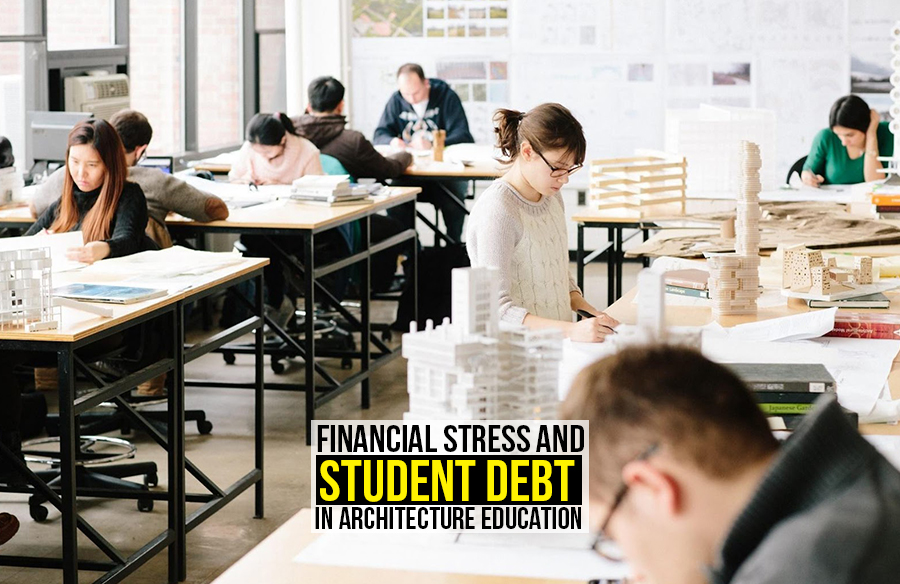
Architectural education has been long revered on the grounds of its rigorous demands, academic intensity, and stringent training. Renowned for its numerous years and technical variety, the architecture degree is renowned- historically, socioculturally, and internationally. However, beneath this façade of academics and strenuous training is a recurring, global feature: the burden of financial stress.

While student debt is a widespread theme regardless of the course of academic study or socioeconomic background, it is widespread for those who academically pursue architecture. This is due to a myriad of different reasons, including a generally financially expensive academic program, as well as different running expenses such as materials, software, and various technologies- notwithstanding average costs for daily life (rent, food, transportation, etc.). And, although student debt is quite common, its negative long-term effects are further aggravated by the intensity and workload of architectural education in comparison to other fields and majors: “that long hours, a heavy workload and intense design scrutiny were embedded in the culture of architecture education” (The Guardian). To add to this, this culture of intensity within architectural education further translates within the context of the workforce, in which unpaid internships, coupled with long hours, are the widespread norm. In both cases, whether academic or within the context of the workforce, it must be noted that any negative effects often disproportionately affect certain subgroups in society- notably, minorities that cannot afford the same luxuries.
One main cause for financial strain is the particularly exorbitant cost of tuition- considerably higher than other majors due to the exceptionally specialized nature of the architectural pedagogy: According to the National Architectural Accrediting Board (NAAB), each tuition fee per annum can range from $20,000-$45,000, depending on institution and location: even more amplified through “a steady increase of at least 20% in the fees structure of architecture education globally” (Novatr). This is further coupled with steep added costs for architectural materials, software, and equipment, increasing the financial burden on students, as previously established. Oftentimes, a clear solution to this would be the application of student loans: while this temporarily alleviates stress during education, it creates a significant financial burden upon graduation. The student loans thus accumulate, taking years, if not decades to repay, affecting long-term financial stability: Once again, the cyclical nature of financial constrain is evident. Furthermore, this, in turn, causes graduates to prioritize jobs based on financial necessity, rather than design-oriented personal passion, leading them to, lose their design aspirations. And so, financial constraints are a multidimensional problem, with long-term consequences.

While these issues are often undermined, it is notable to consider that they have profound challenges on individual student’s career choices, leading to a general impact on the overall market- socially and economically. To add to this, due to its financial stress, it enforces and creates a particularly selective, exceptionally elitist filter, with a high barrier to entry in both academic and professional work settings. And so, taking into account all of the following leads a large percentage of students to live off of student loans and debt- a trend only further increasing over the years. Further issues include a delayed career progression, in terms of advanced degrees, certifications, or establishing personal practices: once again, re-emphasizing the concept and idea of an incredibly elitist career, with a high barrier to entry. The aforementioned continuous barrier to entry is particularly negative in its influence, most notably within an academic setting: “Challenges such as homelessness, lack of space, expensive materials and transportation costs leave no margin for error or space for experimentation” (Jolliffe, 2018). Essentially, the allowable safe space to explore and experiment is predominantly associated with students who are of a relatively higher socioeconomic background, in which financials are not an issue or a constraint. Once again, as established in terms of analyzing the working culture, this also trickles into the architectural workforce.
While financial constraints and issues are rampant within the field of design and architecture, there are different opportunities such as scholarships, grants, and financial aid. However, it must be noted that, while they benefit a mere handful of students, they do not solve what are essentially structural issues. Architecture as a career path is filled with creativity and potential- however, due to financial constraints, this is not necessarily a democratically provided process. Furthermore, it must be noted that certain marginalized groups within society are more likely to face financial issues: “Three in four current AIA members had to borrow money to pay for college, with BIPOC, first-generation students, and female members especially likely to need loans” (Flynn, 2023). And so, considering the aforementioned, it is clear that financial instability and incontinence is a recurring structural theme- nationally, and internationally- and, one that affects certain subgroups more than others. The solutions offered can assist and mitigate certain levels of stress, but they are surely not a response to the scale and scope of issues faced within the field.

References:
Anandita (2023) Architecture education is expensive: What can we do about it? (2022), Novatr Prev OX. Available at: https://www.novatr.com/blog/why-is-architecture-education-so-expensive (Accessed: 07 September 2023).
How is student debt shaping architecture? – architect magazine. Available at: https://www.architectmagazine.com/aia-architect/aiafeature/how-is-student-debt-shaping-architecture_o (Accessed: 07 September 2023).
Jolliffe, E. (2018) The hidden costs of studying architecture are causing profound suffering, Building Design. Available at: https://www.bdonline.co.uk/opinion/the-hidden-costs-of-studying-architecture-are-causing-profound-suffering/5094592.article (Accessed: 07 September 2023).
Survey: 25% of UK architecture students treated for mental health problems (2016) The Guardian. Available at: https://www.theguardian.com/education/2016/jul/28/uk-architecture-students-mental-health-problem-architects-journal-survey (Accessed: 07 September 2023).