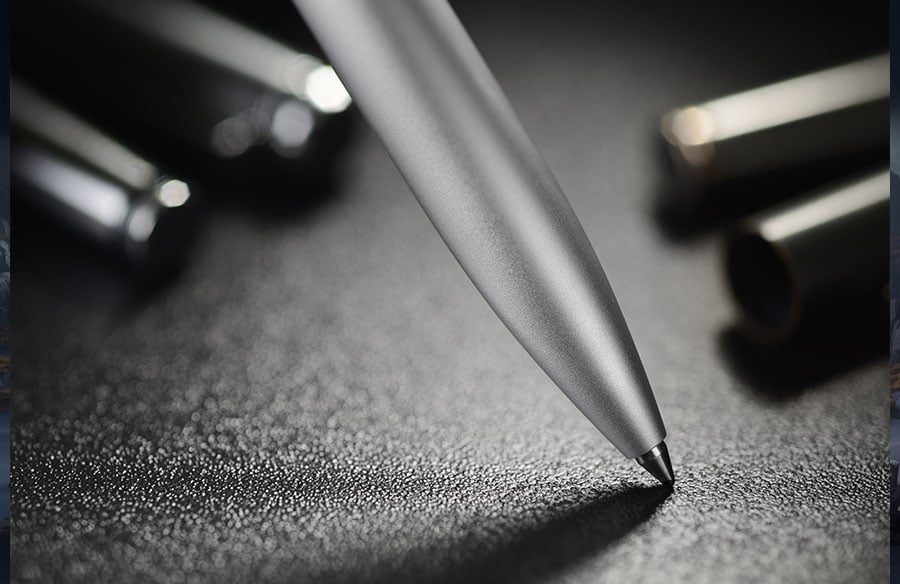
There is a moment, when you hold a laser-engraved metal pen next to a printed one, where the difference stops being a matter of opinion. Run a thumb across the barrel of the engraved pen and the logo is not sitting on the surface; it is cut into it. The mark is part of the metal now, catching the light differently from the polish around it, and it will still be there when a printed logo on a lesser pen has long since worn to a ghost. Understanding why that happens, and when it is worth paying for, is one of the more useful pieces of knowledge a merchandise buyer can carry.
Printing and engraving are fundamentally different acts. Printing lays ink onto a surface; engraving removes material to reveal a permanent mark. GoPromotional offers both across its range of promotional pens, and the choice between them is not about one being better than the other in the abstract, but about matching the technique to the pen, the budget, and the impression you want to leave. On a high-volume plastic ballpoint, print is exactly right. On an executive metal pen intended as a gift, engraving changes the object into something else entirely.
The permanence is the headline advantage, but it is not the only one. An engraved mark cannot smudge, flake, or fade with handling, which matters enormously on a pen that will be used daily for years rather than handed out and lost within weeks. A printed logo on a pocket pen takes a beating from keys, coins, and constant friction; an engraved one is immune to all of it. For a pen meant to last, engraving is not a cosmetic upgrade but a durability decision, and durability is precisely what you are paying for when you buy a metal pen in the first place.
Then there is the tactile dimension, which is easy to underestimate until you experience it. An engraved logo has texture. You can feel it under the fingertips, a subtle recess that registers as craftsmanship in a way a smooth printed surface never quite does. This is not marketing mysticism; it is a genuine sensory signal that the human hand reads as quality. On a corporate gift, that signal is doing real work, telling the recipient that thought and expense went into the object before they have consciously assessed anything at all.
The finish interacts with the metal beneath it, too, which opens creative possibilities print cannot reach. On an anodised or coloured aluminium barrel, engraving cuts through the coloured layer to expose the metal underneath, producing a two-tone effect where the logo appears in the natural aluminium against the coloured barrel. The result is elegant and impossible to fake with ink. The Electra range, engraved rather than printed, is a good example of how the technique and the material work together rather than the branding simply sitting on top.
None of this makes engraving the automatic choice, and the honest guidance is that it usually is not. Engraving suits metal, not plastic, and it suits lower volumes and higher price points where the per-unit cost of a premium technique is justified by the premium nature of the gift. For a mass giveaway, print delivers colour, coverage, and cost-effectiveness that engraving cannot match, and full-colour print in particular can do things with a logo that a monochrome engraved mark never will. The techniques serve different ends.
The way to think about it is to ask how long this pen is meant to last and what you want the recipient to feel when they hold it. If the answer is years, and the feeling is considered quality, engraving on metal earns its cost. If the answer is a broad, colourful, affordable reach, print on the right barrel is the smarter spend. The mistake is defaulting to one technique out of habit rather than choosing deliberately between them.
If you are unsure which suits a particular pen, the surest test is to see both. Request a sample of an engraved metal pen alongside a printed one and let your own hand make the call. The difference is one of those things that is obvious the moment you feel it and almost impossible to judge from a screen, which is exactly why the buyers who handle before they order tend to be the ones who get it right.