Urban theory can be a debatable topic of study due to how and why cities are analysed and studied. Urban studies, over the years, have accumulated knowledge from various theories and experiences of users that cover conceivable aspects of urban life. In today’s age, where the majority of the population leans towards an urban lifestyle, various claims are piled up regarding urban sociology, politics, ecology, geography, morphology, etc. (Urban Theory, n.d.). The elements that suffice an urban lifestyle, therefore, cannot be a self-contained practice. Thus, it can be endeavoured to be a tricky classification of approaching urban theory as a coherent theory or having overlaps within the same discipline.
Questioning the Prototype?

Urban theory can be a cyclical process of revisiting disseminated knowledge of the past whilst inculcating present understandings of society and architecture. One of the renowned urban sociologists, Peter Saunders, claimed in 1970 that “if you could find it happening in cities, then you could find it discussed somewhere in the… literature” (Urban Theory, n.d.). According to this sociologist, he interprets the scenario as fragmented societies that exist, and questions some quintessential norms of how urban life is experienced by users? How are distinct identities of places formed within a city? Is urban life perceived differently for different user groups based on parameters such as class, gender, nationality, or income? Ultimately, how does it impact the socio-cultural relationship of the users with the wider city? This scrutiny of urban theory can be argued as a proficient approach to understanding the fundamentals of a city’s functionality. Subsequently, this process can aid with a city resurging or maintaining its utopianism (Urban Theory, n.d.).
Garden City Movement
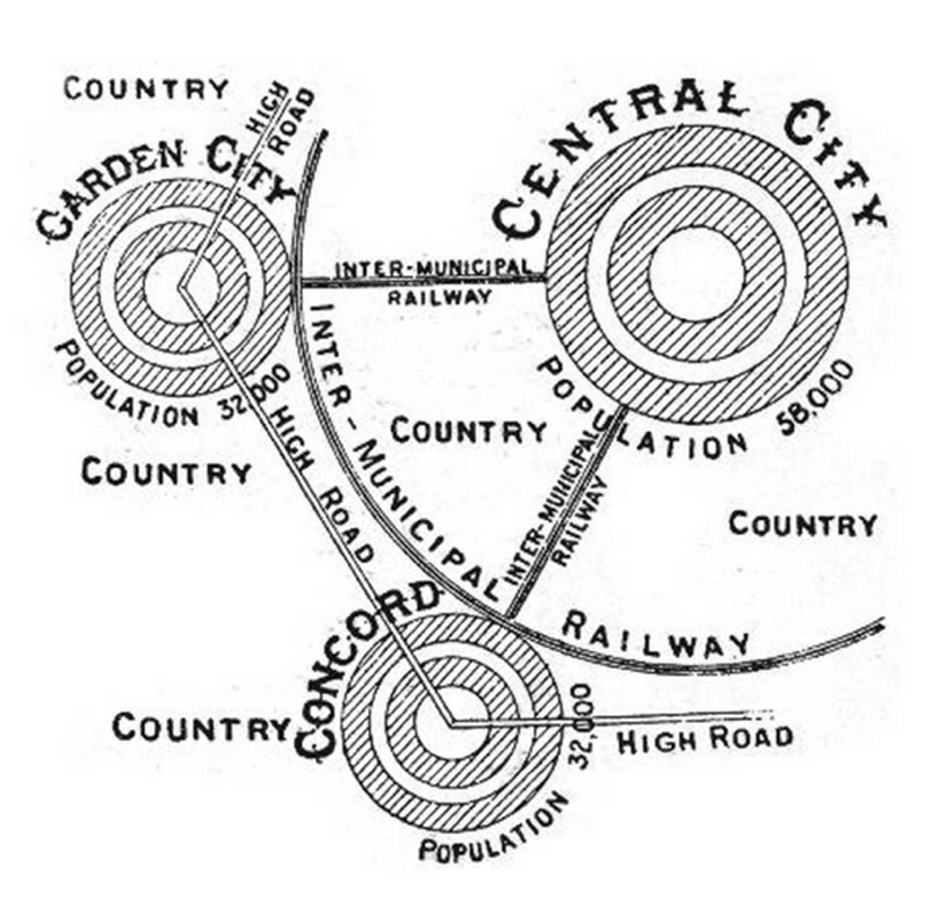
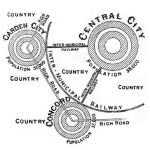
One of the famous English urban planners, Ebenezer Howard, conceptualised his understanding of town planning as a garden-city movement. This can be endeavoured as a fulcrum towards revolutionising urban planning throughout the world. Initially, a book was written by Edward named ‘To-morrow: A Peaceful Path to Social Reform’ in the 1880s. However, the book was not published until 1898 under the altered name ‘Garden Cities of To-morrow’ (Sir Ebenezer Howard | British urban planner, 2019). This paradigm shift in urban planning occurred due to the unprecedented population growth during the Industrial Revolution. Thus, to improve the quality of urban life for its residents, Howard suggested an equilibrium to strike between residential communities and the green spaces around them. This ideation led to a positive amalgamation of rural and urban living, whilst zooming in on sustainability, social equity, and improved lifestyle (Urban Design lab, 2023).
The key aspects of the sociologist’s design principles included (Garden city | urban planning, 2019):
- Acquiring a large area of agricultural land within a ring fence
- Planning a compact town surrounding a wide rural belt
- Combining residential, agricultural, and industrial spaces within the town
- Limiting the town expansion to a balance between the rural environment
- Natural spike in land value must be used for the town’s welfare
Proposed as a 6000-acre tract of land, Howard visualised the garden city to be utilised for agricultural purposes, moreover, initiating private ownership of these spaces. This would potentially help with aiding the city’s economy through revenue to fund city services and raised by rents (Garden city | urban planning, 2019)
Multiple Nuclei Model
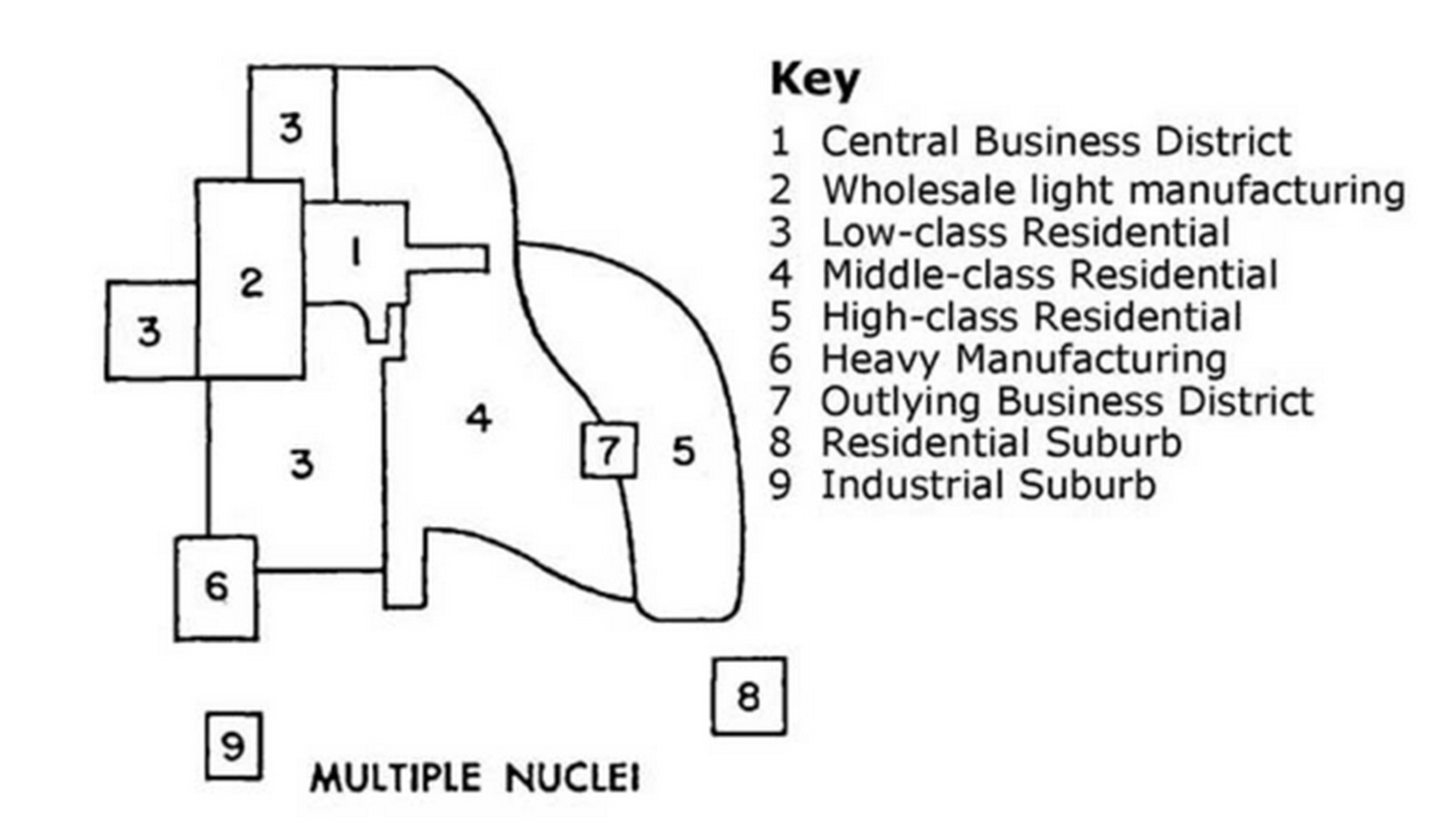
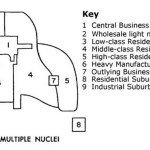
Another prominent theory inscribed within the broader topic of urban theory includes the Multiple Nuclei Model. Studied and established by Chauncy Harris and Edward Ullman in the 1950s, this theory confronts the idea of a centrally revolving around business district and suggests that cities have multiple nodes of socio-economic activity taking place (Urban Design lab, 2023). One of the studies, conducted by Juybari (2021), examines in detail various multiple nuclei model principles that exist in a city that is situated in a different geographical location with a difference in demographic, socio-economic, and spatial structures. This research paper by Juybari (2021) identifies the dynamic fluctuations that are interdependent with each other in terms of city functionality. For instance, rapid urbanisation has had a major impact on the environment, like climate change, air pollution due to motorisation for transportation. The inverse proportion, therefore, increases the city’s growth by decreasing the availability of valuable urban land. Consequently, the requirement for natural resources increases to build infrastructure and buildings.
Revisiting the theory developed by Harris and Ullman, they claimed that as the multiple nuclei model evolved in newer cities, intra-urban dispersal created a structure of urban land use. This ease in mobilisation allowed regional centres to focus on businesses. The term ‘nuclei’ referred to smaller growth centres around the metropolitan area. These spaces can be airports, ports, universities, government, or business buildings. This model highlights the complexity of urban theory and contradicts the notion of ‘concentric zones’ (Juybari, 2021).
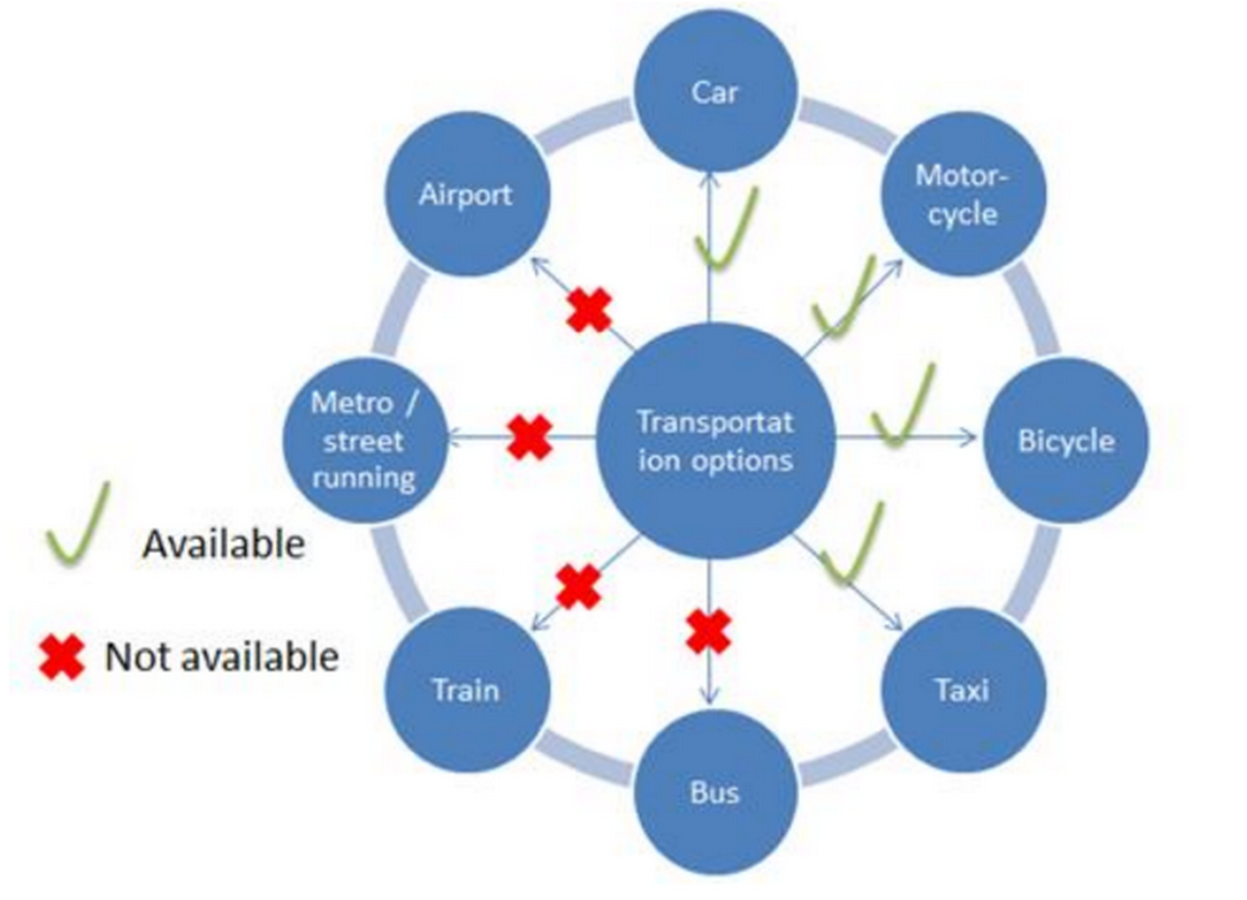
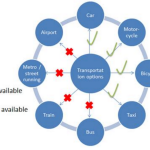
According to the preceding analysis and Image 4 visualisation of transportation access around Juybar city, perhaps some of the neglected centres that may be located in the outskirts of a city can be centralised with the help of increased commutation in and around the city. Subsequently, Juybar has shown results of the public highly utilising private transportation, hence the road infrastructure has been developed over the years. This bifurcation increases the rate of interaction within the city. Through the evolution of the multiple nuclei model, transportation hubs have increased, allowing industries to be established, thus reducing shipping costs (Juybari, 2021).
- Garden city | urban planning. (2019). In: Encyclopædia Britannica_© https://www.britannica.com/topic/garden-city-urban-planning.
- Juybari, A.S., 2021. Principles of smart growth and land use planning for the cities with multiple nuclei models of development: the case of Juybar City. In 27nd International Sustainable Development Research Society Conference, Mid Sweden University, July (pp. 13-15).
- Sir Ebenezer Howard | British urban planner. (2019). In: Encyclopædia Britannica_© https://www.britannica.com/biography/Ebenezer-Howard.
- Urban Design lab. (2023). Top 15 Theories In Urban Planning_© https://urbandesignlab.in/top-15-theories-in-urban-planning/?srsltid=AfmBOorn53BrgzM-Obhz_GMSuesvZFfCJWXHViN4WDPH82em40Y5WfNQ.
- Urban Theory. (n.d.). Available at: https://us.sagepub.com/sites/default/files/upm-binaries/62041_Harding__Urban_theory.pdf.