Identity is most simply known as ‘who you are’. Your name, age, ethnicity, etc. are all part of your identity – in a shallow sense. Identity refers to your unique characteristics and attributes, as well as how others perceive you. Your culture, values and beliefs are a significant indicator of your identity. Identity can span from an individual to a group, exemplifying who they are, what they value, and how they interact with their environment. In the era of globalization, a community’s identity poses a significant risk of eradication. Identities are reinforced through various media, including word of mouth, practices, and lifestyle choices. A lesser-known one, however, is architecture. Architectural identity creates an environment for the community, thereby influencing their lifestyle, and serves as a long-lasting reflection of a community. Architectural identity is the characterisation of built spaces that echoes the culture, people, and lifestyle of its context.
Identity in Architecture
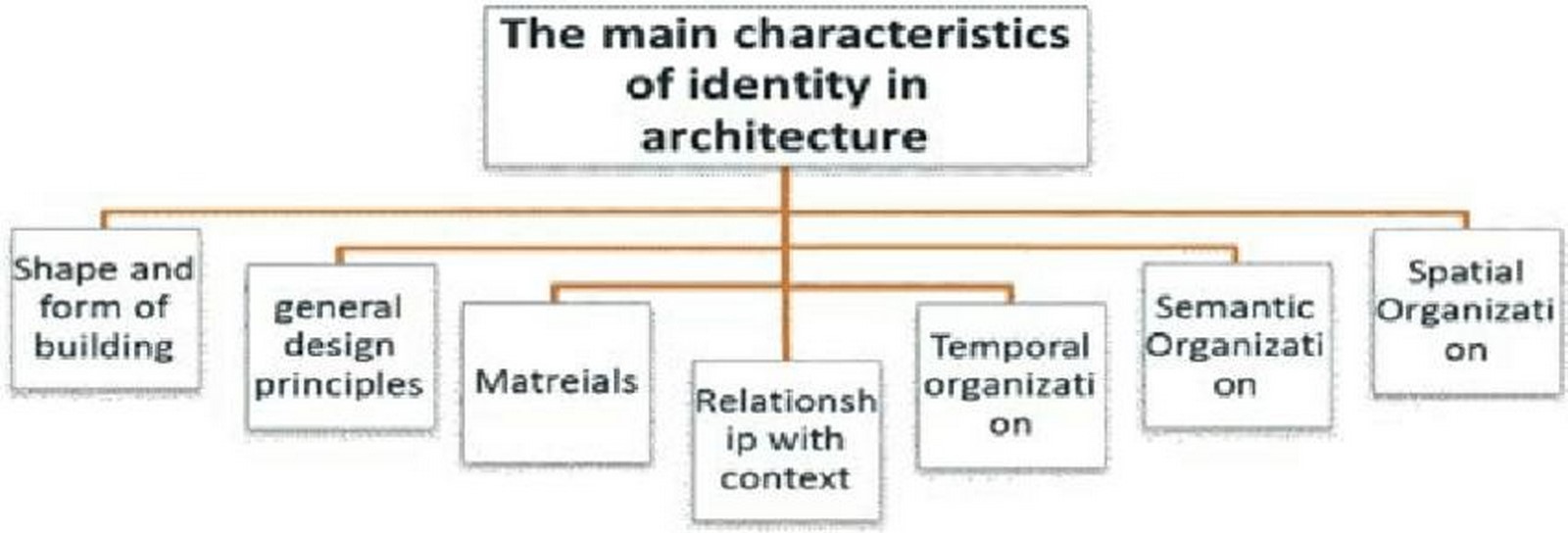
Identity can be infused into a structure through different design principles. Shape, form, materiality, and temporal, semantic, and spatial organisation can all be categorised as the main characteristics of identity in architecture. To put it simply, the basic building blocks of a building can carry meaning, reflecting the identity of its users. Ensuring that a prayer room in a Hindu household always faces north is an example of spatial organisation. Ensuring a house doesn’t trap heat refers to materiality, and the use of geometric shapes within the house is a clear reiteration of shape.
Swahili Architecture
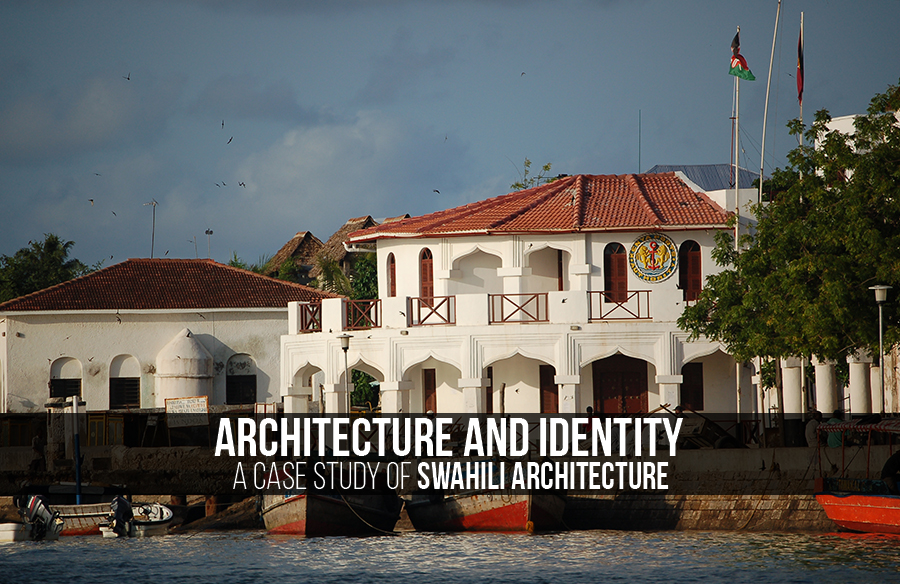
Swahili architecture is an excellent example of maintained identity through architecture. The Swahili people, also known as Waswahili, are an ethnic group found on the coast of East Africa, spanning from Somalia to Mozambique. The Swahili culture, as it is known today, was formed through trade with Arabs, Persians, Indians, and Portuguese around the 7th to 8th centuries.
Swahili architecture, deeply influenced by Islam, reflects the lifestyle and values of the coastal people. The key characteristics of Swahili people are their strong sense of pride in their religion, their sociable nature, and the importance they place on social status. All of these characteristics are evident in their architecture if you look hard enough!
To reflect their Islamic principles, Swahili homes are very private. Since their towns were built in Coastal areas in a tropical climate, they built narrow roads to channel wind and cool down the residents. As a result, balconies were close and houses low; therefore, many have carved and decorated wooden brackets, allowing the cool breeze to pass while maintaining privacy. From the interior of the balcony, it’s easy to see outside, but challenging to see inside from the street.
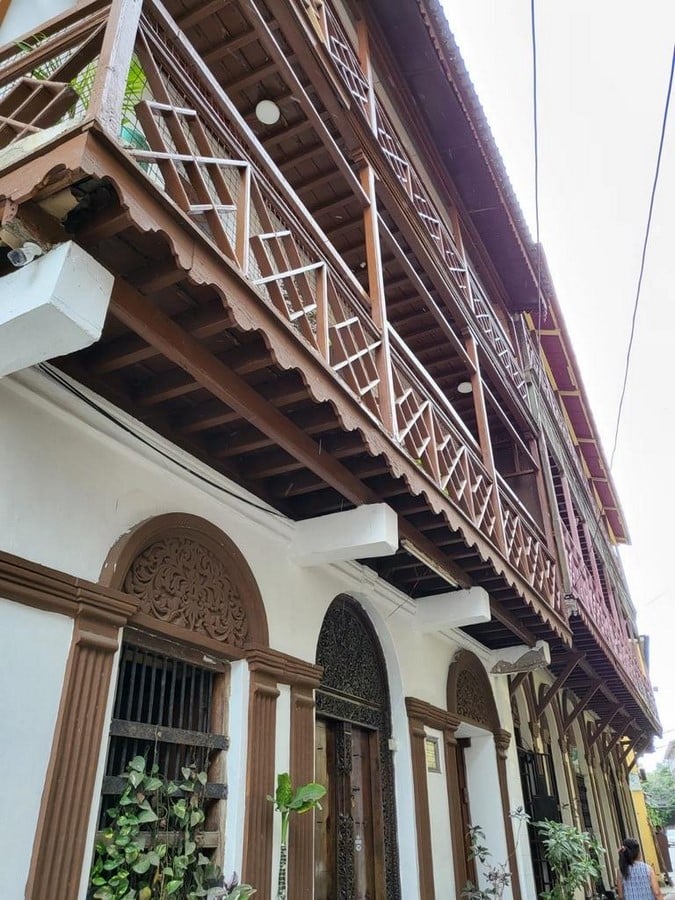
The Swahili are highly sociable, as it is in their nature to make people feel welcome. Leading up to the doors and underneath the balconies are barazas. The large porch, featuring two or three steps, is purpose-built to welcome and invite guests, providing a space where homeowners can engage with visitors and socialise. Since the balconies provided shade for the people underneath, they were the ideal spot on the busy streets.
Swahili doors, which serve to boost one’s social standing and tell the resident’s story, are a famous feature. These facades serve as a means of conveying power, occupation, religion, and social status through motifs. The bigger the door, the more power the resident has. The centre of the door’s arch usually features Quranic/Arabic inscriptions, hinting at the homeowner’s religious affiliation. The carvings on the sides reveal information about the homeowner’s occupation or ethnicity (Arab or Indian). Floral designs were associated with Indians, geometric patterns with accountants, and wavy lines/ropes with fishermen or those who made a living by the sea, while chains were often linked to the slave trade or security. These features, to name a few, quietly mimic their residents and express them to tourists.
The link between Architecture and Identity
Since this architectural style is centred around their very sense of self, it serves them. All of their needs, from self-actualisation to physiological, are met. This way of building makes a structure feel like a home already, without any customisations. It gives environments a soul and makes them feel unique.
A powerful architectural work serves both inwardly and outwardly; it meets its users’ needs and expresses who they are. Of course, everything has evolved to meet modern-day needs and desires. However, local identity can still be considered in modern houses, as exemplified by the work of Urko Sanchez. Their beautiful Swahili-inspired dwellings on the coast not only seamlessly blend modern needs and tradition, but also maintain a uniform typology of structures throughout those towns.
Ingraining identity with architecture not only benefits the user but all of the larger community – it immortalises them. It is easier to preserve and teach children about their identity and the culture that surrounds them. That’s why even centuries later, the Swahili culture in Mombasa and along the East African coast remains as flavoursome. The same argument could be made for other traditional architectural styles, such as Gujarati ‘pol’ houses, Moroccan ‘riads’, and so forth. They encapsulate the values, beliefs and lifestyle of the people in their local context. Ignoring identity in the context of structures poses the threat of erasure to specific communities. I reiterate the phrase ‘out of sight – out of mind’. As humans, we are primarily visual creatures. If we aren’t reminded of our identity through our very own surroundings, how do we know how to preserve and teach it?
References:
Facing History & Ourselves (2021) Exploring the concept of identity, Facing History & Ourselves. Available at: https://www.facinghistory.org/resource-library/exploring-concept-identity#citation-information-1541 (Accessed: 26 May 2025).
Muhammad (2024) The influence of cultural identity in contemporary architectural expression, INJ Architects. Available at: https://injarch.com/cultural-identity/ (Accessed: 26 May 2025).
Torabi, Z. and Berahman, S., 2013. Effective factors in shaping the identity of architecture. Middle-East Journal of Scientific Research, 15(1), pp.106–113. https://doi.org/10.5829/idosi.mejsr.2013.15.1.2357