In today’s world, most of our daily routine is largely confined within an indoor space, irrespective of a Work-from-home routine or an On-site routine. Regardless of the profession you belong to, be it creative, technical, or administrative, we spend long hours confined to the same space. While most of our office spaces and homes give us a quiet and calm space to focus on work, does that help beyond that is a question we consciously ask or subconsciously feel. While the conscious feeling is mostly a direct questioning of tangible character like the space available for us to sit, work, and move around comfortably, the subconscious feeling of being comfortable comes from aspects that we often tend to overlook like having a comfortable table and chair that is ergonomically designed for a particular type of work, adequate presence of natural lighting without affecting the thermal comfort of the space, spatial layout that either encourages social interaction or adds to feeling isolated, color choices that influences the mood of the occupant and spatial proportion to name a few.
Let’s begin with understanding the impact of Spatial Proportion on a person, especially in terms of the height of a room (between floor to ceiling). A room with a higher ceiling is generally perceived to give more freedom while a room with a lower ceiling type is perceived to provide a cozy and imitate feel (Kriger, 2024).
A study of the psychological impact of ceiling height, as mentioned in Frontiers in Psychology Journal, says that “Rooms with higher ceiling and open spaces are more likely to be judged as beautiful, activating brain structures related to visuospatial exploration, attention and perceived visual motion” (Zhang Z, 2023). While this study speaks about the impact of ceiling height in Gallery type of spaces, it can also be taken as a context for office spaces, as this also involves a large number of people working under the same roof. As in terms of office space, a high ceiling height is preferred in the creative profession as it promotes abstract thinking and creativity while a low height ceiling is preferred in other technical professions as it promotes detail-oriented approach and problem-solving ability (Kiff, 2023).


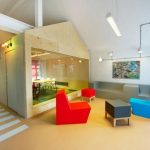
The spatial proportion can be perceived beyond its scale, with the choice of colors and materials playing a significant role. An article by Mental Health America says that colors have a physiological and psychological impact on our feelings and behavior, with bright, warm colors like red, oranges, and yellow stimulating energy and happiness while cool colors like blue, green, and purple evoking a soothing and calming effect on our mind (Mental Health America, n.d.). As in a workplace, the choice of colors should not only evoke the mentioned emotions but also help employees manage anxiety, and stress, enhance productivity, and increase concentration and focus (WB Wood, n.d.). Over the last few years, employers have shifted from using neutral colors like white, black, or beige to being playful by opting for more colors, especially green as it is said to create alertness (Steele, 2020)
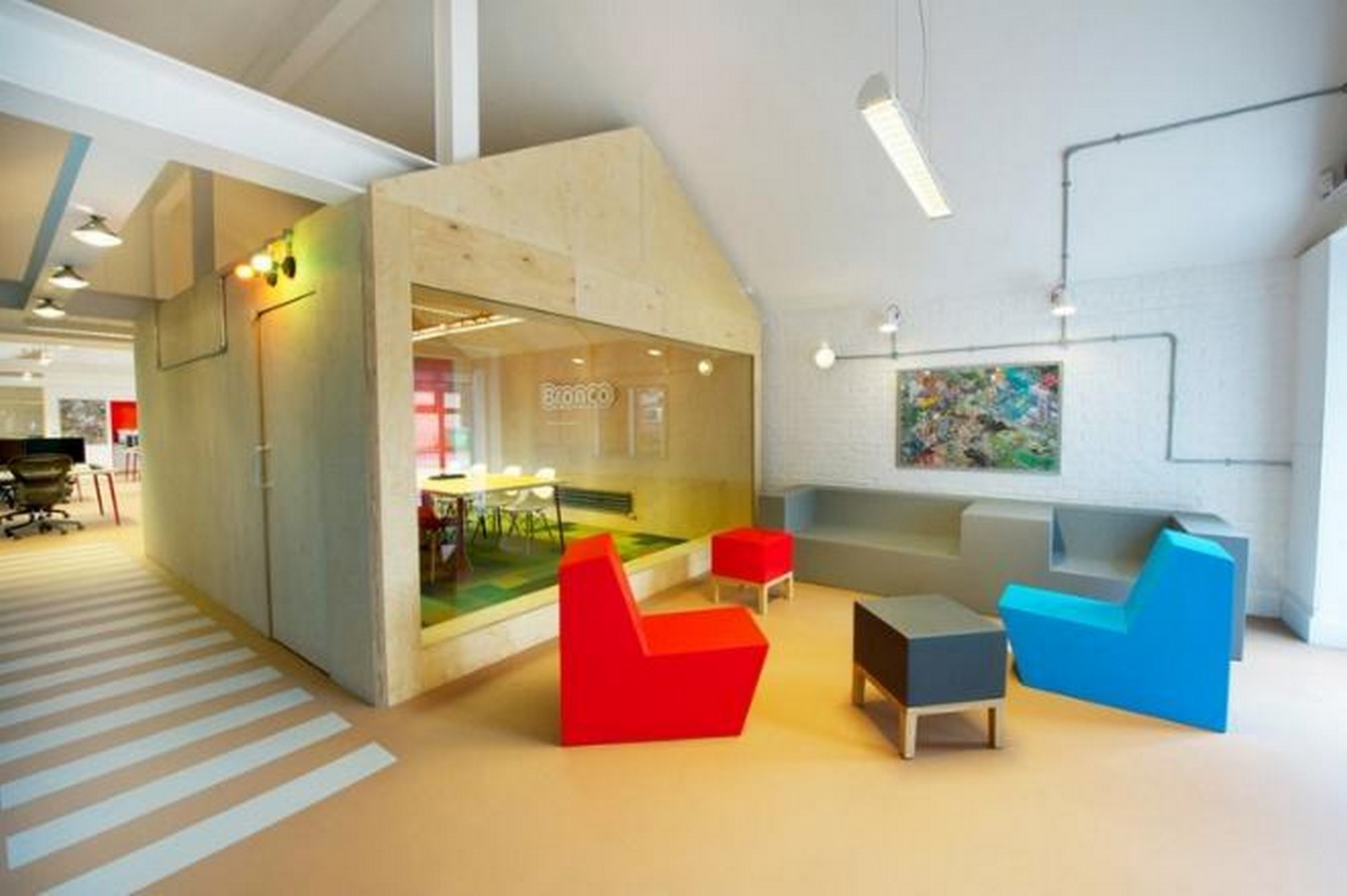
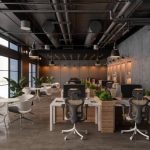
While these parameters are focused on individual well-being, the social character of the space is dependent on the type of spatial organization. We are starting to see open office layouts being commonly adapted in offices. The benefits of using this type of layout go beyond the economic benefits of reducing material costs, especially in terms of breaking the hierarchical barriers between workers making employers more approachable to each other. This type of spatial layout enhances the collaborative spirit in an office as it encourages interaction and engagement which boosts productivity. Furthermore, a reduction in anxiety levels is also seen in employees as this type of setup reduces the social isolation directly making a positive impact on the employee’s mental health and wellbeing. (Tonna, 2024)
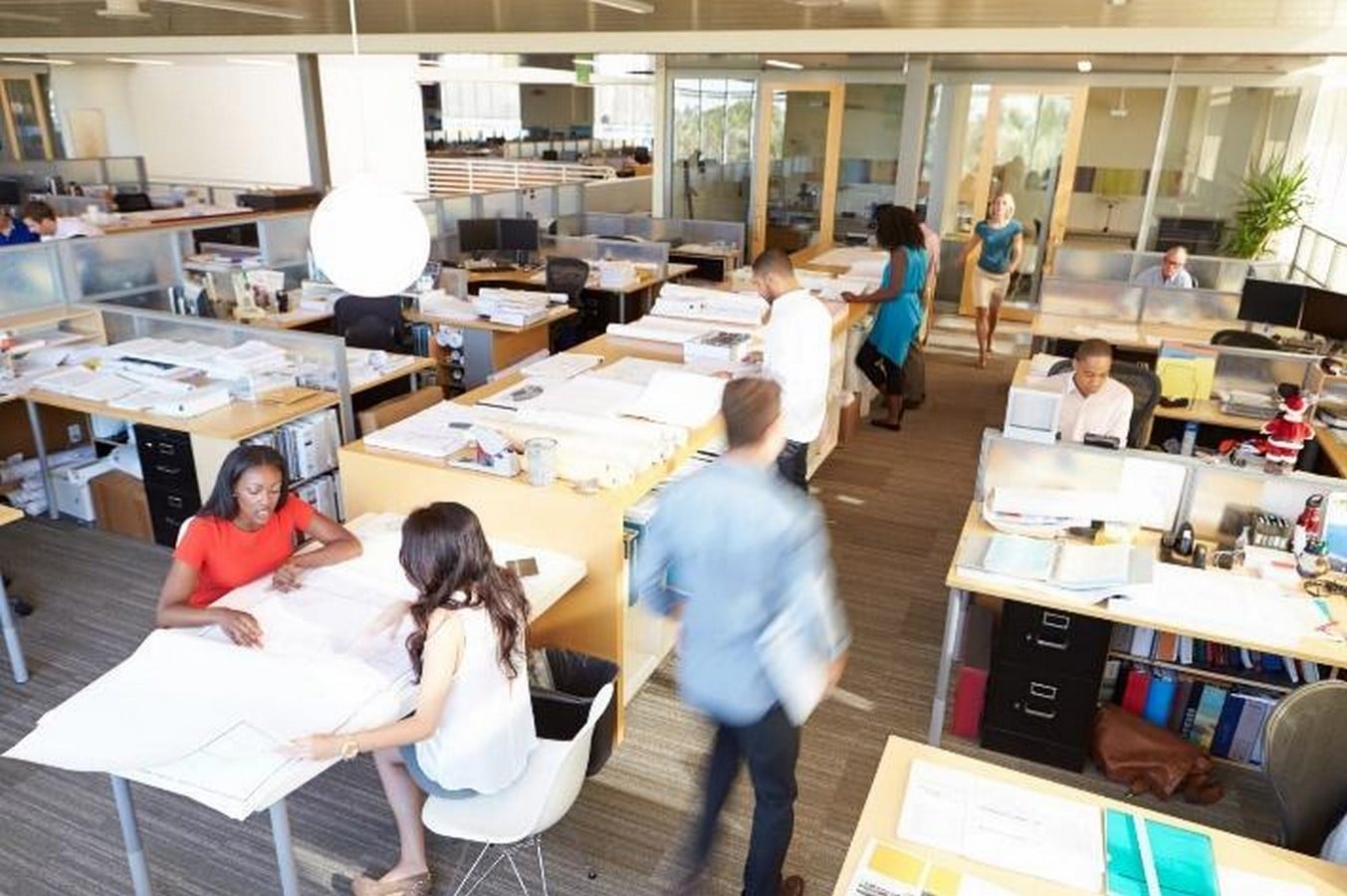
The open office layouts too have a flip side to it of not working in all instances. An article by WeWork Ideas addressed the drawbacks of having an open office layout, one of them primarily being distractions and lack of privacy. Without physical barriers, the chances of always hearing conversation in the background are high, making it difficult for workers to focus (WeWork Ideas, 2017). Through both studies, it is important to note that the choice of opting for an open office layout versus a traditional layout of having cubicles has to be contextual, for example: a creative industry might benefit from an open office layout as that allows discussion of ideas to develop whereas technical sector might need more of a traditional setup to enable privacy to focus on detail-oriented works.

In conclusion, aspects like spatial proportion, scale, color choices, and layout play a key role in shaping our daily lives and activities. A well-designed space must take these parameters into account based on the context of the design because these define the character of a place and also enable us to perform better in our daily tasks and enhance our well-being.
Bibliography:
Jennings, J., 2013. Office Snapshots : Inside Bronco’s Playful and Colorful Offices. [Online]
Available at: https://officesnapshots.com/2013/10/15/inside-broncos-playful-colorful-offices/
[Accessed 05 02 2025].
Kiff, A., 2023. How your office design reflects on your employee productivity by Magenta Associates. [Online]
Available at: https://www.magentaassociates.co/office-design-effects-on-productivity/#:~:text=Generally%2C%20people%20prefer%20high%20ceilings,oriented%20approaches%20to%20problem%20solving.
[Accessed 25 January 2025].
Kriger, B., 2024. Medium. [Online]
Available at: https://medium.com/global-science-news/architecture-and-psychology-the-influence-of-space-on-our-consciousness-389515312214#:~:text=The%20scale%20and%20proportion%20of,on%20the%20context%20and%20design.
[Accessed 25 January 2025].
Mental Health America, n.d. How do colors in my home change my mood? color psychology explained. [Online]
Available at: https://mhanational.org/surroundings/color-psychology-explained#:~:text=Bright%2C%20warm%20colors%20(reds%2C,like%20bedrooms%20or%20even%20bathrooms.
[Accessed 25 January 2025].
Monkeybusinessimages, 2018. iStock : Elevated view of a busy open plan office. [Online]
Available at: https://www.istockphoto.com/photo/elevated-view-of-a-busy-open-plan-office-gm1011792694-272602151
[Accessed 05 02 2025].
Nigel Young, R. M., 2023. Office Snapshots: Inside Foster + Partners Headquarters. [Online]
Available at: https://officesnapshots.com/2013/01/04/foster-partners-headquarters-office-design/
[Accessed 05 02 2025].
Onurdongel, 2022. iStock : Interior of Ecofriedly Open Place Office with Desks, Computers, Plants and Waiting Area. [Online]
Available at: https://www.istockphoto.com/photo/interior-of-eco-friendly-open-plan-office-with-desks-computers-plants-and-waiting-gm1441568782-481231538
[Accessed 05 02 2025].
Steele, J., 2020. How color psychology impacts today’s workplace by Forbes. [Online]
Available at: https://www.forbes.com/sites/jeffsteele/2020/01/06/how-color-psychology-impacts-todays-workplace/
[Accessed 25 January 2025].
Tonna, P., 2024. Serve Crop Blog. [Online]
Available at: https://www.servcorp.co.uk/en/blog/business-networking/pros-and-cons-open-plan-office-vs-cubicle/
[Accessed 25 January 2025].
WB Wood, n.d. Office Color Psychology. [Online]
Available at: https://wbwood.com/2023/01/31/office-color-psychology/#:~:text=Color’s%20Role%20in%20Employee%20Well%2DBeing%20and%20Office%20Design&text=The%20best%20office%20colors%20should,colors%20have%20a%20universal%20meaning.
[Accessed 25 January 2025].
WeWork Ideas, 2017. Pros and Cons of an Open Office. [Online]
Available at: https://www.wework.com/ideas/research-insights/pros-cons-open-office
[Accessed 25 January 2025].
White, R., 2020. Architecture Journal : Coronavirus Crisis – Big name practices Shed Staff. [Online]
Available at: https://www.architectsjournal.co.uk/news/coronavirus-crisis-big-name-practices-shed-staff
[Accessed 05 02 2025].
Zhang Z, F. J. G. M. L. a. C. Y., 2023. Frontiers of Psychology. Uncovering the Connection between ceiling height and emotional reactions in Art Galleries.