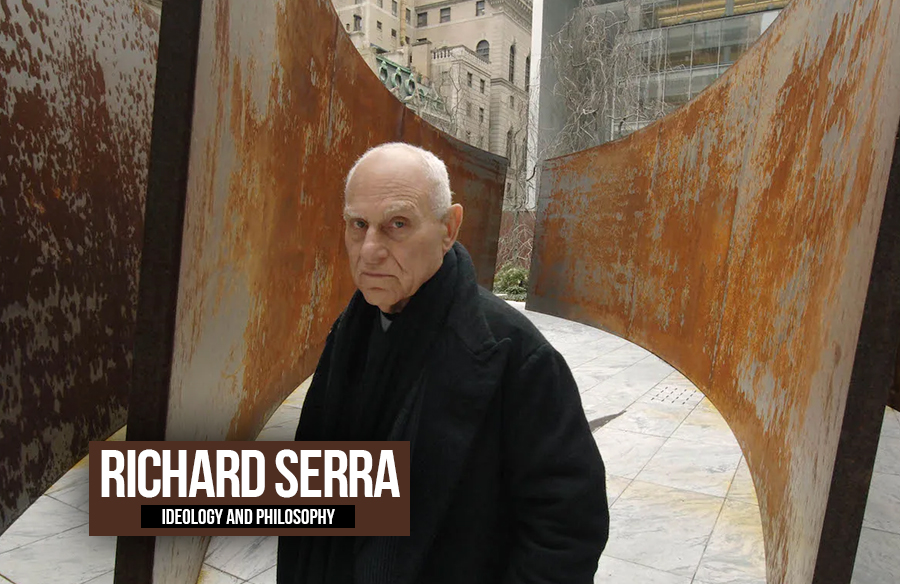
Richard SerraI is known for his contemporary art and for his monumental works. Serra’s art depicts the exploration of materiality, space, and human interaction. His ideology and philosophy show challenging perceptions, and pushing the boundaries of artistic expression.

Early Life and Education
Richard Serra was born on 2nd of November, 1938, in San Francisco, California, in a working-class family. His fathers profession was a pipefitter which gave him an exposure of industrial materials and an opportunity to experiment things and that later influenced his art. Serra attended the University of California, Santa Barbara, where he pursued a degree in English literature in 1961. He later pursued a Master of Fine Arts at Yale University, where he studied influential artists such as Josef Albers and was exposed to the principles of modernist abstraction.
Artistic Beginnings
Serra’s in the beginning of his career was experimenting with materials and forms. During the 1960s, he created works using industrial materials like lead, rubber, and steel. One of his best works in the early series was the “Splashing”, in which he splashed molten lead against walls and corners. This raw approach to materiality became his style of work.
In 1966, Serra began compiling his famous “Verb List” , a collection of words such as “To roll,to fold,to cut,and to splash.” This list serves as a concept for his artistic process, showing the importance of action and transformation in the creation of art.
Richard Serra (1938-2024): Ideology and PhilosophyIdeology: Material and Space
Serra’s ideology was the art that should engage directly with its environment and audience. He believed in the evolving power of materials and the importance of spatial relationships. Serra believed that each material carried its own meaning and its manipulation was an act of discovery or an art.
Serra used steel in his artworks and that became a medium for him to explore balance and gravity in his art. He made large-scale steel sculptures which challenge the viewer’s perception of space and physical interaction. Some of his works are Torqued Ellipses (1996-1998) and The Matter of Time (2005) , they are good examples of this approach, which allows the viewers to walk through the sculptures, experiencing the evolution of space and form.
Philosophy: Art as Experience
Serra believed that art is not just an object to be observed but it also should reflect the emotions and it is something to be experienced as well. He created works that engage the viewer’s senses and bring out their emotional and intellectual response. His sculptures break the boundaries between art and architecture, creating environments that challenge the art.
Serra once said, “The viewer becomes the subject. The work becomes the predicate.” This statement explains his view that the audience’s interaction with the artwork is central to its meaning. By situating his sculptures in specific contexts whether urban landscapes or natural settings Serra showed the importance of site-specificity in shaping the viewer’s experience.
Key Works and Their Impact

- Tilted Arc (1981) This was of Serra’s controversial works,The size of Tilted Arc was 120-foot-long, 12-foot-high steel sculpture installed in Federal Plaza, New York.The art led to a debate with critics that it obstructed the plaza’s functionality, This incident highlighted the challenges and It was removed in 1989 following a public hearing.

2. The Matter of Time (2005) This sculpture is Installed at the Guggenheim Museum Bilbao, this is a series of eight steel sculptures which shows Serra’s exploration of time and space. The curved forms create an interplay of light and shadow, guiding viewers through a journey that alters their view of scale and movement.
3. Shift (1970-1972) It is Located in King City, Ontario. Shift is an example of Serra’s early work. The sculpture, made of concrete walls that cut across a rural landscape, engages with the topography and invites viewers to consider their relationship with the land.
Legacy and Influence

Richard Serra’s work had a strong influence on contemporary art and architecture. His philosophy shows exploration of materiality and spatial experience, and has inspired generations of artists. Serra’s sculptures challenge traditional artworks, encouraging the audience to think critically about the role of art in society.
Moreover, Serra’s artistic vision highlights the importance of artistic integrity even in the face of controversy. His work serves as a power of art to provoke dialogue, evoke emotion, and transform spaces.
Final Years and Reflection
Serra continued to create monumental works in his later years, while creating his own legacy. He remained creating phenomenal sculptures and breaking the boundaries of sculpture, exploring new forms and materials. His death in 2024 was the end of an era, but his ideas and creations live on, continuing to inspire and challenge.
Richard Serra’s life and work shows the evolution and vivid experiments of art with different material, space, and human experience. His philosophy shows a deep exploration of the potential of the materials, space used in the art. Serra redefined the role of the artist and the artwork in contemporary society. His artworks remain as an example and show the power of art to shape our understanding of the world and our place within it.
Book and Article Citations:
- Image 1 – “Serra in 2005.” Photographed by Oliver Mark. © Oliver Mark. Accessed 21 Dec. 2024.
- Image 2 – “Tilted Arc installation in Federal Plaza, New York.” Photographed by Carol M. High. © Carol M. High. Accessed 21 Dec. 2024.
- Image 3 – “The Matter of Time at the Guggenheim Museum Bilbao.” Photographed by Timothy Hursley. © Guggenheim Museum Bilbao. Accessed 21 Dec. 2024.
- Image 4 – “Close-up of Serra’s Torqued Ellipses, highlighting the curved steel forms.” Photographed by Richard Serra Studio. © Richard Serra/Artists Rights Society (ARS), New York. Accessed 21 Dec. 2024.
Books:
- Foster, Hal. Richard Serra: The Matter of Time. Guggenheim Museum Publications,
- Cooke, Lynne, and Michael Govan. Richard Serra: Sculpture. The Museum of Modern Art, 2007.
Articles:
- Serra, Richard. “Rigging.” Artforum International, vol. 14, no. 4, 1975, pp. 52-57.
- Rose, Barbara. “Richard Serra: Sculptor in Steel.” Art in America, vol. 68, no. 10, Dec. 1980, pp. 102-109.