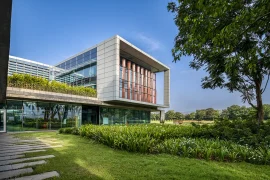
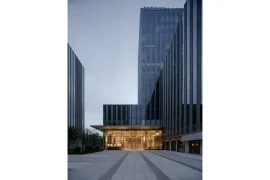
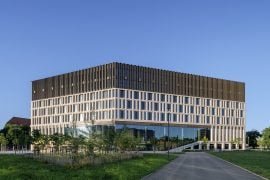
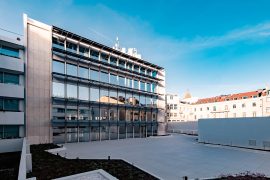
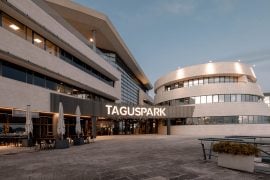
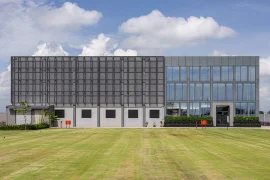
The SAB office building is embedded in the grounds of the historic Koenigstadt brewery in the Berlin district of Prenzlauer Berg, directly on Saarbruecker Strasse, which is characterised by Art Nouveau and Wilhelminian style architecture.
Project Name: Sab Office Building, Saarbruecker Strasse 21, Berlin
Studio Name: Tchoban Voss Architekten Gmbh
Address: Saarbruecker Strasse 21, 10405 Berlin
Client: N.D.C Projektentwicklung GmbH, Berlin
GFA: 6,150 m²
Completion: July 2024
Architect: Sergei Tchoban
Project partner: Philipp Bauer
Project leader: Philipp Bauer, Kenan Ozan
Team: Valeria Kashirina, René Hoch, Puk Paludan, Manel Reig Florensa, Azzurra, Pippia
Photographer: HG Esch

The site is located directly on the striking edge of the Barnim plateau and rises by around two metres from Saarbruecker Strasse into the inner block area. The new building occupies the free corner of the street and the private road leading into the extensive industrial estate.
Beer has not been brewed on the site of what was once Berlin’s largest brewery for around 100 years. After an eventful history, the buildings are now in mixed use by neighbourhood initiatives, media companies, restaurants and start-up businesses. The listed industrial complex of the Koenigstadt AG brewery dates back to the ‘Wagner’s Bairisch-Bier-Brauerei’ brewery founded in 1849 and today consists of six historic buildings that frame the new office building: The former warehouse of the industrial monument from 1872 is directly adjacent to SAB. The former, partially exposed vaulted cellar, which was used as a beer storage room, has been preserved and sensitively integrated into the new building.

Concept
The reinforced concrete skeleton structure with five upper floors and two basement floors rests on a solid base faced in a wild clinker brick bond, which picks up on the materiality and colours of the surrounding industrial buildings and at the same time reinterprets them. The plinth follows the building boundary on the street side. The rising storeys are set back and rotated by around 15 degrees, allowing a view of the listed brewery buildings at the rear of the site. Around the exposed upper storeys, the plinth area facing Saarbruecker Strasse is designed as a spacious, partially planted terrace area.
The façades of the first to fifth upper storeys consist of sawtooth-like scaled, floor-to ceiling windows in a dark aluminium frame. The torsion of the rising storeys with differently orientated scaling of the façade and alternating two-storey bays emphasises the rotation of the upper part of the building, which strengthens the visual relationship. The rotation and setback of the building volumes create a certain lightness and honour the existing buildings through the resulting visual axes. Depending on the perspective, the historic façade fronts on the opposite side of the street are reflected in the window fronts, a calculated optical interplay that allows the new building to appear as a harmonious component of a grown historic row in a visual liaison of old and new.

Due to the development of the sloping site, the ground floor cuts into the terrain by half a storey and forms an open space towards the courtyard, partly overhung by the rising storeys, into which the exposed vaulted back of the underground beer cellar is integrated like a historical ruin. Two ground-floor conference rooms are orientated towards this special outdoor area. A further, significantly smaller courtyard, recessed on all sides, is sunk into the plinth between the new building and the neighbouring building in Saarbruecker Strasse and provides light for a further meeting room located in the plinth massif.

The building offers flexible space for 400 workstations in single or multi-tenant use. On the ground floor there is a conference centre with a central foyer and Japanese garden. The roof of the building is covered in greenery and the technical structures are recessed into theroof surface so that they cannot be seen from the upper floors of the neighbouring buildings. The two basement levels contain bicycle and car parking spaces, sanitary facilities for cyclists and e charging stations as well as various technical and storage rooms.