Neuenburg, the city is elevated on a terrace between the Vosges in France and the Black Forest in Germany, midway between Freiburg im Breisgau in Germany and Basel in France with the Rhine delineating the borders of both countries.
The transformation of the urban landscape at Neuenburgam Rhein is testimony to the city’s historical importance and the pressing needs of its contemporary residents. Strategically located at the confluence of borders abutting France, Switzerland, and Germany, Neuenburg has been at the crossroads of different cultures, and victims of wars, thus carving out an evolving identity over the centuries. In 2022, the city boldly decided to revitalize the “Am Kronenrain”, an abandoned area between the town center and the newly redesigned Stadtpark am Wuhrloch, for the State Garden Exhibition. This redevelopment aimed to address the functional needs of the burgeoning urban populace but also yearned to create a space for the public that resonates with the cultural heritage and natural habitat in and around the city.
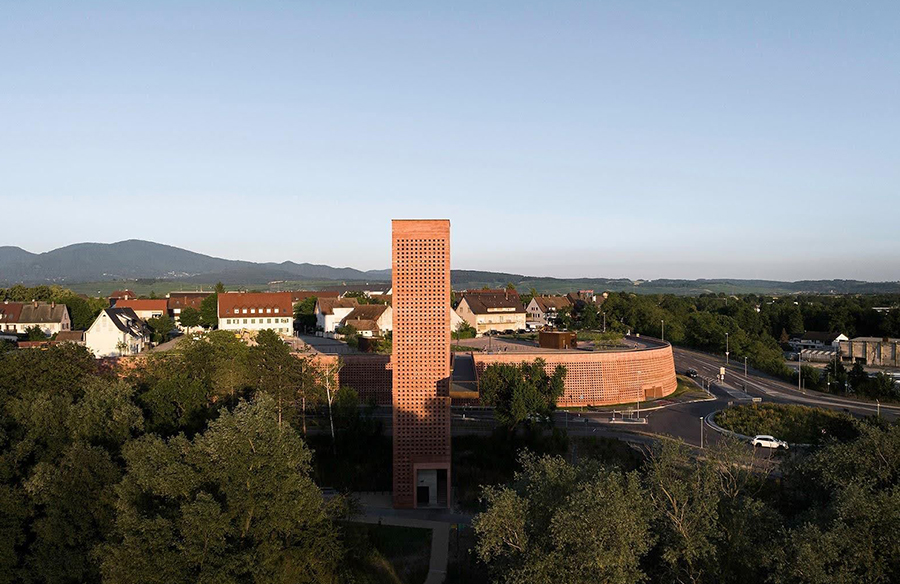
The centerpiece of the transformation was the new gateway to the city, the brainchild of the Berlin-based studio Mono Architekten. The gateway was instrumental in combining many urban and environmental elements in a blend that pervades thoughtfulness yet strikes the right balance. The perforated concrete tower, a carpark with an expansive public park on its roof, and a network of seamlessly integrated pedestrian walkways welcome visitors and attract residents alike.
As one approaches the city from its west, the visitors are intrigued by the novel buildings in red earth comprising the elevated 3-storied car park (231 spaces), the viewing tower (36 meters in height) with a viewing bridge, and the public square that are quite attracting but in harmony with the adjoining habitat. The elevated car park is contoured to match the adjoining contours connecting the commercial center with the surrounding habitat. The undulating car parking structure contoured naturally into the Münsterplatz, a public plaza camouflaging the carpark and blending seamlessly with the ecosystem. This elevated plaza has since become a happening place for urban activities, and the functionality of the transportation hub was converted into an event space fostering community gatherings to engage in Neuenburg’s history and culture. The public plaza was designed with lavish seating areas and lush green plants that welcomed the public to ponder tranquility at the beautiful views of Neuenburg’s adjoining green terrain.
The Intersection of Tradition & Innovation: The Architectural Blend
Neuenburg makes its stamp with the design statement synchronizing locally available traditional materials to form contemporary architectural masterpieces. Mono Architekten was inspired by the city’s history and its pristine location along the banks of the Rhine river, to develop its façade. The buildings are enveloped in red-colored rammed earth using the locally available red sandstone. The red earth buildings ensure durability, provide continuity with the city’s past, and harmonize with the surrounding green landscape.
Neuenburg as the former riverbank of the Rhine makes it a natural choice for the usage of sandstone considered functionality and the region’s culture. The punctuated rammed earth walls of the façade enhance the aesthetics of the buildings and narrate a story of Neuenburg’s former position along the Rhine River. The reddish tint in the red earth denotes the locally available sandstone whilst the layers of compacted red earth echo the geological strata and landscape.
The Corten steel has a rusty appearance with its weathered look in contrast with the earth-toned walls, augmented by the modern touch whilst resonating with the city’s industrial heritage. Both materials, the rammed red earth and corten steel connect the new structures with their surroundings in a story that unravels as one delves into it.
Seamless Connections: Inside & Outside
A key aspect of Mono Architekten’s design is the seamless integration of infrastructure with public spaces. The 3-storied car park was essential for functionality without disrupting the landscape, enhancing connectivity between the town center and the new public park. The elevated parking structure is designed for accessibility with wide ramps at both ends and vehicular access whilst creating pedestrian walkways within the building.
The design of Mono Architekten emphasizes the importance for the community to engage and interact. The public spaces, especially Münsterplatz, are where the residents of Neuenburg am Rhein can gather, connect, and share experiences. The layout of the plaza allows flexibility thereby supporting the various community activities such as markets, social events, and leisure gatherings. The surrounding green spaces encourage a closer interaction with nature, fostering tranquility and well-being.
Neuenburg’s strategic location at the confluence of these nations, Germany, France, and Switzerland, has fostered a rich cultural heritage, and the redevelopment embraces diversity. The city has been a melting pot of different languages, traditions, and influences, and the architectural language of the new gateway honors that heritage, yet it looks forward. The habitual use of naturally available local materials such as rammed earth and sandstone reduces cost whilst creating a dialogue between the past and the future, paying homage to the rich craftsmanship in the region that was pervaded with an innovative design responding to contemporary needs.
The design is future proof allowing the future environmental goals including the extension of the bridge from the viewing tower to the park below with a fully accessible and step-free route that is ADA compliant for inclusive participation by all residents and visitors, including the public with mobility challenges and cyclists alike.
It would appear that the redevelopment of Neuenburg am Rhein provides just the impetus for a broader and more ambitious vision for the future. It has certainly set the precedent for harmonizing infrastructure, public spaces, and sustainable design, a model to emulate for other cities. The integration of mixed-use development without disturbing the natural habitat serves to enrich the urban fabric of Neuenburg, creating a vibrant and sustainable environment to welcome future generations.
This architectural model encompasses community, sustainability, and cultural respect. It ensures that Neuenburg am Rhein will continue to be the beacon of progressive character where history combined with the future complement each other to shape an evolving identity that has become the city’s legacy.
Farah Harris is a graduate in Bachelor of Architecture from TKM College of Engineering, Kollam, affiliated with APJ Abdul Kalam Technological University, Kerala. With a keen eye for detail and a passion for collaborative design, she enjoys exploring the relationship between architecture and the human experience. Farah's interests span across various aspects of design, continually evolving as she engages with new ideas and approaches. She is focused on expanding her professional network and contributing to projects that inspire innovative thinking.
We use cookies to ensure that we give you the best experience on our website. If you continue to use this site we will assume that you are happy with it.