“अनन्तनागशयनं पद्मनाभस्य च श्रियम्” — this ancient Sanskrit verse, which translates to “In the repose of Ananta (the serpent deity) lies the wealth of Padmanabha,” has great meaning. The Sree Padmanabhaswamy Temple calls on us to discover its hidden stories enclosing the secrets of a mysterious history within each stone.

We’ve taken a journey through our previous explorations, where we’ve envisioned the future of architecture—from self-healing materials to floating cities. But now, let’s explore the mysteries that are hidden within the walls of this old temple, the shadows of the past. This is a world where architecture and faith coexist in intriguing ways—a place of devotion, art, and untold stories.
Allow yourselves to become part of the sanctum. Together, let’s journey through the stone hallways, breathe in the historic atmosphere, and listen to the gentle hum of tales passed down through the ages by people who have worked here for generations. Welcome to Thiruvananthapuram, Kerala’s Sree Padmanabhaswamy Temple, where architecture and history blend harmoniously.
Dravidian Mastery: Ancient Architecture’s Magnificence

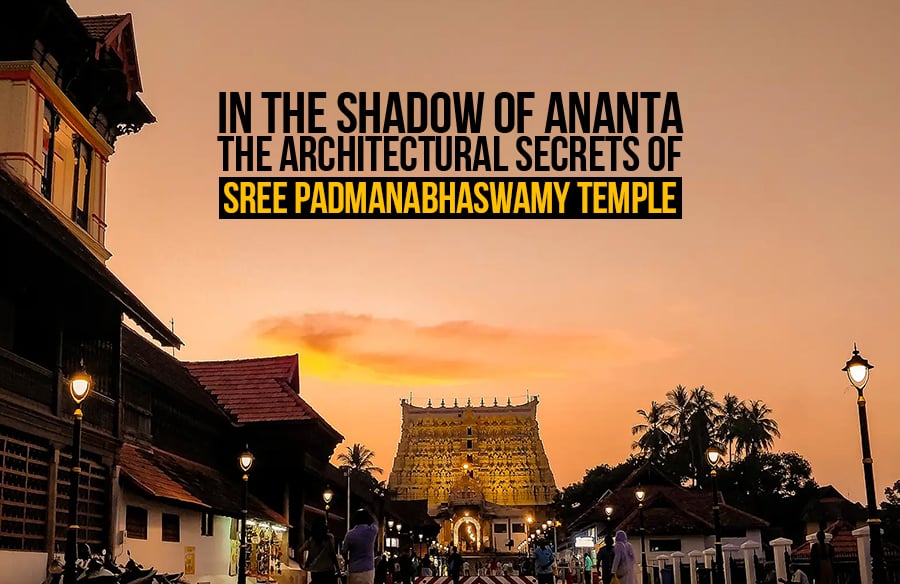
With its seven-tiered gopuram that pierces the sky, the Sree Padmanabhaswamy Temple is a stunning specimen of Dravidian architecture. Dedicated to Lord Padmanabha, a manifestation of Vishnu who is perched atop the formidable snake Ananta, this architectural wonder features elaborate sculptures of Hindu epics on every floor that evoke tales of devotion and faith. The exact astronomical alignment, which permits the sun’s rays to shine on the deity’s statue at specific times of the year, especially the equinoxes, is one of its most intriguing features. Devotees’ spiritual experience is enhanced by this alluring effect, which draws them into a magical dance between the divine and the heavens and symbolizes the divine connection between the cosmos and the terrestrial sphere.

The Vaastu Shastra, an ancient manual for building temples and sacred spaces, is followed in the design. The Sree Padmanabhaswamy Temple’s spiritual aura is enhanced by the exact alignment of every stone, hallway, and archway. Though much of what we see now was created and developed during the reign of the Travancore monarchs, who saw themselves as Lord Padmanabha’s humble devotees, the temple itself dates back to the sixth century.
These emperors invested a great deal of money to build a temple that would represent the divine presence in every carved figure and cavity, according to research from the Travancore Devaswom Board’s records.
Locals claim that Sree Padmanabhaswamy Temple priests, who saw the construction process as a kind of prayer, guided the talented craftspeople as they laid each stone. One can just feel the weight of that commitment, the somber intent with which each pillar and sculpture was created when they picture themselves going beneath these imposing archways.
Legendary Vaults: Mysterious Wealth and the Puzzle of Vault B

The greatest mystery of the Sree Padmanabhaswamy Temple is hidden deep beneath its stone flooring, inside six historic vaults that haven’t been opened in generations. Gold coins, elaborate jewelry, and holy items valued at billions of dollars were among the astounding treasures found in the first five vaults, which were inspected in 2011. However, there is still one vault that has never been opened, horribly called Vault B, and myths envelop it like a protecting veil.
The story of a British officer who tried to access Vault B during the colonial era is one of the darkest. The priests at the temple urged the officer not to disturb the vault, which is believed to be protected by divine curses, but the officer disregarded their cautions, according to local legend. Unbothered, he gave his soldiers the order to break it open. Strange things allegedly happened as soon as they started: an unusual storm formed over the Sree Padmanabhaswamy Temple, and the officer, who had a severe fever that night, passed away within days.
According to the locals, this was a warning to anyone who dared to violate the contents of Vault B and retribution from the gods. As a warning that some secrets are not meant to be revealed, followers still whisper this narrative to one another. Vault B, according to an ancient priest interviewed by The Hindu, is “a vault of the gods,” and “even the royal family would never dare open it.”
The story, whether true or not, gives Sree Padmanabhaswamy Temple a sense of suspense and transforms it from a place of worship into a world where spirituality, legend, and history are inextricably linked.
Ananta Shayana: The Iconic Idol of Padmanabha in Eternal Repose

The temple’s prominent depiction is of Lord Padmanabha, the god, lying down on the serpent Ananta. Crafted from thousands of salagramas (holy stones), this statue is more than eighteen feet long and is separated into three parts for devotees to see: the head, the middle, and the feet. Every doorway provides insight into a distinct facet of Vishnu’s function within the cosmic cycle.
Ananta Shayana’s reclining pose represents the cycle of creation and preservation, which is central to Hindu philosophy, and the eternal repose of Vishnu. I can’t help but feel timeless as I picture myself standing in front of this magnificent idol—as if Vishnu himself is sleeping, unconcerned by the passing of the ages, a silent observer of history.
According to a Sree Padmanabhaswamy Temple priest who was interviewed by The Indian Express in 2018, “The essence of the cosmos itself is the deity’s repose.” He reminds us that everything starts and ends in him by keeping watch over the processes of birth and rebirth. Because of the way this reflection is incorporated into the temple’s design, Sree Padmanabhaswamy Temple is more than just a house of worship—it is a spiritual story preserved in stone.
Innovative Architecture: Ancient Methods for Contemporary Wonders

Sree Padmanabhaswamy Temple’s architectural brilliance attracts architects worldwide, while its spiritual atmosphere enchants admirers. The temple, which was constructed in the ketara vritta (circular) style, is intended to stay cool even during Kerala’s muggy summers. Modern architects continue to admire the natural ventilation system created by its stone hallways, high ceilings, and well-placed windows.
The construction of the temple was a phenomenal architectural achievement, according to records from the Kerala Tourism Board. It is still unclear how the enormous stone slabs that were carried to the pinnacle of the gopuram were raised without the use of modern gear. While some hypothesize about long-forgotten procedures that were passed down among craftsmen, others think that intricate pulley systems and elephants were utilized.
“People say these stones were blessed before they were laid, and even today, they carry the prayers of those who built this place,” a temple guide said in a recent documentary. Every one of these stones appears to be whispering ancient secrets as I picture them beneath my feet, beckoning me to marvel at the architects’ ingenuity for doing so much with so little.
Sree Padmanabhaswamy Temple – A Journey Beyond Time

Imagining Sree Padmanabhaswamy Temple is a unique experience that takes you beyond a simple historical tour and into a realm where art and devotion coexist and where every stone is shrouded in mystery. With its imposing gopuram, secret chambers, and the solemn figure of Lord Padmanabha, this temple is a monument to the close relationship between architecture and spirituality.
A feeling of subdued amazement lingers as one departs from this ancient beauty. We have witnessed the magnificence of Dravidian architecture, the abundance of incalculable treasures, and the creativity that can only be produced by years of hard work. Long after one depart, we are still surrounded by the whispers of tales, the prayers in stone, and the secrets kept in quiet.
Citations & Credits:
- Books
Nair, R. (2018). The Eternal Vishnu: A History of Sree Padmanabhaswamy Temple. Trivandrum: Devika Press.
- Articles
Print Journals:
- Ramachandran, S. (2020). Temple Architecture and Mysticism in Kerala. Journal of South Indian Culture, Volume 17 (2), pp. 12-34.
Journal Articles Accessed on a Website:
- Krishna, T. (2017). Mysteries of Vault B in Sree Padmanabhaswamy Temple. Volume 5 (4), pp. 21-30. Available at: www.templemysteriesjournal.com/vault-b [Accessed: 02 November 2024].
- Online sources
- Padmanabhaswamy Temple Official Site. (2023). Architecture and Design. Available at: www.sreepadmanabhaswamytemple.com/architecture [Accessed:02 November 2024].
- Kerala Tourism Board. (2021). History of the Temple. Available at: www.keralatourism.org/padmanabhaswamy
- Images/visual mediums
- Image 1: Unknown. (Year of production not specified). [JPEG image]. (Available at: https://bharattravelguru.com/wp-content/uploads/2024/05/Sree-Padmanabhaswamy-Temple-Kerala-State-1024×683.jpg).
- Image 2: Unknown. (Year of production not specified). [JPEG image]. (Available at: https://pbs.twimg.com/media/F7uxCP1awAAFOMj.jpg:large).
- Image 3: Unknown. (Year of production not specified). [JPEG image]. (Available at: https://miro.medium.com/v2/resize:fit:1280/1*wcBd-QowMHEFng-tZRc-ow.jpeg).
- Image 4: Unknown. (Year of production not specified). [JPEG image]. (Available at: https://blogger.googleusercontent.com/img/b/R29vZ2xl/AVvXsEg3xD0gqp4IgYDhbdsWfOfFqcZjpMi_8uSzw7lt8Erx4zZMQzBw6hnYMVProEcZyQf6qqJJIPkUhjmikdv7b5CFWldmh4Gc8MbpdOEHWefUd-pTgkejv-s5e3QBXXGDa366TkkMlRqacgzb/s640/8c1d3c14821967accc40ee9f8302ce2f.jpg).
- Image 5: Unknown. (Year of production not specified). [Untitled]. [JPEG image]. (Available at: https://pragyata.com/wp-content/uploads/2020/09/e1f028c4d2a8558403bfb845141d0b37.jpg).
- Image 6: Unknown. (Year of production not specified). [Untitled]. [JPEG image]. (Available at: https://eastindiantraveller.com/wp-content/uploads/2021/11/sree-padmanabhaswamy-temple.-1-1.jpg?w=1023).
- Image 7: Unknown. (Year of production not specified). [Untitled]. [JPEG image]. (Available at: https://pbs.twimg.com/media/E_npXW6VgAMxZ1S.jpg).