The Temple is an alluring structure that speaks out for itself, through its jingling bell sound, the breeze that surpasses its walls, and the Architecture the Temple holds. Nevertheless, India is a Continent of religions, culture, traditions, rich ancient history, and Ethnolinguistics. The Temple is the very next place to connect with the Almighty. The Temples are filled with Art, Architecture, Manuscripts speaking out the rich history, Materials that connect to form a structure, technical detailing to seek attention through elegance, and Philosophy to identify the divine fabric of the existence of the temple and the supreme importance of the temple.

The Saga begins with the great saint, or the first Peethadipati, “Mahadasohi Sharanabasaveshwar,” achieving Lingaikya. The Maha-samadhi (The temple) of Sharanbasaveshwar was built by the second Mahadasoha Peethadipati “Poojya Sri Adi Doddappa Appa” in 1822. The idol of Mahadasohi Sharanabasaveshwar and his Guru Marulasidda was placed on the Maha-samadhi i.e., the idol and Maha-Samadhi are placed in the garbhagriha of Sharanabasaveshwar temple. The Temple is dedicated to the eminent Saint Sharanabasaveshwar. The Architecture of the Sharanabasaveshwar temple showcases the fusion of Hindu and Islamic Architecture in the Muslim dynasty i.e., the Bahmani Kingdom ruling Kalaburagi during that Period.

The Samadhi of Lord Sharanabasaveshwar is housed in the Garbhagriha temple, with the idol of two faces i.e., of lord Sharanabasaveshwar and his Guru (Teacher) Marulasidda. The deity’s idol – on the right side of the idol is Sharanabasaveshwar’s Guru’s idol Marulasidda and on the left side of the idol is the lord Sharanabasaveshwar.
Architectural of the Shrine

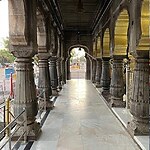
The temple consists of single and couple columns (i.e. known as Jodi Khamba) with intricately carved bulged columns at the bottom and decreases on top as shown in Fig – 3


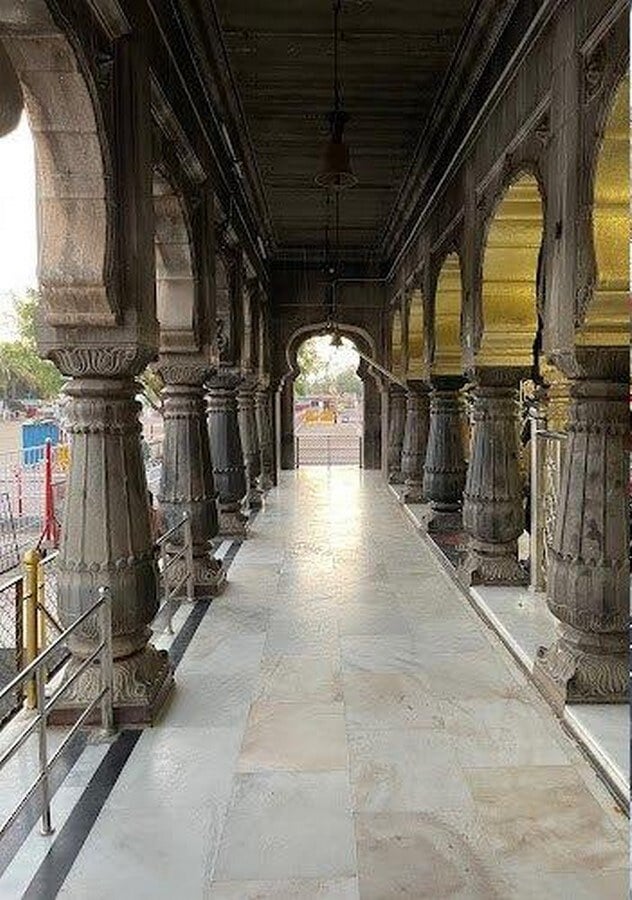
The arches in the interior and exterior of the temple are finely crafted and carved out of basalt stone (locally available black stone), which is a combination of Islamic and Hindu architecture. The columns supporting the arches are part of the ancient temple’s art and architecture.


Topped on the elevated platform (that is, a tall plinth with dressed white marble flooring at the foot) is the temple. The temple is planned in a way where the Mandapa and steps leading up to the sacred place, (Garbhagriha), which is capped with a gorgeously carved Shikhara that is covered with a holy gold Kalasha. The shikhara is again carved into tiny arches holding Lord Sharanabasaveshwar which showcases the Leela’s (the miracles of lord Sharanabasaveshwar). The roof of the temple is surrounded by four elephants on the four sides of the temple top. The boundary of the Temple is fenced by low heighted parapet (which is similar to the Fortress parapet wall as the Architecture is a fusion of Hindu and Islamic Architecture) as shown in Fig – 8.


Pradakshina is the ritual of circling an idol in a shrine in a clockwise fashion. Hinduism is based on the idea that God is the ultimate focus and center of human existence. In Sharanabasaveshwar temple the Pradakshina path is around the Garbhagriha and Mandapa. The path is elongated and welcomed with the carved columns and arches. The access to the Garbhagriha is through two doors, the access to both doors is given through the Pradakshina path. One entrance door (i.e., the door to Garbhagriha) faces the eastern direction of the rising sun. The Garbhagriha always draws the focus of the devotees due to its low-lit area.

Garbhagriha & Car Festival
The Garbhagriha of Sharanabasaveshwar temple is square in plan and sits on the high raised plinth (The complete plinth of the temple) which is a cube. The Garbhagriha is a dark room, it is windowless and consists of two doors and small niches in the walls, the niches provide natural light and Ventilation.


In a typical Hindu temple, the Garbhagriha is preceded by one or more adjoining pillared mandapas (Open or closed Mandapa) which are connected to the sanctum by an open or closed vestibule (Antarala). The entrance doorway to the Sharanbasaveshwar temple is through the Mandapa which is outlined by the single and the couple column (Jodi Kamba) Reflective mirrors, stained glass, and sparkling glass pieces cover the entire inner roof of the Mandapa. The Mandapa is decorated with the sculptures of the Leela’s (Miracles of lord Sharanabasaveshwar) and also the idol of 7th Mahadasoha Peethadipati Poojya Sri Doddappa (the Headcount/family of the Lord Sharanabasaveshwar). The temple with attractive supporting pillars, 36 arches, decorative mirror work, life-like sculptures of Sharanabasaveshwara and his Leela’s, and extravagant chandeliers, also features intricate embellishments. These carvings depict majestic creatures such as Garudas (Hindu mythological birds), parrots, and elephants, as well as flowers.

The Temple complex Entail traditional Deepa stambha, the entire structure, or stambha, is a long, elongated column that works similarly to a standard natural lamp and is typically lighted by oil Deepa’s or Dias. Located on the eastern side of the temple is the Deepa stambha.

Every year a famous car festival (Rathotsava) and Jatra (Fair) takes place in the temple complex of Sharanabasaveshwar temple. The purpose of this car festival is, the God Sharanabasaveshwar comes out of Garbhagriha and visits his devotees. During the Jatra, oodles of people come from various distant villages, cities, and states and gather here to watch and celebrate the Jatra and seek the blessings of lord Sharanabasaveshwar. The car festival & Jatra is celebrated for 15 days every year during the Holi festival.
Reference –
- Mahadasohigalu – Book published by Sharnbasva University Kalaburagi
- Posted by Siddeshwar (Aug 27, 2016) – Retrieved from – https://karnatakatravel.blogspot.com/2016/08/sharana-basaveshwara-gudi-gulbarga.htmlhttps://karnatakatravel.blogspot.com/2016/08/sharana-basaveshwara-gudi-gulbarga.html
- Posted by Manjunath Doddamani Gajendragad (July 2017) Retrieved from – https://www.karnataka.com/gulbarga/sharana-basaveshwara-temple/
- Retrieved from – https://www.holidify.com/places/gulbarga/sharana-basaveshwara-temple-sightseeing-1254351.html
- Retrieved from – https://www.tripuntold.com/karnataka/gulbarga/sharana-basaveshwara-temple/
- Siddarama Garur (6/2/32024) Retrieved from – https://www.aimamedia.org/newsdetails.aspx?nid=202689
- Popular Hindu Temples, Retrieved from – https://thetempleguru.com/listing/sharana-basaveshwara-temple/