The famous Iraqi-born British architect Zaha Hadid, “queen of the curves”, is known as one of the few women who’ve had a substantial impact in the field of architecture. Known for her deconstructive forms and fluid facades, she was the first woman to win the esteemed Pritzker in 2004.

She studied at the Architectural Association with the famous Rem Koolhas and Elia Zenghilis. Upon graduating where she was offered a job position at OMA, which she refused lest it was turned into a partnership, which it was! Zaha Hadid, from an early age, would command her worth. After working with OMA for a short time, she went on to establish her own architectural practice and thus in 1979, Zaha Hadid Archirects was born.
Zaha Hadid has been the brains behind many of the iconic architectural works of today, from the London Aquatics Centre (England) to the Sheikh Zayed Bridge (United Arab Emirates) the journey to the Pritzer and Sterling awards was not easy. Most of her designs from the late 80s and early 90s – including the competition-winning proposal for the Peak in Hong Kong, Kurfürstendamm in Berlin, Zollhof Media Park in Dusseldorf and the Cardiff Bay Opera House in Wales – while bringing her fame and recognition (being displayed in famous galleries and museums), were never built, considered to be too “avant-garde” to be displayed beyond works of art as paintings and sketches.


Background of the Cardiff Bay Opera House
In the early 1900s, the capital of Wales, Cardiff, was undergoing a massive redevelopment project to turn the area into a vibrant space, rich with culture and commerce to serve as an active tourist destination. One of its crucial components was thus the center of performing arts, the Cardiff Bay Opera House, to serve as a world-class venue and a landmark, cementing Cardiff’s place on the global map. Alun Michael, a former Cardiff city councilor said:

“Sydney, as a city, was an empty space in people’s minds until the Opera House was built. We need a similar sort of building in Cardiff for us to make our mark.” (Bruin-Molé, 2016)
The proposed plan, as approved by the Cardiff Bay Development Corporation, was to construct a permanent home for the Welsh National Opera on a site in Cardiff Bay – the Inner Harbor.
The Cardiff Opera House Trust then organized a design competition, seeking proposals from the industry’s creative minds. 268 international firms competed, from Rem Koolhaas, and Norman Foster + Partners, to Mario Botta, but Zaha Hadid eventually won in all three rounds.
Zaha Hadid’s Design and Concept
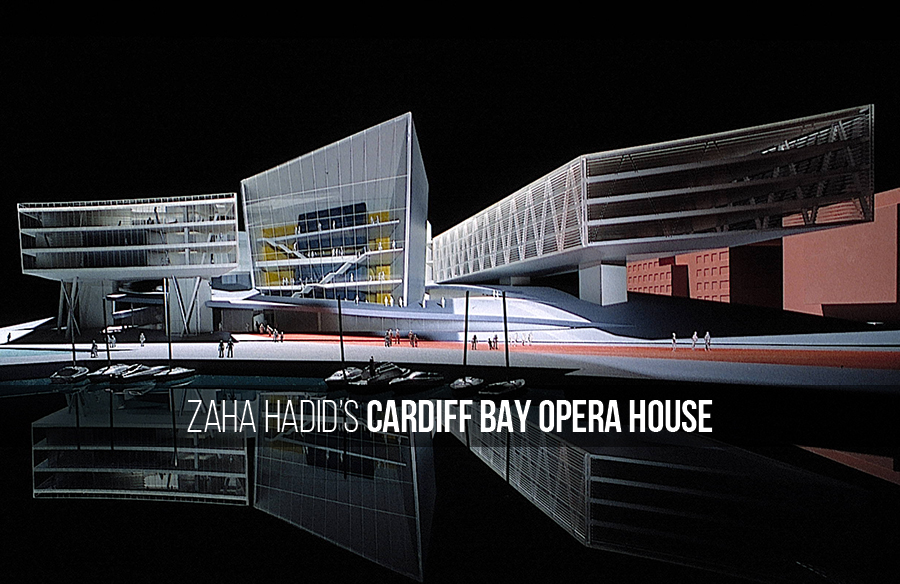
Zaha Hadid’s proposal dubbed the “inverted necklace”, was a dauntless landmark on the Cardiff waterfront. The design featured futuristic deconstructed forms challenging the user’s perception of form and space by seamlessly blending public space with the secluded space using spatial hierarchy and placement. It involved a glass building that wrapped around another centralized glass building that would serve as the performance hall.

“The building concept is based on the architectural expression of the hierarchy between serviced and servicing spaces: the auditorium and other public and semi-public performance and rehearsal spaces spring like jewels from a band of rationally lined-up support accommodations. This band is then wrapped around the perimeter of the site like an inverted necklace, where all the jewels turn towards each other creating a concentrated public space between each other, accessible to the public from the center while serviced from the back around the perimeter.


This central space is experienced from the courtyard open to the sky, as well as from the foyer areas under the raised ground floor. The auditorium and the main rehearsal studios penetrate this floor. Cuts in this plane mark the two axes crossing the space from the two main entrances: the main pedestrian entrance from the Oval Basin Piazza and the concourse entrance with drop-off from Pier head Street.” (Architects, n.d.)
Controversy
Despite the radical proposal by Zaha Hadid, and its unanimous support from the jury panel, the project lacked support from either South Glamorgan County Council or Cardiff City Council, and was savaged by the media as being “elitist”. Welsh politicians and the public were also divided over the acceptance of such an avant-garde landmark in Cardiff, especially in contrast to its existing architectural landscape. The public opinion was largely towards a more traditional building which would reflect the culture of the Welsh, the city and its people. Some also had concerns over the estimated cost of the building (approximately £80 million) which they found to be financially detrimental in the long term. Another opposing view was the program of the centre itself where some pushed for a more sports-centric facility.
The Millennium Commission responsible for the funding of similar projects refused to fund citing the project as too “financially risky”. In late December 1995, citing concerns about cost and public support, the project was officially rejected sending shockwaves throughout the design world. Jonathan Glancey, a writer for the Guardian wrote.
“It would have become the most radical and compelling building in Britain, but an alliance of narrow-minded politicians, peevish commentators and assorted dullards holding the Lottery purse strings ensured it was never built.” (Glancey, 2011)
The project was succeeded by the Wales Millennium Centre, which included a broader range of artistic offerings and was said to be more in keeping with Welsh culture while retaining the opera element. The Centre opened in November 2004 on the site originally intended for the Opera House. Zaha Hadid cited sexist and racial prejudice as the reason for the rejection. In 2013 she said
“People are much more accustomed now to women. There might be certain prejudices in certain places but I honestly have not encountered them…I have encountered them, on the other hand, sometimes in the Anglo-Saxon world – here in the UK, maybe in America…I’m not sure it’s worse, it’s only a personal experience…Nobody’s going to come and tell me: ‘We don’t want me to get this job because you’re a woman’. But I did come across a lot of resistance and prejudice when I wanted to build the Cardiff (Bay) Opera House, which is almost 20 years ago now.I don’t think that it was in any way hidden – there was commentary by certain people in various papers, on the radio – maybe not because I’m a woman but because I’m a foreigner.” (Deacon, 2020)
Aftermath
Even though the Cardiff Bay Opera House was never built, it remains one the most significant works of Zaha Hadid to date. In the words of Alun Michael ‘the most famous unbuilt building in Wales’ and 2011, was rebuilt in China as the Guangzhou Opera House. An unbuilt project from her early career managed to hold such value in the eyes of architects today and goes to show the boundaries the young Zaha Hadid was willing to push for the sake of her craft. The rejection of her design also underscored the challenges that groundbreaking architects often face in trying to realize their visions, particularly in the context of public and government-funded projects.
References:
Architects, Z. H. (n.d.). Cardiff Bay Opera House. Retrieved from Zaha Hadid Architects: https://www.zaha-hadid.com/architecture/cardiff-bay-opera-house/
Bruin-Molé, M. d. (2016). Fantasies of Cardiff Bay Opera House. Frankenfiction.
Deacon, T. (2020, January 03). Wales Online. The controversial history behind the doomed plans for a Cardiff Bay opera house.
Glancey, J. (2011, February 28). Move over, Sydney: Zaha Hadid’s Guangzhou Opera House. The Guardian.