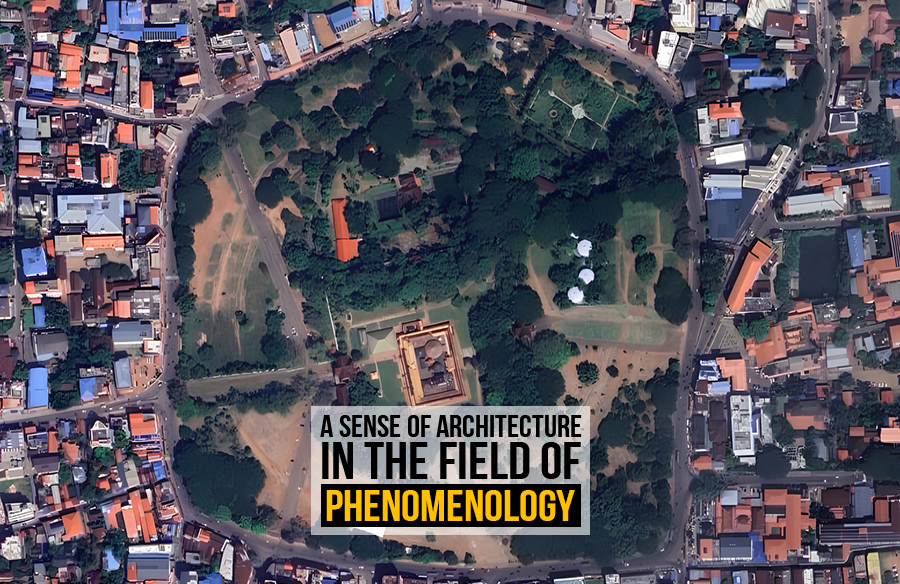
Humans’ reliance on their visual sense was always preferred over other senses and is often associated with ‘Seeing is Believing’. This idea of image has pervaded our senses so much that we have come to associate good architecture with beautiful images. But can a glamorous image of an architectural space capture the true sensorial value it holds? What role does phenomenology play in the experience of architectural space?
What is Phenomenology?
Phenomenology studies the subjective and conscious experience of the world and its objects.
As a movement and a philosophical discussion, it started in the early half of the 20th Century, first believed to be introduced by Philosopher Edmund Husserl. Although this term was used by other philosophers like Immanuel Kant and Martin Heidegger, Husserl questioned how objectivity is possible when all the experiences of the world and its objects are subjective.
Architecture & Phenomenology
Like in every art and philosophical field, Phenomenology has its impact on how architects understand and develop space organisation. It was initially seen as a sharp response to the cold-functional aesthetic of Modernism – where the emphasis was on functionality and maximum useability – often the sensory and the emotional experiences taking a low priority. The key elements towards a phenomenological approach to architecture include careful consideration of Materials, the effect of light, shadow and shape of the space as well as tactile experience of the spaces – to evoke feelings and emotions.

Early Advocates of the Movement
In 1958’s ‘Poetics of Space’, the French philosopher Gaston Bachelard voiced the emotional and personal responses of life inside architecture through prose and poetry. He urged the architects to base their work on the experiences that we gathered and not some abstract rationale. During the same period, the essays and books of Architect philosopher Steen Eiler Rasmussen sought to advocate the idea of experiential spaces to a much wider audience. Rasmussen’s famous book Experiencing Architecture (1959) presents itself as a series of experiential instances of everyday life and exploration of inanimate objects inside buildings and cities. It distils a clear introduction to the architectural profession, its responsibilities, and most importantly the magnificent power of architecture to shape human lives. He goes on to explain that the great works of art are always subjective.
Later Treatises of Phenomenology
In the later period of the century, Christian Norberg-Schulz in his important book, Genius Loci: Towards a Phenomenology of Architecture (1980) advocates the idea of ‘Genius Loci’ or the spirit of the place which he believes is central to the idea of Phenomenology in Architecture. In his book, he emphasises how places have unique identities that affect the human experience of that place – landscape, light, and culture. He urged architects to respond to this Genius Loci and resonate with its context, and character.
The Finnish architect, Juhani Pallasmaa is another of the advocates of Phenomenology. Originally a rationalist, Pallasmaa’s initial works were characterised by standardisation and prefabrication. His initial work highlighting these principles was the Moduli 225 of 1969, a series of 6 industrially produced summer houses of wood. They were influenced by Japanese modular construction and the works of Mies Van Der Rohe. It was this interest in Japanese Architecture and his return from teaching in Africa that he studied culture, materiality and phenomenology in depth. His seminal book, “The Eyes of the Skin’ also discusses how the visual sense has been prioritised over other senses. He believes in the usage of natural materials which express their age, and the story of their origin and he criticises the buildings of the technological era with their emphasis on ageless perfection. He argues that the fear of the traces of wear and ageing is indeed man’s fear of death.

Although Phenomenology as a movement has faded from the discourse, the idea is evident in the works of architects like Peter Zumthor and Daniel Libeskind. Zumthor plays with the material, aural and light effects to create an edifice of balance and harmony in the Serene Therme Baths at Vals. In Libeskind’s dramatic Jewish Museum in Berlin, the architecture twists and contorts. The design of the building emphasises better communication of the emotions that the Jews felt during the holocaust.

Phenomenology as a movement offers a fresh new expose to today’s architecture wherein architects are limited to exploring aesthetics on a surface level rather than deep diving into the sensual qualities of space. The fascination to put up the fanciest facade and the superficial ‘skin’ is synonymous with the short attention span, and mobile-centric, visual culture we are encapsulated in. When was the last time we broke free of the ‘surface’ to get a feel of the spaces? What emotions do the walls, windows, spaces and materials we take for granted bring forth? How do they affect us as a person, a family, a society?