Every discipline, science and invention is born out of the need to solve a problem a community faces. It is born out of empathy, a willingness to help each other out, and a solution that allows people to live a normal life despite their problems.
Architecture is, at its core, an incredibly empathetic discipline. A house cannot be designed without keeping the user’s requirements in mind and heart. Any space, for that matter, is designed to ensure that the user is at their most comfortable and can perform the function the space was designed for to the best of their abilities.
Humans are inherently social animals. This trait is what gives way to civilization. We have been since primitive times and share this trait with many other organisms. It is ingrained in our brain cells and inherited from our ancestors through blood.
Communities came through evolution from this trait. Community is a value, an intangible currency that binds people. It brings in solidarity, trust, value, empathy and mutuality.

So how does architecture, a vital discipline to human life and community, a vital trait to the social structure come together?
What defines a community
‘Fellowship is heaven, and lack of fellowship is hell; fellowship is life, and lack of fellowship is death; and the deeds that ye do upon the earth, it is for fellowship’s sake ye do them.’ (A Dream of John Ball, Ch. 4; first published in The Commonweal 1886/7)
Communities can be categorised on 3 broad variables/factors
- Place: Place community can be seen when a group of people have the shared element of location or geography.
- Interest: Communities of this type share factors like religious belief, ethnic origin, occupation, caste or sexual orientation, among others. This might also be called intentional communities as they focus more on personal identity than predestined factors.
- Communion: It can be described as an attachment to a place, group or idea. Or a deeper meaning would entail a profound meeting or encounter.
While these categorizations might ease our understanding of communities, there is always the strongest possibility that these overlap in instances. At its roots, communities are simply groups of people who share something meaningful and rely on each other through trust and mutual understanding.
Community influencing architecture
Both, architecture and communities, are vital parts of the societal fabric. Architecture is a physical manifestation of the goals, struggles, past, present and future of communities.
Communities inadvertently influence the architectural fabric of a city in many ways.
1. Chinatown:
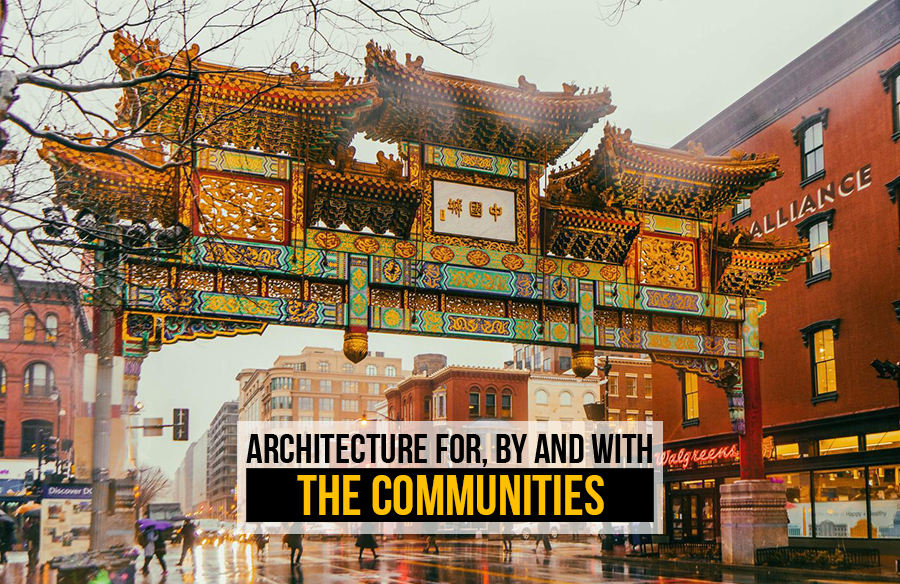
Human migration has had an impactful influence on the architecture and urban fabric of cities. The most common of these are the Chinatowns, found not just in the Asian continent in Japan and India but all over the world. They occupy a distinct place in the city’s fabric.
Chinatowns around the world are recognised by their recurring architectural motif, Archways and the traditional pagodas. They borrow architectural aesthetics from traditional Chinese architecture and symbols.

While Chinatowns have now become attractive tourist destinations and a refuge to the migrants and people living away from their homeland, especially on foreign soil, it belies the struggle the community had to go through to get there.
2. Aldo Rossi and Collective Memory
One can also argue that cities also act as communities. People living in the same city are tied together by the shared geography of the city and the spaces they occupy in the city.
Aldo Rossi, a Pritzker-winning Italian architect, described the city as an artefact that possesses its history. This artefact leaves traces of its history; these traces embody the memory of the city. As a diverse whole, the city is haunted by meaning, which the collective memory extracts from its traces.
Many theorists argued whether collective memory was applicable in an architectural context. Aldo Rossi’s answer to those questions was that, in many ways, collective memory is another way of describing what the city is. Collective memory exists not as an abstract category of thought, unverifiable by scientific means, but in the relationship between the urban fabric of the city and those who inhabit it
3. National migration and its manifestations
Migration is a global phenomenon that has been driving countries for aeons. People locate within country boundaries for a chance at a better lifestyle, job opportunities and a myriad of reasons. People belonging to the same state lines, then, naturally build a community of shared geography.
Over time, these communities grow in size and spirit. It is no surprise then that communities create their nooks and crannies within the city they inhabit. A home away from home. The urban fabric of the city then changes, new threads get weaved in and enrich the city. It can mean community spaces with architectural motifs from their state, eateries and restaurants that serve the local cuisine, religious places that might represent the majority of a community and residential localities that a major part of the community inhabits.
Prominent examples of this phenomenon can be observed in culturally rich cities like Mumbai like Matunga, a city with major influence and community from the south of India or Dadar which houses the Parsi community.

Architecture shaping communities
Architecture is a powerful tool for shaping the physical environment and intangible values and dynamics between people. It acts as a facilitator for human connection, and growth and encourages community well-being.
A community thrives under physical manifestations that give them the space to interact, collaborate, co-exist, and stimulate their dynamics.
1. High Line, New York:
The High Line is a public park built on an abandoned railroad in Manhattan. Nestled in between post-industrial ruins, the park is an elevated walkway that runs for 1.5 miles.
Its influence goes beyond being a haven between the rush of the city. The High Line has reclaimed an unused public space, boosted growth and business in the surrounding area, and has proved to be a successful example of adaptive reuse. The varied biodiversity seamlessly gradient with the built atmosphere giving the space a natural feel.


2. Kutch earthquake rehabilitation:
The deadly earthquake ravaged structures and community spirits in Bhuj, Gujrat. Hunnarshala organisation partnered with the rural population to facilitate building earthquake-resistant houses that valued and respected the traditional styles of the region as well. Building their own houses brick by brick created a feeling of belonging and ownership with their spaces.

3. Empower Shack project:
Based in Khayelitsha, Cape Town, South Africa post-apartheid, the Empower Shack project is a participatory design project that aims to upgrade informal settlements. Architects created a 2 storey housing prototype by involving the community in the design and spatial planning process.
The model created meets the current needs of low-income families while still being expandable when the families’ financial situation improves. An empathetic design solution that involves the community, gives them a sense of control over their living spaces which public housing solutions usually lack.

What does the future hold
Architecture represents many things. It enables a whole lot more. But it is humans, and communities that afford it value.
Throughout the article, we talked about the positive relationship between communities and architecture and how they influence each other in uplifting ways.
But this relationship is not bereft of various other factors that are beyond the power of the parties involved. It would be ignorant to say that thoughtful, empathetic architecture is the key to solving all issues that communities, especially marginalised, face. Systemic issues like poverty, lack of access to education and healthcare, economic inequity and discriminatory policies don’t have a one-size-fits-all solution and need the absolute support and power of law-making systems.
Architecture can act as a starting point for designing spaces that are inclusive and welcome to all, but it would be futile if communities were unable to access those spaces for reasons beyond their power.
The future should hold more tolerance for different communities to co-exist. It should hold accountability from decision-making, and powerful systems. It should hold architecture that is driven by empathy, equity and inclusivity and free of classist notions. It should preserve the relationship between communities and architecture.
The future should have Architecture For All.
References:
Ferreira, D.B. (2024). Designing with Empathy: Architecture for Social Equity. [online] ArchDaily. Available at: https://www.archdaily.com/1021532/designing-with-empathy-architecture-for-social-equity?ad_campaign=normal-tag [Accessed 14 Oct. 2024].
Tovar, E. (2024). Community Growth Through Architecture: Maximizing Limited Resources for Positive Impact. [online] ArchDaily. Available at: https://www.archdaily.com/1016682/community-growth-through-architecture-maximizing-limited-resources-for-positive-impact?ad_source=search&ad_medium=projects_tab&ad_source=search&ad_medium=search_result_all [Accessed 14 Oct. 2024].
Yachi Johari (2024). How can architects design public spaces that are accessible, inclusive, and safe for all members of the community? [online] RTF | Rethinking The Future. Available at: https://www.re-thinkingthefuture.com/architectural-community/a12251-how-can-architects-design-public-spaces-that-are-accessible-inclusive-and-safe-for-all-members-of-the-community/#google_vignette [Accessed 14 Oct. 2024].
Infed.org. (2013). What is community? | infed.org. [online] Available at: https://infed.org/mobi/community/.
Young, S. (2008). The neurobiology of human social behaviour: an important but neglected topic. Journal of psychiatry & neuroscience : JPN, [online] 33(5), pp.391–2. Available at: https://www.ncbi.nlm.nih.gov/pmc/articles/PMC2527715/.
Hoffer, C.R. (1931). Understanding the Community. American Journal of Sociology, 36(4), pp.616–624. doi:https://doi.org/10.1086/215480.
ArchDaily. (2021). Cities Within Cities: Chinatown Around The World. [online] Available at: https://www.archdaily.com/964522/cities-within-cities-chinatown-around-the-world.
Diller Scofidio + Renfro (2019). The high line. [online] DS+R. Available at: https://dsrny.com/project/the-high-line.
Hunnarshala Foundation. (n.d.). Kutch Earthquake Rehabilitation. [online] Available at: http://www.hunnarshala.org/kutch-earthquake-rehabilitation.html.
Architizer. (2017). EMPOWER SHACK by Urban-Think Tank. [online] Available at: https://architizer.com/projects/empower-shack/.
Parsi Khabar. (2018). Dadar Parsi Colony: A Photo Tour. [online] Available at: https://parsikhabar.net/bombay/dadar-parsi-colony-a-photo-tour/16955/ [Accessed 14 Oct. 2024].