K.C.S. Paniker (1911–1977) was one of the founding fathers of modern Indian art, and a well-known painter and sculptor (Anon., n.d.). In the end, Paniker born in Coimbatore, Tamil Nadu became the leading great artist of postcolonial India where tradition and innovation met. His outputs in areas that are best classified in abstract expressionism, indigenous imagery, and his brand of modernism left an indelible mark in both Indian and international scenarios.

Paniker’s childhood and youth were improvised and revealed the essentially autodidact character of this stellar Indian artist. He received a British colonial education but never ceased to develop an interest in Indian mythology, mythology, scriptures, and art. Prejudices from Indian and Western art forms characterised his work till the end of his career. It must also be remembered that Paniker was a life of an artist, teacher, and pioneer, who in addition helped to build an institution. His pioneering establishment of the Cholamandal Artists’ Village near Chennai in 1966 leaped on a new phase in the art scenario in India as the village earned recognition as an art commune of artists which encouraged creativity away from the formal domain.
In his production, which was able to encompass a whole career, Paniker fulfilled the task of mediating between the two forms of art which are the modernist form from the West and the indigenous arts of India.
Career: Philosophy, Style, and Medium
The main platform of Paniker’s artistic concept was “sacred proportions” and symbolism. His work is characterised by the complex and symbiotic arrangement of shapes, letters, and symbols similar to Indian calendar art, Tantric ritual diagrams, and temple paintings. Unlike the existentialist abstract paintings by many of the Western artists who focused on the minimalism of the artwork’s surface: colour and line, for Paniker the abstraction was born out of Indian metaphysical traditions. The objectives were thus to represent beauty in visions but also in-depth, spiritual values, lessons. He always insisted on the aesthetic ideas that should be reflected in artwork as a philosophical and cosmic field of research, and this approach Seliger followed throughout his work.

In his early days, Paniker was a figurative artist but the themes he selected were related to rural and Indian terrain. His subjects included scenes from rural life, deities, and worship rituals and therefore reflected the nationalistic movements In post-colonial India. As for the tools, during this time he worked in watercolour, oil, and perhaps sketching. His stroke resembled that of some of the Western painters in the modern art movement that has characterised the end of twentieth-century painting.
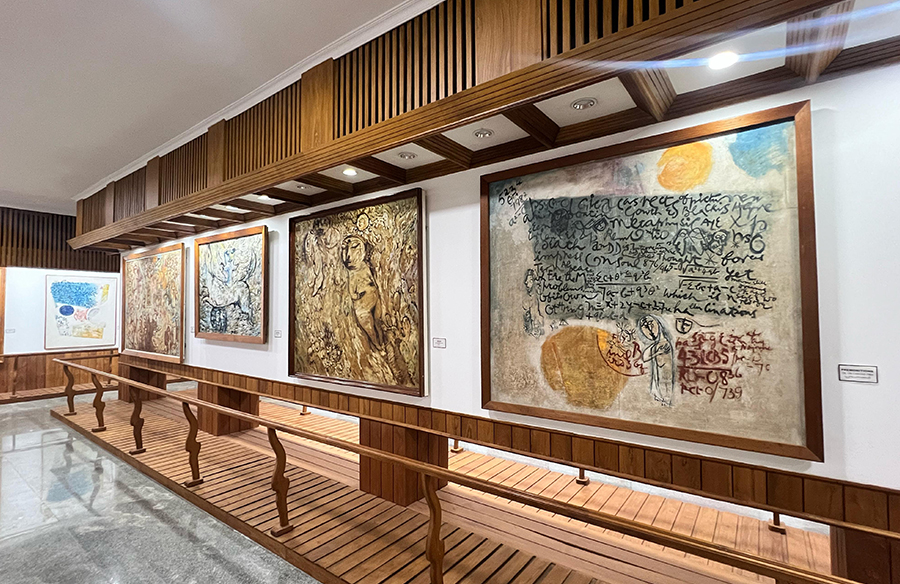
Yet, in the sixties, there arose a metamorphosis in Paniker’s style. His paintings progressed to produce more abstraction and shifted from realism, what might be referred to as symbolic realism. From this time forward his style can be defined as a collection of symbols and signs that are mysterious, resembling the calligraphy handwriting. These symbols were sometimes composed in panels and thus had a systematic layout resembling more of ancient Indian scripts and scrolls. This shift started his “Words and Symbols” series, in which he incorporated letters from different Indian scripts, geometric forms, and symbols integrated with arts, nature, and divinity for he regarded art, nature, and divinity as part of cosmic harmony.

Generally in Paniker’s creations during this period, the colours were dark, mostly dominated by ochre, red, and brown, which looks like old manuscripts or frescoes. He started using different media and then making a combination of various textures and he also had depth in his works which were flat surfaces. More philosophically, Paniker’s art was an attempt to move above the gross physical realm. Repetition of the symbols and letters seemed not only to be too aesthetic to him but also he believed in the cyclical character of life and the universe. The ideas that shaped the artist originally were the ideas of India’s metaphysical way of thinking based on the circle of cycles contrary to the linear ideology of Tantrism.
Recognition After Death
Paniker was a well-known figure during his lifetime and he gained influence even more after he died in 1977. His work has been exhibited in leading galleries and museums in London, Paris, and New York and his distinctive approach to modern Indian art thus received deserved recognition. All these research works of Paniker contributed a lot to set the base for the identification of an Indian style of ‘Modernism’ which although influenced by Western movements, but distinctly Indian.
The Cholamandal Artists’ Village, which is still functioning as an artist’s colony and a centre for what Paniker specified as experimental arts practice particularly rooted in the context of collective action, is Paniker’s enduring contribution. Even those artists who are affiliated to the village are now among the most recognized faces on the contemporary Indian art circuit. It was the vision of Paniker to have an exclusive artist community that was self-sufficient with no association to the gallery systems This idea is as relevant to this very day and it inculcates the young artists to start experimenting new modes of creative practices.
As far as critical acclaim, Paniker’s paintings today remain widely analysed in art historical view mainly due to the successful blend of the element of the abstract with Indian iconography. His paintings are exhibited in many galleries and museums around the world as well as in private collections and galleries, and a number of his exhibitions were intended to highlight the work of the pioneer of modern Indian painting of the twentieth century.
International art also feels Paniker’s presence. His symbolical and metaphysical attitude has been popular among international circles to follow the art mixed with cultural and modern tendencies. This hits on his themes of spirituality and philosophy without regard to particular locations or cultural norms and is therefore aptly respected all over the world.
The contribution of K.C.S. Paniker to the world of art cannot be measured by his talent, or the quality of his paintings. He recast the vision of modernity in art from the margins of India in tandem with the imperative of an international modernist abstraction that was at once philosophical and spiritually defined. His works are a witness to art as one of the superior types of human activity as it is categorically involved with values of culture and the beyond, thereby his impact living on to spur and challenge generational artists internationally.