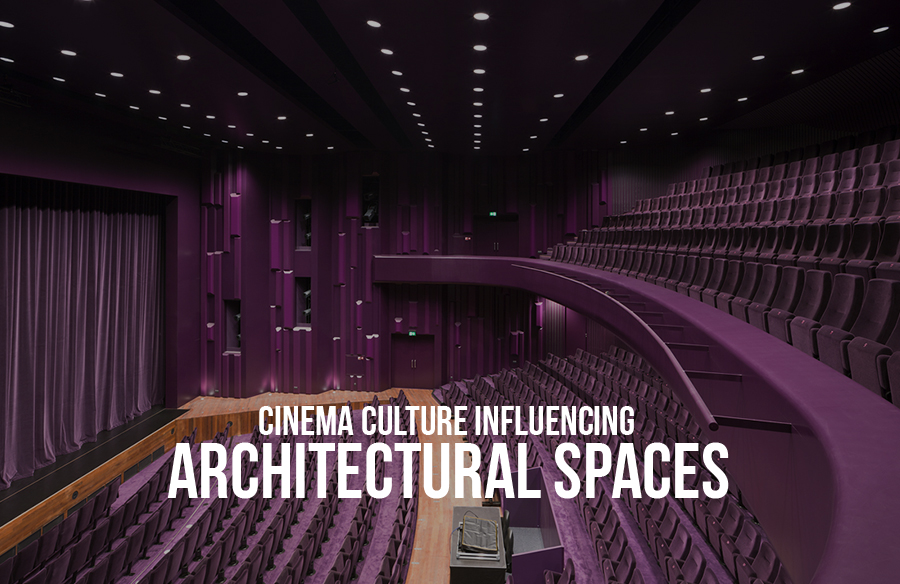
In today’s world, the expression of culture is diverse; it has different mediums through which it shapes and reflects on society as it continues to evolve. Originally, culture was expressed through language, traditions, food, costumes, etc., However, the two most common modes include art forms—music, dance, paintings, and storytelling—the present-day “Cinema Culture” and through built forms, public spaces, and city planning— the “Architectural Forms.” The gap between these two cultural forms is bridged beautifully as each continues to complement and support the other’s development and evolution. This article delves into the relationship between them and focuses on how cinema culture shapes and influences architectural spaces from past and historical allusions to emerging technologies and innovations.

Past References of Architecture In Cinema Culture
Architectural references in cinema, in the past, through historical structures and iconic architectural marvels, convey a strong sense of visual narratives while captivating the audience. Cinema culture, however, began its mark, not through the current day’s mega screens and multiplexes but through “Tent Kotta,” especially in semi-urban and rural areas of India. Tent Kotta refers to the old practice of projecting black and white films in large canvas tents, with the help of white screens and a projection booth. The architecture of these tent kottas, yet basic and minimal, catered to and accommodated a large crowd. The design focus in those days was restricted to the comfort and practicality of the users, unlike today’s aesthetic preferences for interiors and exteriors. Moreover, tent kottas were made with cost-effective materials and temporary structures and have made a significant mark in the evolution of architecture in cinema culture.
Communicating Architecture Through Cinematic Elements
Cinema culture’s prime role is to showcase and convey different components and genres to a wide spectrum of audiences. The components include drama, fantasy, action, suspense, comedy, romance, animation, sports, morality, and more. To produce such content-oriented films, the role of architecture is crucial because cinema culture, in the absence of spatial design, might struggle to convey stories to the crowd. Spatial design potentialized to express and elevate the feel of the content that even normal scenes fail to communicate. Set design is a major part of spatial design, which involves setting up and building structural layouts from scratch that serve the theme. Filmmakers often hire architects and architects who pursue set design to create set environments that offer aesthetic yet realistic spaces. The set design, in turn, uses architectural and interior elements that establish an atmosphere for the audience to immerse in cinema culture.

Depending on the film, different lighting schemes and techniques highlight the architectural and interior spaces in cinema. Lighting gives a realistic character to the spaces, making the spaces speak for themselves. Camera angles and movements are another vital factor in offering life to a space. It harmonises the relationship between humans and the surrounding environment. Whether it is a housing environment, an urban space, or an animated set, a camera transmits and communicates human emotions and dynamism through its angles and dimensions. A skillful combination of these elements in cinema culture leads to films that convey the design intent behind the architectural spaces.
Cinema Culture’s Role In Shaping Architecture Careers
The collaboration between cinema culture and architects has opened the doors for new careers by breaking conventional architectural practices. Through literature and scripts, cinema culture sparks the essence of writing and journalism in architects to incorporate architectural storytelling in the film’s content. Cinema culture also influences architectural journalism through illustrative spaces and design, setting a trend not only in the realm of architecture as well as the cinema industry. Moreover, documenting films in architectural contexts caters to a spectrum of audiences apart from the architectural community.

Architectural Schools Promoting Film Studies
Architectural schools worldwide have started incorporating film-oriented studies, workshops, and seminars to incorporate the knowledge and skill sets behind this combination. It creates new perspectives in fresh minds and gives clarity for designing developed environments that make sense. Students analyse films showcasing architectural masterpieces, futuristic urban landscapes, and unspeakable settings, gradually acquiring a sort of aesthetic appreciation for how architecture enhances storytelling and vice versa. This while enhancing the young architects’ practical design skills, makes them excel in creating visual arts through various mediums. Cinema cultures promoting architectural films and documentaries play a vital role in moulding a student’s knowledge by updating ancient spaces to the existing spaces of today.

Future Of Cinema And Architecture
The future of both cinema and architecture is already overflowing with technological advancements through virtual reality, augmented reality, animations, digital fabrications, sustainability, and more. As cinema culture begins to evolve, the architectural realm will start shifting and upgrading for the betterment of the environment and quality enhancement in life. Science fiction movies enable the architects to push boundaries in design that lead to present yet futuristic spaces through forms, design concepts, ideologies, illustrations, renders, walkthroughs, etc., This technology while upgrading the future of cinematic stories, innovates and uplifts the viewing experience through architectural spaces. Both cinema culture and architecture are levelling up the futuristic game through scripts and spaces. It is crucial to update concerning the current trends, be fearless, and take risks to break the stereotypes and thresholds.

To conclude, cinema culture has deeply affected architectural spaces, creating this very dynamic relationship between both art forms where each of them inspires and shapes each other. It is in cinema’s visual storytelling that architecture gains an expansive narrative and emotional component beyond its physical function. From historical monuments to futuristic cityscapes, cinema often emphasises architectural features such as these, thereby igniting the imaginations of both designers and the general population. Besides, in actual architectural practice, directors use different cinematic techniques like framing, light, and spatial perception to enrich the experience and relationship of people with the spaces. Hence, with progress in technology, this interplay is going to enhance in-depth techniques wherein virtual reality and digital rendering will provide architecture with new spaces of exploration and experience in cinema which is real life alike. A continuing dialogue between these two disciplines demonstrates cinema’s monumental role not only in reflecting but also in shaping the built environment of the future.