Set in the embrace of Lodhi Garden, India International Centre is a prominent cultural institution in New Delhi. The Centre contributes as a hub for social, cultural, political and intellectual discussions and gatherings. IIC offers memberships to scholars, statesmen, diplomats, policymakers, intellectuals, scientists, jurists, writers, artists, and members of civil society to be a part of the intellectually rich culture of IIC and participate in the exchange of ideas and knowledge.
IIC, designed by American architect Joseph Allen Stein, provides a dedicated space for interactions and discussions among people from different societies, cultures, and nations.

Impression
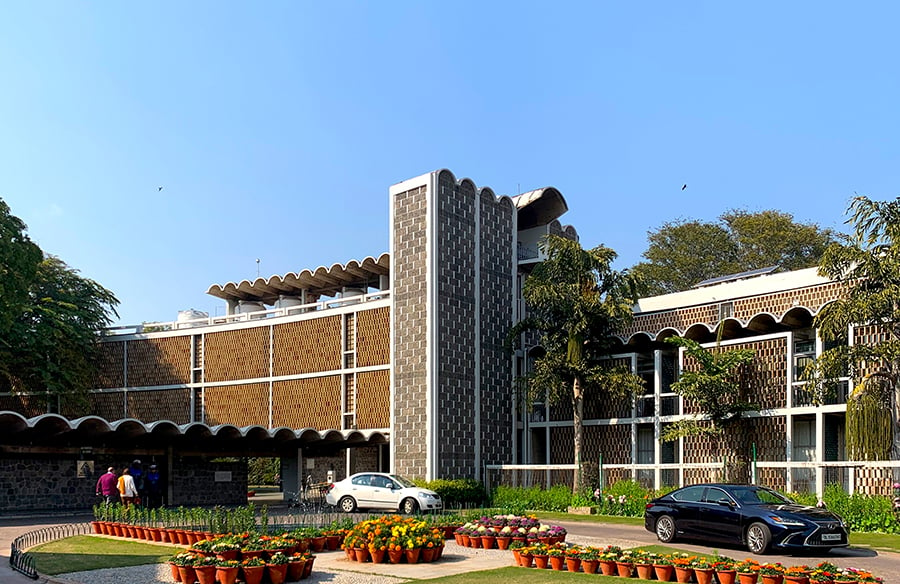
On entering the IIC premises from Max Mueller Marg, the visitors are welcomed by lush green vegetation and vibrant flower beds, enhancing the grand and aesthetic entrance. The landscape, rich with greenery and colourful flowers, creates a striking contrast against the backdrop of muted coloured building materials such as stone, cement, and brick. Natural elements like herbs, shrubs, pathways, and roads are thoughtfully designed to guide the movement of vehicles and pedestrians.
The entrance driveway, extending along a north-south axis, features a drop-off point that gathers people before leading them to the central courtyard. The courtyard serves as a central gathering point, providing access to the various blocks of the campus.

Movement within the premises is very comfortable and straightforward because of the signages at regular intervals and landscape elements that guide the way, eliminating any potential difficulties. The journey is further enhanced by scenic views and natural elements that maintain a serene and refreshing micro-climate throughout the campus.

Planning
WINGS – The central courtyard, extending from the entrance driveway, welcomes visitors to the heart of the premises. The layout divides the blocks according to their functions into three wings, all connected by walkways with overhanging eaves.
- The South Wing, the main block, houses the library, auditorium, and administrative offices.
- The North Wing contains residential rooms, featuring balconies with views of the fountain water body and upper floors that open to the mesmerising view of the Lodhi Gardens.
- The West Wing is designated for dining areas.

SPATIAL ARRANGEMENT – Each courtyard, lawn, and wing within the premises serves a specific function and purpose. The sequential arrangement of built, semi-open, and open spaces facilitates smooth transition and maintains connectivity across the campus, both visually and in terms of accessibility.
This seamless transition is achieved through careful consideration of materials, ambiance, functionality, and connectivity among spaces. The design prioritises user experiences, ensuring a thoughtful layout.
The segregation of service and main activities via service corridors and dedicated basement for services ensures an uninterrupted flow of people in the main visiting areas.

The PHILOSOPHY behind the design of the IIC is best expressed in the architect’s own words: ‘There was an attempt to create something which depended upon simplicity and relationships rather than things. So this is not a five-star appearance in marble and granite. But it is a place where a certain kind of relationship exists—between the garden and the building and the water and the earth and the sky, and the learning and activities that take place and the things that happen.’

STYLE – Architect Joseph Allen Stein is renowned for his Modernist style, which is prominently reflected in the design of the India International Centre. The design thoughtfully integrates the context and rich heritage of Lodhi Gardens, combining Modernist architecture with elements of traditional Indian architecture.
The IIC showcases a geometric variety of shapes, including lines, curves, and patterns, creating volumetric spaces characterised by a lack of ornamentation—an evident trait of Modernist architecture. At the same time, it pays homage to traditional Indian architecture through the use of local materials such as stone and brick, and features like jalis, which provide natural ventilation and filtered light.

The CONSTRUCTION METHODS utilised reflected the skills and techniques available in India during that period. Precast elements were employed to ensure construction of high quality, emphasising both structural integrity and finishing details.
Stein incorporated the modern use of exposed concrete, massive piers, and visible roof patterns into the design. He used local materials, such as rugged quartzite stone and blue Kota flooring, with ceramic blue-tile jalis that echo the intricate patterns of Islamic architecture. Perforated screens were also installed to suit the city’s climate.

NATURAL ELEMENTS – The campus of IIC is a home to a variety of vegetation like grass, herbs, shrubs, trees, creepers, flowering plants, and flower beds. The flora creates contrasting features in the site with the materials used.

Other natural elements like water bodies, lawns, and fences covered with dense creeper vegetation enhance the micro-climate and spatial quality of the campus. The creeper-covered fences serve as the boundary walls for the campus, offering visual protection, noise reduction, and security. The creepers seamlessly blend with the natural vegetation of Lodhi Garden.
The Vision
The vision of establishing an institution to promote true and thoughtful understanding between peoples of different nations resulted from a discussion between Dr. S. Radhakrishnan and John D. Rockefeller III in 1958. Pandit Jawaharlal Nehru, who was then Prime Minister of India, was enthused by the idea that he personally took an interest in selecting the 4.76-acre site adjacent to Lodhi Gardens for the centre’s construction. Architect Joseph Allen Stein was invited to design the centre to fulfil this vision and purpose.
Stein’s design achieved a balance between his modernist style and contextual considerations, while also respecting India’s rich history and heritage.

Social, Cultural and Political Importance
In the era it was built, the vision for the space was accomplished, and it was widely used for a range of activities such as lectures, seminars, panel discussions, international and national conferences, and various cultural events including music, cinema, and performing and visual arts, both classical and folk.
Today, the importance of IIC remains intact. It continues to serve as a hub for gatherings, with people visiting the auditorium for performing arts, the library for quiet intellectual space, and the conference halls for meetings. The centre operates on a membership basis, providing access to its various facilities. Many political leaders and scholars are members of the centre and benefit from its amenities.

Impact on Urban Fabric
IIC is a vital element of the city’s urban fabric, contributing to its historical, cultural, social, and political significance by embodying the style, philosophy, vision, and purpose of its existence. It attracts people with its serene and interactive environment.
As an architectural marvel, the structure has successfully hosted various activities for a long time. Studying the methods, techniques, and architectural features that ensure its effective functioning and fulfilment of its purpose can inspire further innovation and revolutionise architectural achievements.

IIC continues to contribute significantly to society in today’s digital age by facilitating interactive gatherings and offering offline sources of learning in a natural setting. It enhances human experiences by immersing visitors in a serene environment, promoting face-to-face interactions and personal growth.
The experience at IIC is enriched by rustic buildings surrounded by vibrant flowers, the soothing sounds of flowing water, and pathways that guide visitors. The sight of squirrels darting between trees, birds chirping, and the shaded coolness of the central courtyard, despite the intense sun outside, all contribute to a unique and inviting ambiance.
IIC serves humanity by integrating seamlessly into the urban fabric, addressing the social, cultural, and intellectual needs of society. It stands as a testament to an intellectually rich history and plays a crucial role in shaping a culturally rich future.

Citation:
- Home Page: India International Centre (no date) Home Page | India International Centre. Available at: https://iicdelhi.in/ (Accessed: 10 July 2024).