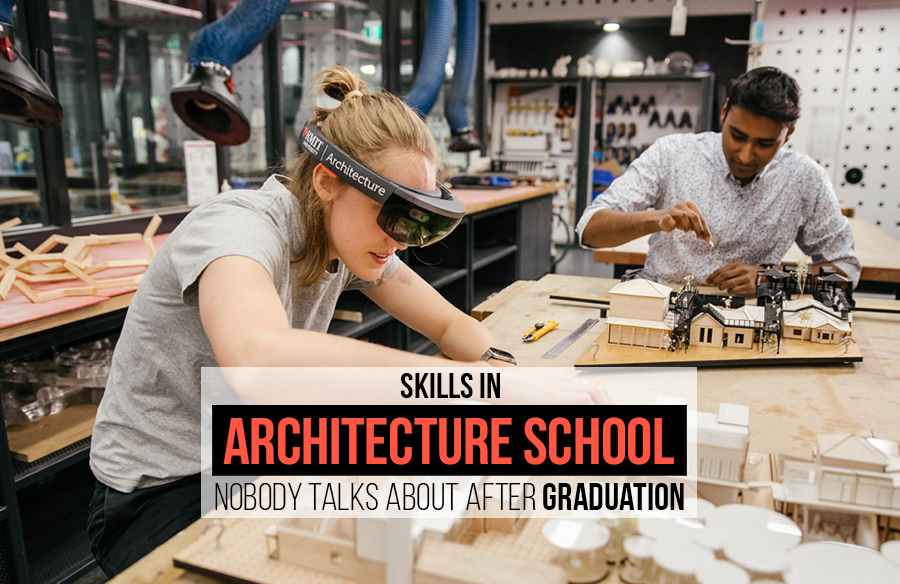
Going into architecture school with the only assumption being that ‘if you are good at drawing, architecture is for you’, one quickly realises that the idea is so far removed from reality. Yes, you need to know how to draw basic sketches but, fundamentally one needs to arm oneself with several technical, soft and personal skills to navigate the world of architecture successfully. There are a few overlooked skills in the profession which hardly pass muster among the professionals to consider.

One approaches the fresher year in Architecture school with wide eyes and enters the field with the very purpose of creating an ostentatious building with little regard for the structure. As the years progressed, it became a challenge to make the building stable. and then make it beautiful. With each subsequent year, the realisation that form, structure, and skin are all that need to be carefully balanced. The beauty of the building starts from the very thought of putting up a space and is rarely skin-deep and requires deep thinking.
The ability to think deeply about solving space requirements and sketching multiple options on paper before finalising an approach is something that most architects are comfortable with. What most architects are not comfortable with is iterating multiple times on the finalised design to further refine it. It is at these iterative attempts that newer ways of approaching the design emerge.
Create Vs Consume
Browsing pages and pages of Architectural Record and El Croquis for ‘inspiration’ before putting oneself down to work is typical of most students. ‘Consuming’ the design of the master architects in the form of plans, sections, and isometric drawings to prod, understand and likely replicate in one’s design, one immediately feels that they are ‘creating’. The skill to overcome the inertia to ‘start’ work is relevant at any age. Unless one puts a conscious effort to draw a line and get out one’s thinking into a paper or another medium, it is not creation. Sitting down with little to no distractions, engaging with the programme at hand, and creating is a skill. With constant interruptions from omnipresent mobile devices and the ever-rising prevalence of social media content, one is never short of ideas or planning; one is only short of time and persistence to put out quality work.

Creativity in Constraints
It is easy to imagine that designing without any external influence is noble and many consider inspiration from other work ‘stealing’. The simple fact is that we are subconsciously shaped and influenced by our surroundings. Starting with a clean slate, ‘Tabula Rasa’ in most cases is not feasible and leads to non-contextual designs. Banking on ideas already available and drawing upon their conclusions and if needed, tweaking them is a skill. Moodboards and other images on Pinterest, and Instagram are all possible because of the wealth of information provided by designers, photographers and writers. The meta-skill here is to follow people with integrity and high standards for their work.
“Immature poets imitate; mature poets steal; bad poets deface what they take, and good poets make it into something better, or at least something different. The good poet welds his theft into a whole feeling which is unique, utterly different from that from which it was torn; the bad poet throws it into something which has no cohesion.” —T. S. Eliot
Software Stacking
Architecture school is the best place to learn multiple software at speed. The sheer volume and easy availability of student versions of popular software help the student try out different applications. Although there are common must-know applications like AutoCAD & Photoshop, tinkering with software like Rhino, Sketchup, 3Ds Max etc was often seen as a badge of honour. The different functions require this skill of juggling multiple software to help multiple thinking perspectives. A particular form may need to be explored from a Sketch to a 3d form in Rhino, which needs to be rationalised to proper dimensions in AutoCAD, taken apart in sketches once again and iterating this entire process again. Then again comes the presentation of the said drawings in Photoshop, setting out the individual components of the design in a neat Layout in the InDesign software.
Nowhere is this software stacking skill more important than after graduation – wherein apart from that regular ‘architecture’ software one has found the liking to, a host of project management & coordination software skills need to be acquired.
Presenting your work
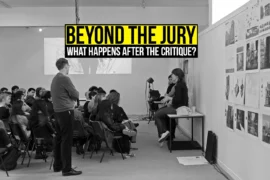
Architecture school prepares you for another important skill: public speaking and presenting your ideas. The jury presentation, reviews and feedback address are all necessary events that lay the foundation for presenting and pitching projects to clients. The skill of speaking confidently and with marked assurance can only be improved by continuously working on it. Balancing the client’s minute expressions in real-time and creating the necessary subtle tonal and verbal language is a skill that needs practice. As someone said, practice makes progress, not perfect.
Dealing with imperfections
Almost no project is entirely completed or perfect in the real sense. Perfection is the enemy of progress. For feedback or improvements, the work must be out first for people to see and review. Even for work deemed finished, a lot of changes or errors can be perceived after completion. There is the constant worry of people reacting to a flaw, blaming the designer and the whole imposter syndrome that comes with it. It is a skill to be content with imperfections and be at peace with it. Finally accepting that none of the options created is a perfect solution and most designs will have some flaws which must be accepted by all in this case the client.
- Books
Eliot, T. (1920).The Sacred Wood: Essays on Poetry and Criticism. London. Methuen & Co. Ltd.